A Pregnancy That Felt Unique From the Beginning
For many families, pregnancy is filled with excitement, anticipation, and hope for the future. For Millie Smith, it also came with an unexplainable feeling that her experience might be different.
From early on, she sensed that something about her journey would not follow the usual path. With a family history of twins, the possibility stayed in her thoughts. When a scan confirmed that she was expecting two babies, it felt like a moment of joy and confirmation.
Together with her partner, Lewis Cann, she began imagining a future filled with shared milestones, laughter, and the unique bond that twins bring.
But that sense of happiness was soon met with unexpected and difficult news.
When Joy Meets Heartbreak
During a routine checkup not long after discovering they were expecting twins, the atmosphere shifted.
What should have been another exciting moment became quiet and uncertain. It was clear something wasn’t right before any words were spoken.
Doctors later explained that one of the babies had anencephaly—a rare condition where parts of the brain and skull do not fully develop.
They gently prepared the couple for a painful reality: babies with this condition typically do not survive long after birth.
In that moment, their expectations changed. What had once been a shared future now held both hope and inevitable loss.
Choosing Love Through Uncertainty
Faced with such a situation, Millie and Lewis had to make a deeply personal decision.
For Millie, the choice felt clear. Both babies were equally important, equally loved, and deserved to be carried and cherished, no matter how long their lives might be.
They chose to continue the pregnancy.
From then on, each day carried a mix of emotions. There was joy in feeling both babies move and grow, but also quiet sadness knowing one life would be brief.
Giving a Name, Giving Meaning
As the pregnancy progressed, Millie knew she wanted to name both of her daughters.
It was important that the baby they would lose would always be recognized as part of their family—not just a memory, but an individual with a name and identity.
They chose the name Skye.
The name carried a sense of openness and connection. It symbolized a place that feels vast and ever-present—something that could hold their love even after loss.
A Birth Full of Emotion
At 30 weeks, the pregnancy took an unexpected turn when early labor began.
The delivery happened quickly, leaving little time to prepare emotionally or physically.
When the twins were born, something remarkable happened—they both cried.
It was a moment no one had been certain would happen. Hearing that sound brought a brief sense of completeness.
Millie and Lewis held both daughters, focusing on the present moment. They took in every detail, holding onto the time they had together.
Three Precious Hours
Skye lived for three hours.
Though short, that time was deeply meaningful. It allowed her parents to hold her, love her, and say goodbye in their own way.
Her passing was quiet and gentle.
The loss that followed was profound—something that would always remain part of their lives.
At the same time, their other daughter, Callie, needed urgent medical care.
Life in the NICU
Callie, born prematurely, was taken to the neonatal intensive care unit (NICU).
Life there followed a steady, structured rhythm. Machines monitored vital signs, nurses moved carefully between patients, and families stayed close, hoping for progress.
Millie found herself living in two emotional worlds—grieving the loss of one child while supporting the other.
Initially, hospital staff showed understanding and compassion. They recognized what she had experienced.
But over time, that awareness began to fade.
When Loss Isn’t Seen
As days passed and new families arrived, fewer people knew about Skye.
Conversations naturally focused on the babies receiving care. Slowly, her story became less visible to those around them.
Then one moment brought that reality into sharp focus.
Another parent, overwhelmed and trying to cope, made a casual remark: “You’re lucky you didn’t have twins.”
The comment wasn’t intended to hurt. It came from exhaustion and stress.
But for Millie, it was deeply painful.
In that instant, her experience—and her loss—felt unseen.
An Idea That Made a Difference
That moment led to an important realization.
There needed to be a simple way to communicate what families like hers had been through—something that didn’t require explaining painful details over and over.
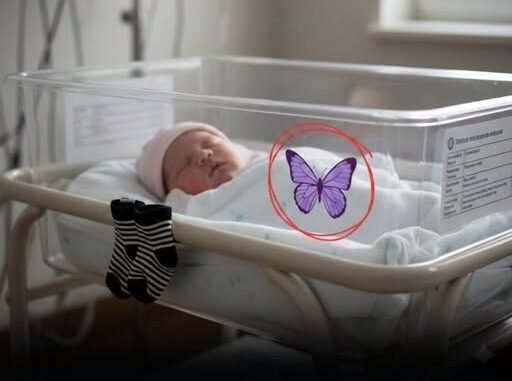
From that idea, the purple butterfly symbol was born.
What the Purple Butterfly Represents
The symbol was chosen thoughtfully.
A butterfly often represents transformation, presence, and something beautiful that may not last long. It felt like a meaningful way to honor babies who were part of the world, even for a short time.
The color purple was selected because it is neutral and suitable for any baby.
The meaning behind the symbol is clear:
When a purple butterfly is placed on a baby’s incubator, it quietly indicates that the baby was part of a multiple birth and that one or more siblings have passed away.
This allows others to understand the situation without needing to ask questions.
It creates space for empathy, while protecting families from repeated emotional conversations.
A Symbol That Spread Worldwide
What started as one family’s idea quickly gained recognition.
Healthcare professionals saw its value and began using it more widely. Other parents understood its purpose and appreciated the sensitivity it offered.
The purple butterfly became a widely recognized symbol in neonatal care.
It created a silent form of communication—one that speaks through understanding rather than words.
Turning Loss Into Purpose
In time, Millie and Lewis created the Skye High Foundation.
Their goal was to support families facing similar experiences and to continue raising awareness about the purple butterfly symbol.
Through their efforts, many families have felt acknowledged and supported during incredibly difficult moments.
What began as a personal response to loss became a source of comfort for others.
Moving Forward While Holding On
As the years passed, Callie grew into a joyful and energetic child.
She grew up knowing about her sister and carrying that story as part of her life.
Skye remained present in a different way—through memory, love, and the way she was remembered within the family.
Grief didn’t disappear, but it evolved.
It became something that could exist alongside happiness.
Why This Story Matters
The meaning behind the purple butterfly goes beyond one family’s experience.
It highlights an important truth: not all struggles are visible.
Many people carry experiences that others may not immediately see or understand.
This symbol helps bridge that gap.
It reminds us to approach others with kindness and awareness, even when we don’t know their full story.
Final Thoughts
Today, the purple butterfly continues to serve as a quiet yet powerful symbol.
It represents love that remains, even after loss.
It offers support to families without requiring words.
And it shows how one experience can lead to something that helps many others.
In the end, its message is simple:
Even the smallest symbol can hold deep meaning.
And sometimes, the most meaningful act of kindness is simply recognizing what someone else may be going through—without needing them to explain it.
Leave a Reply