I knew something was terribly wrong when my teenage son Drew climbed into my truck on a freezing Montana morning.
He was usually quiet, but that morning there was something different about him. His eyes stayed fixed on the floor. His jaw was swollen, and his left arm hung awkwardly against his chest.
“Dad, I’m fine.”
I looked at his arm.
“No, you’re not.”
He hesitated.
Then he whispered, “It happened at practice.”
I had spent twenty years in the Army. I knew what pain looked like when someone was trying to hide it.
I drove him straight to urgent care.
The X-ray showed a fracture.
A clean break.
While the nurse wrapped his arm in a cast, Drew finally told me the truth.
Neil Gaines had done it.
Neil was the local bully—the kind of kid who had spent years getting away with things because everyone knew who his father was.
Sheriff Carl Gaines.
Carl practically owned Milwood Creek.
People lowered their voices when they mentioned him. Parents complained about Neil privately but rarely filed reports. Teachers seemed reluctant to challenge him. Everyone knew that crossing the sheriff could make ordinary problems suddenly become very complicated.
I drove directly from urgent care to the sheriff’s office.
I carried the medical report, the X-rays, and Drew’s discharge papers.
Carl barely looked at them.
“So kids got into a fight,” he said.
“My son has a fractured arm.”
“Kids roughhouse.”
“This wasn’t roughhousing.”
Carl leaned back in his chair.
“You were in the Army, right?”
“Yes.”
“Then you should know better than to make a federal case out of a playground incident.”
“My son isn’t on a playground.”
His expression hardened.
“I’m not filing a report against my own son based on your interpretation of what happened.”
“Your son broke my son’s arm.”
Carl smiled without humor.
“Then I guess you’ll have to do something about it.”
For one second, every instinct I’d developed during twenty years of military service screamed at me to push back.
But I didn’t.
I picked up the medical documents.
“Thank you,” I said.
Carl looked almost disappointed.
I walked out with Drew beside me.
That night, I sat at the kitchen table and opened a notebook.
I wrote one sentence across the top:
This is no longer about Neil. It’s about a system protecting him.
I began with Drew’s injury.
Date.
Time.
Location.
Witnesses.
Medical diagnosis.
Then I started digging through old messages and school records.
Within hours, I found more incidents.
Neil had shoved another boy into a locker.
He had threatened a younger student.
He had damaged someone’s bicycle.
A parent had once complained about him following her daughter home.
Another family had withdrawn their child from a sports program because of repeated harassment.
None of it had become an official case.
That was the pattern.
People weren’t silent because nothing had happened.
They were silent because they believed speaking up wouldn’t matter.
The next morning, I called the appropriate state authorities in Helena and asked how to report a local law-enforcement conflict of interest.
I didn’t exaggerate.
I didn’t threaten anyone.
I simply asked what evidence they needed.
Then I started collecting it.
I contacted parents who had been afraid to speak before.
I told them I wouldn’t use their names without permission.
One mother sent screenshots.
Another provided emails.
A father gave me a copy of an old medical report.
A school employee agreed to document an incident she had witnessed.
The stories began fitting together.
Different families.
Different years.
The same boy.
The same intimidation.
And, repeatedly, the same conclusion:
Nothing happened.
Because Neil was Sheriff Gaines’s son.
I organized everything chronologically.
I made copies.
I kept the originals.
I created a separate folder for medical records, witness statements, photographs, school documentation, and correspondence.
Then I submitted the packet through the proper state channels.
After that, I waited.
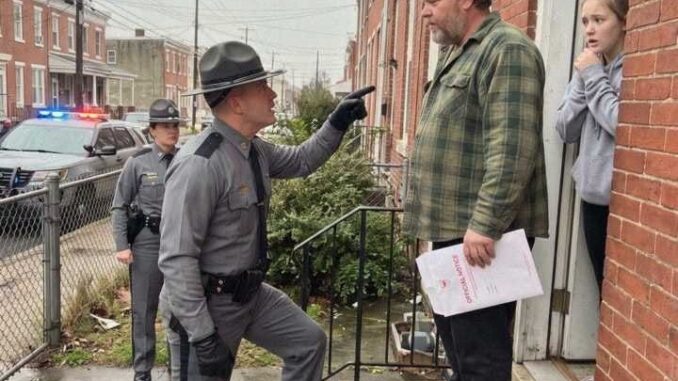
Three days later, black state vehicles appeared on the main road into Milwood Creek.
By noon, everyone knew something was happening.
Carl Gaines arrived at my house with two deputies.
He stepped onto my porch furious.
“You’ve made a serious mistake.”
I opened the door but didn’t step outside.
“No,” I said. “I documented one.”
His face tightened.
“You think you can come into my town and undermine me?”
“This isn’t your town, Carl.”
For the first time, he didn’t have an answer.
A vehicle pulled up behind his cruiser.
Two state investigators stepped out.
Deputy Susan Parsons followed them.
Susan had worked locally for years. She had always been professional, but that morning she looked different.
She carried a thick folder.
Carl stared at it.
“What is that?”
Susan answered quietly.
“Formal complaints.”
Carl’s eyes moved from her to me.
“How many?”
She didn’t respond immediately.
“Enough.”
The investigation lasted weeks.
Parents who had once refused to speak began giving statements.
School records were reviewed.
Old complaints were reopened.
Witnesses were interviewed.
The sheriff could no longer make every problem disappear simply by refusing to write it down.
Eventually, Carl was removed from active duty pending the investigation.
Neil was charged in connection with Drew’s assault.
For the first time, the Gaines name wasn’t protecting anyone.
It was evidence.
Months later, Drew and I stood outside the courthouse.
His arm had healed.
He looked older somehow.
Not because the experience had made him harder, but because he’d learned something important about courage.
“I thought you were giving up that day,” he said.
I knew exactly what he meant.
The day I’d walked out of the sheriff’s office.
“I wasn’t giving up,” I told him.
“Then why didn’t you fight him?”
I smiled.
“Because I wanted to win.”
Drew looked at me.
I tapped the cast he had kept as a reminder.
“When someone abuses power, you don’t always beat them by becoming louder than them. Sometimes you beat them by becoming impossible to ignore.”
He nodded.
For years, people in Milwood Creek had believed they were powerless.
They weren’t.
They had simply been waiting for someone to prove that telling the truth could still matter.
And my son learned something I hope he never forgets:
Being hurt doesn’t make you weak.
And staying calm doesn’t mean you’re afraid.
Sometimes the strongest person in the room is the one who walks away, gathers the evidence, and comes back with the truth.
Leave a Reply