Introduction: A Quiet Morning and a Bizarre Discovery
There is something deeply grounding about stepping outside during the early hours of the morning. The world is usually still, the air is crisp, and the day has not yet rushed into its usual frantic pace. It is a time for quiet reflection, breathing in the fresh morning dew, and briefly connecting with the natural environment just outside your door. However, nature has a way of surprising us when we least expect it. On one particular morning, my quiet routine was instantly disrupted by a strange, unsettling sight waiting for me on the ground.
What initially began as a simple breath of fresh air quickly turned into an intriguing and slightly eerie encounter with a creature I had never seen before in my own backyard. As I stepped off the patio and onto the soil, a glistening shape caught my eye. At first glance, it blended somewhat with the dark earth, but its movement—or rather, the way it glided—was entirely unlike anything I was accustomed to seeing in a garden.
First Impressions: The Enigmatic Crawler
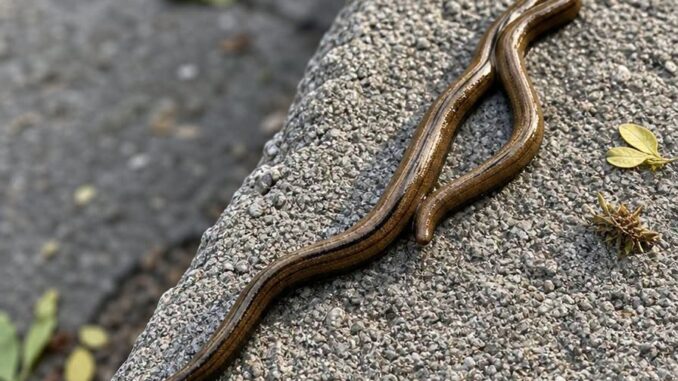
I crouched down slightly to get a better look, maintaining a cautious distance. A long, glistening creature was slowly sliding across the soil. In the dim morning light, its body gleamed with a faint, slimy sheen. My mind initially raced through the usual suspects: perhaps a large earthworm had crawled out from the damp earth after a heavy night of rain, or maybe it was some kind of garden slug.
Yet, the more I looked at it, the more unfamiliar and alien it appeared. Its dark, elongated body featured strange, distinct lines running along its length, almost resembling fine scars or shadows etched into its skin. But the most striking—and frankly, alarming—feature was its head. Unlike the tapered, pointed end of a standard earthworm, this creature possessed a head that was flat, wide, and shaped remarkably like a tiny shovel or a blacksmith’s hammer.
I stood there for several minutes, watching it move with an eerie, quiet confidence. It did not crawl or stretch forward like an ordinary earthworm. Instead, it seemed to glide smoothly across the ground, propelled by an invisible, fluid motion, following a deliberate path as though it had a specific destination in mind. A mix of fascination and deep unease washed over me. Something about its unusual, flattened shape and deliberate movement made it look almost otherworldly. Without consciously deciding to do so, my brain immediately issued a warning: Do not touch that.
Observing the Hammer-Shaped Predator
The hammer-shaped head remained the most unsettling characteristic of the entire encounter. As the creature moved forward, this wide, crescent-shaped structure seemed to sweep gently across the soil, giving the vivid impression that it was actively scanning, probing, or searching for something hidden just beneath or around the surface of the dirt.
I kept my distance, resisting any temptation to lean in closer or poke it with a stick. Curiosity was fighting a losing battle against caution. The longer I watched, the more certain I became that this was definitely not an ordinary garden worm. It belonged to an entirely different category of living things—one that my backyard had apparently kept hidden from me until that very moment.
In nature, unusual appearances often serve a purpose. Bright colors can signal toxicity, and bizarre shapes usually indicate specialized survival tactics. This creature looked engineered for a specific underground purpose, and its slow, methodical glide only heightened the mystery.
Solving the Mystery: Discovering the Hammerhead Worm
Later that day, once the sun was fully up and my daily responsibilities allowed, I sat down at my computer. I needed answers. I typed a detailed description into a search engine: “long dark worm with flat hammer shaped head” and began browsing through images and scientific descriptions.
After a few clicks, the mystery was solved. The strange creature I had encountered earlier that morning was a hammerhead worm—a type of terrestrial flatworm scientifically recognized by its distinctive, shovel-shaped or flattened head.
Reading up on these fascinating organisms opened up a whole new world of biological knowledge. Unlike ordinary earthworms, which are generally harmless detritivores feeding on decaying organic matter in the soil, hammerhead worms are specialized predators. They actively hunt other small soil-dwelling organisms, including earthworms and various invertebrates. Their unique anatomy is finely tuned for this predatory lifestyle, making them efficient hunters in the micro-ecosystems of our gardens and lawns.
Understanding the Risks and Safety Precautions
Learning the true identity of the creature made my morning encounter feel even more significant, and frankly, validated my initial instinct to keep my distance. Hammerhead worms are not creatures that people should casually pick up with their bare hands.
For one, some species of flatworms can produce defensive secretions or toxins that help them subdue their prey or discourage predators. While casual skin contact might not always lead to severe harm, touching them can cause skin irritation or allergic reactions in sensitive individuals. Additionally, there are broader ecological and biological considerations, including the potential transmission of parasites or other microorganisms associated with soil predators.
Because of this, the safest and most sensible approach when encountering a hammerhead worm is to simply avoid unnecessary physical contact.
How to Handle a Backyard Sighting
If you ever happen to walk out into your yard and discover one of these hammer-shaped flatworms sliding across your soil, there is absolutely no reason to panic or feel alarmed. They are not aggressive toward humans, nor are they going to chase you down. However, treating them with cautious respect is essential.
-
Keep your distance: Observe the creature from afar if you are curious, but do not handle it with your bare hands.
-
Protect children and pets: Ensure that young children and curious family pets are kept away from the area so they do not accidentally touch or ingest the creature.
-
Avoid cutting or fragmenting: A common misconception is that chopping a worm in half destroys it; however, with certain flatworms, fragmentation can actually lead to regeneration, effectively multiplying the number of organisms.
-
Leave it be: What looks like a bizarre, alien visitor from a science-fiction movie is simply a specialized part of the local ecosystem.
Reflections on the Hidden Wonders of Nature
That quiet morning, what first appeared to be a mysterious, slightly frightening creature turned out to be something entirely real—and arguably much more fascinating than any fictional monster. Nature is endlessly complex, filled with countless organisms that look completely unfamiliar, bizarre, or even intimidating until we take the time to learn what they actually are and how they live.
Sometimes, the strangest things hiding right beneath our feet in our gardens are not threats or monsters, but highly specialized creatures quietly carrying out their natural role in the broader ecosystem.
The experience also served as a wonderful reminder of how easy it is to misidentify something simply because it occupies a familiar space. I had stepped outside expecting to see a routine garden earthworm, but a flattened head and unusual movement pattern told an entirely different, captivating story. From a safe distance, it was a privilege to watch such a unique organism in its natural habitat. Up close, however, I was more than glad that I had trusted my gut instinct, kept my hands firmly to myself, and simply appreciated the hidden mysteries of the natural world from afar.
Leave a Reply