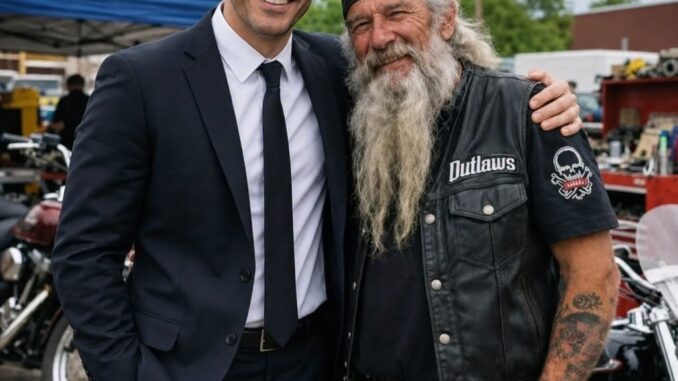
The biker who raised me wasn’t my father; he was a dirty mechanic who found me sleeping in his shop’s dumpster when I was fourteen.
Big Mike, they called him. He stood six-foot-four, possessed a chest-length graying beard, and sported arms covered in faded military tattoos. He was the kind of man who should have called the police on the runaway kid caught stealing his thrown-out sandwich crusts. Instead, he pulled open his shop door at 5:00 AM, peered down at the skinny, bruised kid curled between garbage bags, and uttered five words that completely altered the trajectory of my existence:
“You hungry, kid? Come inside.”
The Dumpster and the Dawn
Twenty-three years after that chilly morning, I stood in a polished courtroom wearing an expensive three-piece suit. I watched the state government try to strip away his motorcycle shop under the arrogant pretense that bikers were “degrading the neighborhood.”
The city council and their ambitious prosecutors had no idea what they were walking into. They had no earthly idea that their lead opponent—the high-powered attorney standing across the aisle—was the very same throwaway kid that this “degrading” biker had rescued, raised, and molded into a lawyer.
Back then, I had fled my fourth foster home. That particular house belonged to a man whose hands wandered in the dark and a woman who pretended not to notice. Sleeping behind Big Mike’s Custom Cycles felt infinitely safer than enduring another night under their roof. I had been living rough for three weeks straight, surviving on discarded food from dumpsters and skillfully dodging local cops who only wanted to shove me back into a broken, cyclical foster system.
Mike didn’t interrogate me that first morning. He didn’t demand to know my last name or threaten to call social services. He simply handed me a hot cup of coffee—my very first taste of it—and half of his own breakfast sandwich.
“You know how to hold a wrench?” he asked casually.
I shook my head.
“Want to learn?”
That’s how it all began. He gave me small tasks to keep me busy, slipped me twenty crisp dollar bills at the end of each workday, and pointed to a cot in the back room, making sure to “accidentally” leave the back door unlocked for me at night.
The Brotherhood
Before long, the other bikers associated with the shop began drifting in, noticing the quiet, skinny kid sweeping floors and organizing socket sets.
To the outside world, they looked terrifying—creatures of heavy leather vests, intimidating skull patches, and massive motorcycles that roared like thunderstorms when they fired up. But to me, they became an unorthodox sanctuary.
-
Snake, a towering man with a thick handlebar mustache, spent hours teaching me practical algebra using engine measurements and gear ratios.
-
Preacher, despite his rough exterior, made me read out loud to him while he rebuilt transmissions, patiently correcting my pronunciation and expanding my vocabulary.
-
Bear’s wife regularly dropped off large bags of clothes her own growing son had outgrown, which miraculously fit my lanky frame to perfection.
Marriage
About six months into my unofficial adoption, Mike finally paused, wiping grease from his forehead with a rag. “You got somewhere else to be, kid?”
“No, sir.”
“Then I guess you better keep that back room clean. Health inspector doesn’t like a mess.”
Just like that, I had a home. It wasn’t legally binding—Mike couldn’t legally adopt a runaway minor he was technically harboring—but in every way that truly counted, he became my father.
He established firm rules. I was required to stay in school, and Mike drove me there every single morning on his rumbling Harley, completely ignoring the judgmental stares of conventional parents. I had to work in the shop after the final bell rang, learning the value of labor “because every man needs to know how to work with his own two hands.”
And I had to attend the club’s raucous Sunday dinners, where thirty burly bikers would aggressively quiz me on my algebra homework and half-jokingly threaten to kick my rear end if my GPA slipped.
“You’re smart,” Mike told me one quiet evening, catching me quietly reading one of his legal documents off his workbench. “Scary smart. You could be something way bigger than a grease monkey like me.”
“There’s nothing wrong with being like you,” I mumbled.
He reached out and roughly ruffled my hair. “Appreciate that, kid. But you’ve got potential for something bigger. We’re gonna make sure you use it.”
Running Away From My Roots
The club pooled their money to pay for my SAT prep courses. When the acceptance letter from college finally arrived, they threw a backyard party that shook the foundations of the entire city block—forty rough-around-the-edges bikers cheering wildly for a skinny kid who had earned a full academic scholarship. Mike cried openly that afternoon, though he stubbornly blamed it on exhaust fumes getting into his eyes.
Yet, stepping onto a university campus was an intense culture shock. Surrounded by affluent peers with trust funds and summer homes, I felt entirely out of place. I quickly stopped mentioning Mike, stopped talking about where I came from, and omitted the biker shop entirely from my life story. When my college roommate casually asked about my family, I lied and told him my parents were dead.
It was infinitely easier than attempting to explain that my primary father figure was an outlaw biker who had essentially fished me out of a commercial dumpster.
Law school proved even worse. It was a vicious ecosystem of relentless networking, wealthy family connections, and pedigree. When colleagues casually inquired about my background, I mumbled vagueities about blue-collar upbringing.
When graduation day arrived, Mike showed up wearing his absolute best attire—a stiff, ill-fitting suit bought specifically for the occasion—paired with his heavy motorcycle boots because proper dress shoes caused his old joints too much pain.
A wave of bitter shame washed over me as I saw my classmates staring. When my study group approached, I introduced Mike simply as “an old family friend.”
He didn’t say a single word of rebuke. He just pulled me into a tight, crushing hug, whispered how proud he was of me, and rode the eight long hours back home entirely alone.
The Call That Changed Everything
I secured a coveted position at a top-tier corporate law firm, slowly stopped visiting the shop, and eventually stopped answering routine phone calls from the club. I was building a respectable, pristine life—the kind of life that would ensure I never, ever found myself peering out from inside a dumpster again.
Then, three months ago, my phone buzzed with a call from a number I hadn’t dialed in years.
“Not asking for me,” Mike’s gravelly voice stated, using his classic preamble for when he needed desperate assistance.
“What’s going on, Mike?”
“The city’s trying to shut us down. They’re claiming we’re a ‘blight’ on the community, dragging down surrounding property values. They’re trying to force me out and sell the land to some corporate developer.”
For forty years, Mike had operated that shop. For four decades, he had quietly repaired motorcycles for working-class people who couldn’t afford expensive dealership prices. And for forty years, he had quietly sheltered runaways like me—though I later learned I was merely one link in a long chain of saved children.
“Get a lawyer,” I advised coldly, trying to distance myself.
“Can’t afford one good enough to fight city hall, son.”
I should have offered my services right then and there. I should have packed a bag and driven down that very night. Instead, I muttered that I would look into it and abruptly hung up, paralyzed by the creeping terror that my elite colleagues might discover my true origins.
It took Jenny, my sharp-eyed paralegal, walking into my office and finding me staring blankly at my computer screen to snap me out of my cowardice. I had just received a text message from Snake featuring a photo of the shop bearing a bright red CONDEMNED notice, with Mike sitting despondently on the concrete steps, his head buried in his hands.
“That’s the man who raised me,” I confessed to Jenny, showing her the phone screen with a trembling hand. “And I’m too much of a coward to help him because I’m terrified people will find out I’m just trailer trash who got lucky.”
Jenny looked at me with profound disappointment. “Then you’re not the man I thought you were.” She turned on her heel and walked out, leaving me alone with the devastating truth of what I had become.
Returning to the Fold
I drove straight to the shop that night, shattering speed limits along the highway. Five hours later, still clad in my expensive designer suit, I walked uninvited into the clubhouse where thirty grizzled bikers sat in grim silence, trying to figure out how they could possibly pool enough money together for a public defender.
“I’ll take the case,” I announced from the doorway.
Mike slowly looked up, his eyes bloodshot and weary. “Can’t pay you what you’re worth, son.”
“You already paid me in full twenty-three years ago,” I said, walking toward him. “When you didn’t call the cops on a dumpster kid.”
The room went dead silent. Then, Bear let out a booming laugh. “Holy shit. Is that Skinny? Is that really you in that monkey suit?”
Just like that, the heavy armor I had worn for a decade melted away. I was home.
The Courtroom Battle
The ensuing legal battle was brutal and adversarial. The city possessed deep financial pockets, powerful political connections, and an agenda to gentrify the district. They painted the repair shop as a dangerous gang hangout that terrorized local residents. They trotted out paid neighborhood witnesses to testify about exaggerated noise complaints and a general feeling of “unsafety”—people who had never once stepped foot inside Mike’s shop or spoken to its patrons.
I countered with the ultimate weapon: unvarnished truth and overwhelming community impact.
I subpoenaed and brought forward dozens of adults whom Mike had quietly supported over the decades. Doctors, public school teachers, skilled tradesmen, and social workers—all of them once desperate children who had found safety, discipline, and a warm meal in the back room of Big Mike’s Custom Cycles.
I presented twenty-three years of meticulous financial records detailing continuous charitable contributions, holiday toy drives, and veteran support rides. I displayed security footage showing Mike fixing elderly neighborhood residents’ mobility scooters entirely free of charge, teaching local teenagers basic mechanical literacy, and hosting open support groups after hours.
The absolute turning point of the trial arrived when I called Mike himself to the witness stand.
The city’s arrogant prosecutor sneered as she approached the podium. “Mr. Mitchell, you openly admit to harboring runaway children in your commercial establishment without parental consent?”
“I admit to giving hungry kids food and a safe place to sleep,” Mike replied calmly, his voice steady.
“Without notifying proper authorities? By definition, that is harboring a runaway—essentially kidnapping.”
“That’s kindness,” Mike corrected quietly. “Something you might actually understand if you’d ever been fourteen, freezing, and desperate with nowhere left to turn.”
“And where are these children now? These runaways you allegedly ‘helped’?”
I stood up from my chair, my voice ringing out clearly across the courtroom. “Objection, Your Honor. Relevance?”
The judge looked over her reading glasses at me. “Overruled. I’ll allow it. Answer the question, Mr. Mitchell.”
Mike shifted his gaze away from the prosecutor and looked directly at me, a fierce, unabashed pride shining in his tired eyes.
“One of them is standing right there, Your Honor,” Mike said, pointing a steady finger toward the defense table. “My son—not by blood, but by choice. He’s standing up here defending me today because twenty-three years ago, I didn’t throw him away when the rest of the world had.”
The courtroom plunged into absolute silence. The prosecutor whipped around, staring at me as if seeing a ghost for the very first time.
“You?” she breathed. “You’re one of his… projects?”
“I am his son,” I stated firmly, buttoning my suit jacket. “And I have never been more proud of it.”
The presiding judge—who had maintained a cold, detached demeanor throughout the entire proceeding—slowly leaned forward over her bench. “Counselor, is this testimony accurate? You were homeless, living at the defendant’s shop?”
“I was a throwaway kid, Your Honor,” I answered, letting the polished veneer of corporate law drop entirely. “Abused in foster care, living in a dumpster, eating scraps of garbage. Mike Mitchell saved my life. He and his brothers gave me a home, forced me to finish school, paid for my education, and turned me into the man standing before this court. If that makes his shop a ‘blight on the community,’ then perhaps this city needs to completely redefine what a community actually is.”
Reclaiming My Name
The judge called an immediate recess. When the court reconvened twenty minutes later, she delivered her oral ruling.
“This court finds zero credible evidence that Big Mike’s Custom Cycles presents any safety or economic danger to the community,” the judge declared firmly. “In fact, the overwhelming evidence suggests Mr. Mitchell and his associates have been a profound asset, providing vital support, stability, and sanctuary to vulnerable youth for decades. The city’s petition is summarily denied. The shop stays.”
The courtroom erupted into thunderous noise. Forty bikers leaped to their feet, cheering, weeping, and slapping each other on the back. Mike rounded the defense table and grabbed me in a massive bear hug that threatened to crack my ribs.
“Proud of you, son,” he whispered into my ear, his voice thick with emotion. “Always have been. Even when you were ashamed of me.”
“I was never ashamed of you, Mike,” I lied softly.
He pulled back, offering a knowing, lopsided grin. “Yeah, you were. And that’s okay. Kids are supposed to outgrow their parents. But you came back when it actually mattered. That’s all that counts.”
Later that evening, during the massive celebration at the clubhouse, I stood up on a makeshift stage and tapped a glass for attention.
“I’ve been a coward,” I confessed into the quiet room, looking out at the sea of leather jackets and patched vests. “I spent years hiding where I came from, hiding who raised me, acting as if being associated with bikers would somehow diminish my worth. But the truth is, everything good, strong, and decent inside me came directly from this shop, from these people, and from a man who looked at a throwaway kid in a dumpster and decided to keep him.”
I locked eyes with Mike—my father in every way that mattered.
“I’m done hiding. My name is David Mitchell—I legally changed my last name to his ten years ago, though I never found the courage to tell him until now. I’m a senior partner at Brennan, Carter & Associates. And above all else, I am the son of a biker. Raised by bikers. Proud to be part of this family.”
The roar of approval that shook the clubhouse windows nearly blew out the glass.
Continuing the Legacy
Today, my corporate office walls are no longer covered in sterile generic art; they are lined with framed photos from the shop, of Mike smiling beside his vintage bikes, of my graduation day, of the club holding my children. My colleagues know precisely where I came from. Some respect me infinitely more for it; others still whisper behind my back. I simply don’t care anymore.
Every single Sunday without fail, I ride my own motorcycle out to the shop. Mike taught me how to ride last year, insisting it was about time I learned how to handle two wheels properly. We spend hours working on engines side-by-side, grease caked deep under our fingernails, while classical music plays softly from his ancient radio—his secret, lifelong passion that never quite fit the stereotypical biker image.
Vulnerable kids still wander down our street from time to time—hungry, scared, and desperate. Mike feeds them, hands them a wrench, gives them honest work, and occasionally offers them a permanent home in the back room. And now, whenever those kids run afoul of the legal system or the state tries to chew them up, they have me.
The shop is thriving. The city council backed off permanently. The surrounding neighborhood, finally forced to actually interact with the bikers they had spent years fearing, discovered what I had known for twenty-three years: leather vests and loud exhaust pipes don’t determine a man’s character. Actions do.
Mike is getting older now. His hands shake slightly on cold mornings, and he occasionally forgets where he put a specialized tool. But he still opens the heavy metal doors every morning at 5:00 AM, still checks the dumpster out back for hungry kids, and still offers the exact same deal:
“You hungry? Come inside.”
Just last week, we found another one hiding behind the pallets. Fifteen years old, bruised, terrified, and trying to steal a wrench from the workbench. Mike didn’t reach for a phone to call the cops. He just walked over, handed him a warm ham sandwich and a clean rag.
“You know how to use this?” Mike asked gently.
The kid slowly shook his head.
“Want to learn?”
And so the cycle continues. The biker who raised me is now helping raise another throwaway kid, passing down the single greatest lesson he ever taught me: family isn’t defined by blood, home isn’t just a physical building, and sometimes the people who look the scariest on the outside possess the softest, most resilient hearts in the world.
I am David Mitchell. I am an attorney at law. I am the son of a biker.
And I have never been prouder of where I came from.
Leave a Reply