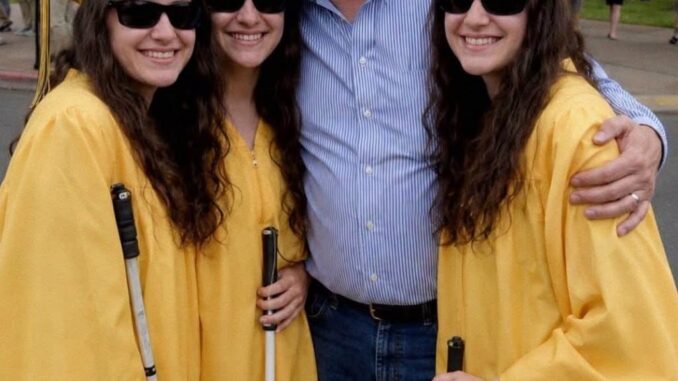
Eighteen years ago, my wife packed two suitcases and walked out on our three newborn daughters.
All three girls were blind.
She told me she wasn’t ready to spend the rest of her life dealing with “feedings, appointments, and disabilities.”
Then she closed the door behind her.
I stood in the nursery that night with three crying babies and no idea how I was going to survive.
But I knew one thing.
I wasn’t going anywhere.
The doctors had explained that complications during delivery had left Lily, Nora, and Gabriella completely blind. My wife, Clarissa, heard those words and saw a life sentence.
I heard them and saw three little girls who needed their father.
So I stayed.
The first years were brutal.
I worked double shifts at a warehouse, came home exhausted, and learned how to do everything I’d never imagined doing alone.
I learned to braid hair.
I learned how to prepare bottles with one hand while holding a crying baby with the other.
I learned Braille alongside them.
I learned how to make our home safe without making it feel like a prison.
There were nights when all three girls cried at once, and I would sit on the nursery floor, completely overwhelmed, wondering how one person could possibly be enough.
But somehow, I was.
Not because I was extraordinary.
Because they were mine.
People called me inspirational.
I hated that word.
I wasn’t inspirational.
I was a father.
And fathers don’t get to walk away when things become difficult.
As the girls grew, I watched their personalities emerge.
Lily became thoughtful and analytical.
Nora became fearless and brutally honest.
Gabriella felt everything intensely and had a gift for understanding people.
Their blindness never became the center of our family.
It was simply one part of their lives.
They learned to navigate school, make friends, argue with each other, and dream about their futures.
They also learned something else.
Their mother’s absence wasn’t their fault.
I never spoke badly about Clarissa.
When they were little, they occasionally asked where she was.
I told them the truth without poisoning it.
“Your mother made a choice,” I would say. “But her choice had nothing to do with how much you were worth.”
I wanted them to grow up knowing they had been loved.
Even if that love came from only one parent.
Then graduation day arrived.
I woke before sunrise and ironed my shirt three times.
The girls laughed at me.
“Dad, it’s graduation, not a royal wedding.”
“You’re not helping,” I told them.
We arrived early and found our seats.
Thousands of people filled the stadium.
Parents waved signs. Parents
Families took photographs.
Everyone seemed wrapped in celebration.
Then I heard a familiar voice.
“Girls?”
My entire body went cold.
Clarissa.
She stood several rows away in an expensive dress, wearing more jewelry than I had seen in one place in years.
For eighteen years, I had imagined what would happen if she ever came back.
I had imagined anger.
I had imagined screaming.
I had imagined telling her exactly what I thought of her.
But when I finally saw her, I felt something stranger.
Nothing.
She approached my daughters with a polished smile.
“My sweet girls,” she said. “Look at you.”
None of them answered.
Clarissa continued talking as though eighteen years hadn’t happened.
She told them she was successful now.
She told them she could finally give them the life they deserved.
Then she made the mistake that changed everything.
She implied that their father had made their lives unnecessarily difficult.
I stared at her.
After everything?
After the sleepless nights?
After the double shifts?
After every school meeting and doctor’s appointment?
After every birthday she missed?
She was going to rewrite the story now?
Before I could respond, the graduation ceremony began.
Then Lily was called to the microphone.
She had been chosen to give the student address.
I watched her walk confidently across the stage.
She adjusted the microphone.
The stadium became silent.
“I want to say something about my father,” she began.
My throat tightened.
“Courage isn’t pretending painful things never happened. Courage is asking the question anyway.”
I knew immediately where this was going.
Lily didn’t name Clarissa.
She didn’t need to.
She talked about the man who had worked two jobs while raising three children.
The man who learned Braille because his daughters needed him to.
The man who never treated their blindness as something that made them less capable.
“The person who stayed,” Lily said, “taught us what love actually means.”
The crowd erupted in applause.
I couldn’t stop crying.
Neither could Nora.
Gabriella reached for my hand.
And somewhere behind us, I heard Clarissa sob.
After the ceremony, the girls asked me to take them to a nearby park.
I thought we were going alone.
Clarissa followed.
She stood several feet away, suddenly looking much smaller than she had at the stadium.
Nora turned toward her.
“Did you ever miss us?”
Clarissa didn’t answer immediately.
Then she whispered, “Yes.”
“Then why didn’t you come back?”
That question seemed to break whatever remained of her composure.
She admitted that she had driven past our old house years earlier.
She had seen the three girls riding bicycles and laughing.
She had watched me helping them.
And instead of stopping, she drove away.
“I didn’t know how to come back,” she said.
Nora’s voice remained calm.
“You could have knocked.”
Clarissa began crying.
“I was ashamed.”
Lily shook her head.
“You weren’t ashamed enough to stay.”
The silence afterward was painful.
But it was honest.
For eighteen years, I had imagined that one day Clarissa would return and everything would somehow make sense.
It didn’t.
There was no magical reunion.
No sudden restoration of our family.
No apology capable of giving my daughters back the childhood she had missed.
But there was something better.
There was truth.
My daughters finally had the answers they had carried questions about for years.
And I realized I no longer needed to protect them from the truth—or from their mother.
They were adults now.
They could decide what kind of relationship, if any, they wanted with Clarissa.
As the sun began setting, Gabriella rested her head against my shoulder.
“We’re okay, Dad,” she whispered.
I looked at my three daughters sitting beside me.
Eighteen years ago, I thought Clarissa’s departure had destroyed our family.
I was wrong.
She left three helpless newborns behind.
I stayed.
And together, the four of us built something she could never take away.
A family.
Not a perfect one.
Not an easy one.
But a real one.
That evening, as we walked home together, I realized something I’d spent years too angry to understand.
Sometimes closure doesn’t come when the person who hurt you finally says they’re sorry.
Sometimes closure comes when you realize you no longer need anything from them.
My daughters had found their voices.
They had found their futures.
And I had everything I’d ever fought for walking beside me.
Leave a Reply