For over a decade, I’ve worked for a foundation that grants final wishes to terminally ill children. I’ve seen it all: trips to Disney World, meetings with professional athletes, and backyard carnivals. But one Tuesday afternoon, I pulled an application from my stack that made my breath hitch.
The name on the form was Rebecca.
Twelve years ago, Rebecca had been the girl I planned to marry. She was my high school sweetheart, my best friend, and my entire world—until the day she vanished. No note, no explanation, just an empty apartment and a hole in my life that never quite closed. Now, here her name was again, listed as the mother of a twelve-year-old girl named Sophie.
The diagnosis was severe. My hands trembled as I grabbed my keys. I had never broken protocol by visiting an applicant’s home personally, but today, the rules didn’t exist.
When Rebecca opened her door, she looked like a ghost of the girl I once knew. The shadows under her eyes were deep, and she gripped the doorframe as if it were the only thing keeping her upright.
“Daniel,” she whispered, her voice fragile. “What are you doing here?”
“I’m here for Sophie,” I replied.
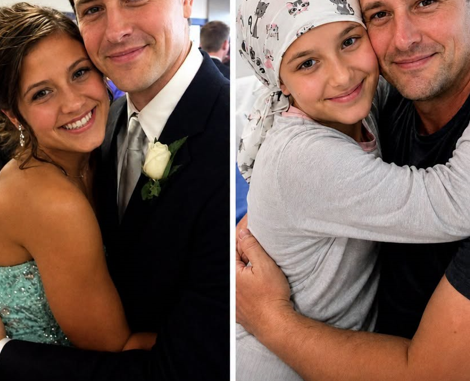
Behind her, a girl stepped into the hallway. Sophie was thin and pale, but her smile was blinding. For a second, I looked for a resemblance—a familiar nose or eye color—but I saw nothing of myself in her. She wasn’t mine. That realization, oddly, hit me harder than the disappointment.
I crouched down to her level. “I’m the wish man, Sophie. I’m here to grant your biggest wish. Anything you want.”
She chewed her lip, thinking deeply. “Can I have pancakes at midnight?”
I laughed, expecting her to ask for a trip or a toy. But she was firm. So, that night at 12:01 a.m., I found myself sitting on Rebecca’s kitchen floor with Sophie, eating strawberry pancakes off paper plates. We didn’t talk about the past or the illness. We just existed in the quiet, surreal normalcy of a Tuesday night.
As the days turned into weeks, the foundation’s official visit evolved into something else. Sophie stopped asking for big events; she asked for my time. We fed ducks at the pond, built blanket forts, and watched terrible movies. And all the while, Rebecca watched from the shadows. I initially thought she was guarding Sophie, but I soon realized she was guarding herself.
Then, one evening, Sophie asked me to come upstairs alone. She clutched an old photograph to her chest, her eyes brimming with tears.
“Daniel,” she whispered. “I figured out my real wish. If I tell you, you might be angry at Mom and never come back. But I need you to promise you won’t refuse.”
My stomach tightened. “I promise.”
She handed me a folded piece of paper. It was a list, written in small, careful script. It didn’t contain toys or trips. It contained things like dancing in the kitchen, wearing lipstick, having coffee with a friend, and playing the guitar.
“She’s forgotten how to be a person who isn’t just my mom,” Sophie explained, her voice cracking. “I want you to be her wish granter, too.”
The next morning, I arrived at their house with two coffees and a mission. I didn’t ask for permission; I just started. I played the music Rebecca used to love. I coaxed her into the kitchen. I demanded she dance.
At first, she fought it. “I don’t need your charity, Daniel. I don’t need you looking at my life like it’s broken.”
“This isn’t charity,” I said, looking her straight in the eye. “It’s a reminder. I’m not here to fix your life, Rebecca. I’m here to remind you who you were before every single day became about being Sophie’s mother.”
She finally broke. She danced, badly and beautifully, and for the first time in years, the tension left her shoulders. That night, after Sophie had fallen asleep, I finally asked the question that had haunted me for twelve years: “Why did you leave? Not one word. You just vanished.”
Rebecca would not look at me. “Because I didn’t deserve to stay. I cheated on you right before graduation. Sophie’s father was a boy from school. I ruined everything we planned, and I thought disappearing was kinder than watching your heart break in front of me.”
The confession hung in the air, heavy and jagged. For twelve years, I had held onto a ghost of a grudge, only to find out the reality was just a messy, human mistake. I looked at her—this woman who had carried the burden of guilt for a decade—and realized that anger was a luxury we no longer had. Sophie was fighting for her life, and Rebecca was fighting to remain human.
Six months later, the miracle we didn’t dare speak of actually happened: the treatments began to work. Sophie started gaining weight, her energy returned, and the house began to feel less like a hospital and more like a home.
Rebecca started playing her guitar again. One Saturday morning, I walked in to find them both laughing in the kitchen, the sunlight pouring over the counter. Sophie looked up at me with a tired, knowing grin.
“You know, Daniel,” she said, “you’re pretty good at this wish thing.”
I watched Rebecca tune her guitar, a soft, genuine smile on her face. I realized then that Sophie had been the true wish granter all along. She had seen that her mother and I were two halves of a broken puzzle, separated by pride and silence, and she had used her final chapter to rewrite ours. I didn’t get the life I had planned twelve years ago, but as I stood in that kitchen, listening to the music start, I knew I had something far better: a second chance at the people I loved most.
Leave a Reply