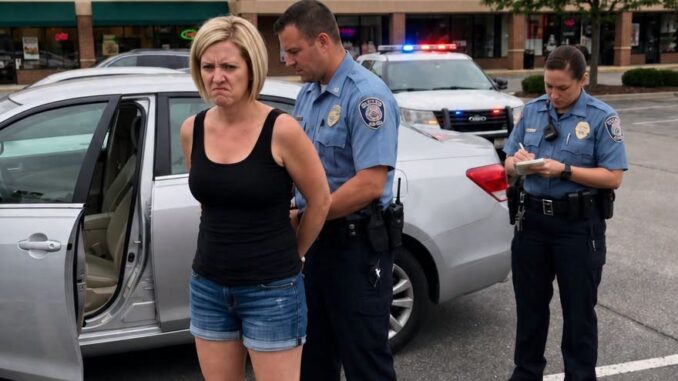
The Officers Thought They Had an Easy Arrest—Until They Pulled What Was in Victoria’s Pocket

The first officer slowly pulled the object from Victoria’s pocket.

For several seconds, neither man said anything.

It was a small black leather wallet.

The officer opened it.

His face changed immediately.

“What the—?”

His partner stepped closer.

“What is it?”

The first officer turned the wallet toward him.

Inside was a government identification card bearing Victoria’s photograph, her full name, and an official seal.

Underneath it was another card.

Then another.

The second officer’s expression drained of color.

Victoria watched them quietly.

“I warned you,” she said.

The first officer swallowed.

“You’re…?”

“An investigator with the state’s Office of Law Enforcement Standards.”

The second officer stared at her.

“That’s impossible.”

Victoria gave him a tired look.

“No. What’s impossible is that you thought I wouldn’t know what you were doing.”

The first officer immediately looked toward the patrol car.

For the first time since stopping her, neither man seemed confident.

Victoria continued.

“My assignment has nothing to do with this county. I was driving home after completing an inspection in the neighboring district.”

She nodded toward the wallet.

“The card you just pulled out identifies me. The device beside it contains my credentials and recording authorization.”

The second officer looked at his partner.

“Turn off your body camera,” he whispered.

Victoria’s expression hardened.

“Don’t.”

The officer froze.

“You already know the cameras are supposed to remain active during an encounter like this.”

Neither officer answered.

Victoria looked at the first officer.

“You stopped me without telling me why. You demanded my documents. You refused to explain the basis for the stop. Then you escalated the situation after I asked reasonable questions.”

She glanced down at the handcuffs.

“And now I’m restrained.”

The first officer’s face was pale.

“Look, there may have been a misunderstanding.”

“A misunderstanding?”

Victoria almost laughed.

“You pulled me out of my car.”

The second officer stepped backward.

“We can clear this up at the station.”

“No,” Victoria said. “You can clear it up right here.”

She nodded toward the patrol vehicle.

“Call your supervisor.”

Neither man moved.

Then Victoria added quietly:

“And don’t delete, alter, or disable any recording.”

That finally broke the silence.

The first officer reached for his radio.

“Dispatch, I need a supervisor at my location.”

Victoria watched him carefully.

The second officer stood several feet away, suddenly unwilling to make eye contact.

Ten minutes later, another patrol vehicle arrived.

A senior sergeant stepped out.

He looked at Victoria first.

Then the handcuffs.

Then his two officers.

“What happened?”

The first officer began explaining.

“We stopped her for a routine traffic check. She became argumentative and—”

Victoria interrupted.

“I did not become argumentative.”

The sergeant raised a hand.

“Let her speak.”

Victoria took a breath.

“I was driving within the speed limit. They stopped me and did not provide a reason. I asked for identification and the basis for the stop. Instead of answering, they ordered me out.”

The sergeant looked at the officers.

“Why?”

Neither answered immediately.

Victoria continued.

“I began recording with my phone. The second officer grabbed it. Then they pulled me out and handcuffed me.”

The sergeant’s expression became increasingly serious.

“Where’s her phone?”

The first officer pointed toward the roof of Victoria’s car.

The sergeant walked over and picked it up.

The screen was still recording.

He pressed the display.

The video began playing.

There was no shouting from Victoria.

No attempt to flee.

No physical resistance.

Just a calm woman repeatedly asking why she had been stopped.

The sergeant watched for nearly a minute.

Then he stopped the video.

“Remove the cuffs.”

The first officer hesitated.

“Sergeant—”

“Now.”

The handcuffs came off.

Victoria rubbed her wrists.

The sergeant turned toward his officers.

“Go wait in your vehicle.”

They walked away.

Victoria remained beside her car.

The sergeant approached her.

“Ma’am, I apologize for what happened.”

Victoria nodded.

“I appreciate that.”

He looked at the identification card still in her hand.

“Are you actually with the state office?”

“Yes.”

“Were you conducting an investigation?”

“No. I was going home.”

The sergeant sighed.

“That may have been the worst possible thing for them.”

Victoria didn’t smile.

“What happens now?”

“That depends on what your office decides.”

Victoria looked toward the two officers sitting inside their patrol car.

“I don’t want special treatment because of who I am.”

The sergeant nodded.

“Then what do you want?”

“Exactly what would happen if I were any other citizen.”

That sentence stayed with him.

The officers were placed on administrative leave pending an investigation.

The department later reviewed the dash-camera footage, body-camera recordings, dispatch logs, and Victoria’s phone video.

The footage contradicted nearly every part of the officers’ initial account.

There had been no dangerous driving.

No suspicious behavior.

No resistance.

No reason documented for escalating the encounter.

The investigation eventually found that the officers had violated department procedures and improperly used force during the detention.

But Victoria’s story didn’t end there.

Several weeks later, she was asked to attend a community meeting.

More than a hundred residents were there.

People had heard about the incident.

Some were angry.

Others were simply curious about what had happened.

Victoria stood at the front of the room.

“I want to make something clear,” she said.

“This isn’t about attacking every police officer.”

She paused.

“Most people in law enforcement do difficult work under difficult circumstances.”

“But authority only works when people trust that it will be used responsibly.”

The room became quiet.

Victoria held up her small black wallet.

“This is what was in my pocket that day.”

She looked at it for a moment.

“But the important thing wasn’t the identification.”

She lowered it.

“The important thing was that before they knew who I was, they had already decided how they were going to treat me.”

That was the part people remembered.

The officers hadn’t changed their behavior because Victoria suddenly became more important.

They changed because they discovered she could hold them accountable.

And Victoria wanted everyone to understand the difference.

“Every person deserves to be treated with dignity,” she said. “Not because they have a government card. Not because they know someone important. Simply because they’re a person.”

The room erupted in applause.

Victoria stepped away from the microphone.

She never expected that a routine drive home would become such a defining moment.

But she learned something that day.

Sometimes people behave very differently when they believe nobody is watching.

The safest answer isn’t always to fight back.

Sometimes it’s to stay calm, document what happens, and make sure the truth has somewhere to go.

And that little wallet in Victoria’s pocket?

It didn’t give her power.

It simply gave the truth a name.

Be the first to comment

Leave a Reply

Your email address will not be published.


*