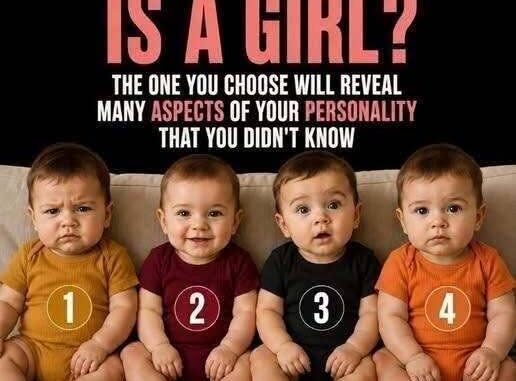
A viral image asks viewers to identify which of four babies is a girl, then promises that the choice reveals hidden personality traits. The challenge is entertaining because the answer is not obvious. It also demonstrates how quickly people rely on stereotypes when asked to make a confident judgment from limited visual information.
The four babies display different expressions and postures. Without reliable context, participants inspect clothing, facial shape, hair, and demeanor. Some choose instantly, while others compare every detail. The test then assigns flattering traits to each selection, making people curious about what their answer supposedly says about them.
Versions of the challenge identify baby number two as the intended answer. People who select that image are often described as emotionally perceptive, kind, balanced, or guided by positive energy. Those descriptions are broad enough that many readers can recognize themselves in them.
There is no scientific method for determining a baby’s sex or gender identity from a photograph like this. Infants share many facial characteristics, and appearance varies widely. Hair length, clothing color, and expression reflect adult choices or a single captured moment rather than biological proof.
The personality claims are not validated psychological assessment. A real personality measure requires carefully designed questions, consistent scoring, evidence that results are reliable, and testing across appropriate populations. A one image choice cannot support conclusions about empathy, leadership, creativity, or emotional intelligence.
Why, then, do the results feel convincing? One reason is the Barnum effect, the tendency to accept vague, positive descriptions as uniquely personal. Statements such as “you care deeply about others but sometimes need space” apply to a large range of people, yet they can feel specific when presented after a choice.
The challenge also uses confirmation bias. Readers remember parts of the description that match their self image and overlook parts that do not. If a friend chooses differently, both can interpret their separate results as accurate because the language gives each person room to fit it to experience.
That does not make the quiz worthless as entertainment. It can start conversations about first impressions and reveal which cues participants notice. One person may focus on a baby’s eyes, another on clothing, and another on posture. Comparing the reasoning can be more interesting than the supposed correct answer.
The test also exposes gender stereotypes learned from childhood. People may associate softness, calmness, certain colors, or particular facial features with girls, even when those traits provide no reliable information. Recognizing that habit can encourage more careful thinking about assumptions applied to real children.
Social media favors challenges that are quick, visual, and easy to share. A difficult academic personality inventory would not produce the same engagement. Four pictures and a promise of self discovery invite instant participation, friendly disagreement, and reposting.
Problems arise only when entertainment is presented as diagnosis or evidence. A viral quiz cannot determine mental health, compatibility, intelligence, or character. People should not make important decisions about themselves or others based on such results.
If you selected baby number two, you matched the answer commonly supplied with the image. If you chose another baby, the difference does not reveal a flaw. The real lesson is that humans create meaning quickly under uncertainty. Enjoy the puzzle, compare your reasoning, and treat the personality descriptions as playful storytelling rather than science.
Seen in that light, the exercise works best as conversation rather than classification. People can compare what they noticed and ask which assumptions guided them. The only responsible conclusion is that an ambiguous picture cannot reveal a baby’s sex or provide a clinical portrait of the viewer.
That is the distinction worth remembering.
Leave a Reply