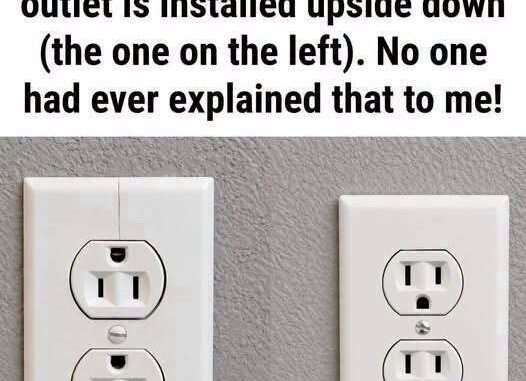
A homeowner was replacing a few wall outlets when one small detail immediately caught their attention. Most of the outlets throughout the house had the ground hole positioned at the bottom, but in one room, every outlet was installed with the ground hole facing upward.
At first, the homeowner assumed someone had installed them incorrectly. Before making any changes, they decided to ask an electrician.
The explanation was surprisingly simple: an upside-down outlet isn’t necessarily a mistake.
In some buildings, electricians intentionally install outlets with the ground pin facing upward for practical or safety-related reasons. The orientation can sometimes help identify outlets connected to a particular circuit, a switched outlet controlled by a wall switch, or equipment that serves a specific purpose.
There is also a safety argument for placing the grounding hole on top.
Imagine a plug that has been partially pulled out of the outlet. If a small metal object were to fall between the plug and the wall, having the grounding pin positioned above the live electrical contacts could potentially cause the object to contact the grounded portion first rather than the energized prongs.
That doesn’t mean every upside-down outlet was installed specifically for this reason, however.
In many residential installations, electrical codes don’t require standard outlets to face one particular direction. As a result, you may encounter outlets with the ground pin facing either up or down, sometimes even within the same building.
The orientation can depend on the electrician’s preference, the design of the electrical system, or the requirements of a particular project.
In commercial buildings, offices, hospitals, and other specialized facilities, consistent outlet orientation may also be used as a visual way to distinguish certain circuits or outlets serving particular equipment.
So the next time you notice an outlet installed “upside down,” don’t immediately assume someone made a mistake.
It may simply be a deliberate installation choice.
What looks like a tiny detail on the wall can sometimes have a practical reason behind it—and that’s exactly what makes ordinary things around the home so interesting.
Leave a Reply