It was 2:15 p.m. on a Wednesday when I got the call.
“Mrs. Prescott, you need to come to the school immediately. There’s been an incident with your daughter.”
My stomach dropped. Janine is twelve. Quiet. Thoughtful. Never once had I gotten a call about her misbehaving.
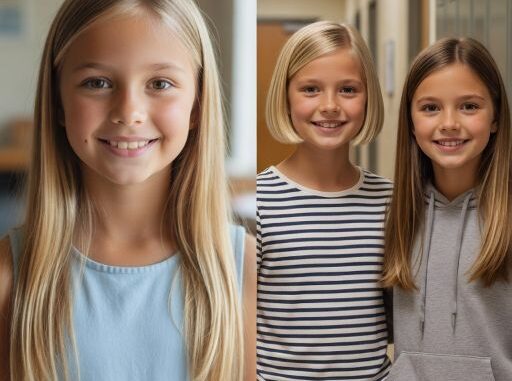
Nine minutes later, I was in the school office. Janine sat calmly in a plastic chair, her once-long brown hair now cut to her jawline, uneven in the most imperfectly perfect way. She had done it herself, using craft scissors she borrowed from the art room, in the girls’ bathroom during lunch.
The principal, Mr. Delvecchio, looked tense. Beside him were the school counselor and another woman I didn’t recognize.
“Your daughter cut her hair on school grounds with a sharp instrument,” the principal said. “This violates our safety policy.”
I turned to Janine. She was calm, unshaken.
“Why?” I asked gently.
“Reese has leukemia, Mom. She came back last week with no hair. The boys were calling her an alien. Nobody sat with her at lunch,” Janine explained. “I looked up how to make a wig. I needed enough hair. I had enough.”
The room went silent.
Then the unfamiliar woman spoke. She was not Reese’s mother, as I had assumed. “I’m filing a formal complaint. My son was upset because your daughter made a scene and called the boys bullies.”
I blinked. “Your son was one of the boys calling a cancer patient an alien?”
No answer.
Mr. Delvecchio cleared his throat. “We need to discuss a three-day suspension for Janine. The scissors, the disruption—”
“Suspension?” I repeated.
Janine held a Ziploc bag in her lap. Her carefully measured hair sat inside, tied with a rubber band. She had done everything intentionally, thoughtfully. She had acted from compassion.
I faced the principal. “Before you punish my daughter for an act of kindness, check your inbox. A TV crew is setting up in your parking lot. They’re here for a story about the school board budget—but I wonder how quickly they’d pivot if they knew what was happening here.”
His face went white. The other woman left silently. The counselor, suddenly attentive, flipped through her clipboard.
We waited in the hallway for eleven minutes. Janine leaned her head on my shoulder. “Am I in trouble, Mom?” she asked.
“Not with me. Not ever.”
When we returned, the principal’s desk phone rang. He listened for ten seconds, then looked at me like he had swallowed something sharp. “The superintendent just called. Apparently, Reese’s mother posted the story online—forty thousand shares in an hour. They want to know why the only student standing up to bullying is being punished.”
Two days later, a package arrived at our door. Inside was a handwritten letter and a check from Diane Colford, a tech entrepreneur who had survived childhood cancer herself. Her note read:
“Your daughter did for my child what no one did for me 30 years ago.”
The check was generous, earmarked for Reese’s medical bills, with a portion for Janine’s college fund. But the last line stunned me:
“I’m not just sending money. I’m sending my lawyers. The school’s record of bullying is worse than you know, and I have proof.”
Diane’s team arrived that Monday, uncovering fourteen bullying complaints over three years that had been ignored or buried. The counselor resigned; the principal was placed on administrative leave. Travis Wynn, the ringleader of the bullying, was transferred, required to complete anti-bullying training, and no longer held a free pass.
Meanwhile, Janine returned to school. She sat with Reese every day, quietly supporting her. The hair wasn’t long enough for a professional wig, but Reese’s mother reassured Janine:
“You didn’t give her hair. You gave her hope. That matters more than any wig.”
A proper custom wig was later provided by Diane’s foundation, and when Reese wore it to school, students cheered. Janine’s simple act of empathy had sparked real policy changes, including a district-wide reporting system with third-party oversight and training funded by the Reese and Janine Initiative.
Through it all, Janine remained the quiet, thoughtful girl she always was. She didn’t seek recognition; she only acted from a sense of right and wrong. But her courage exposed a system that ignored the vulnerable, reminded the community of the power of compassion, and taught all of us a lesson we’ll never forget.
Sometimes courage isn’t loud. Sometimes it’s a twelve-year-old girl with craft scissors, acting for the sake of another, standing steady in a world that often overlooks kindness. And sometimes, the truth finally catches up.
Leave a Reply