I thought Buster and I were in for another completely ordinary evening walk.
My golden retriever and I were following our usual paved path through the park as the sun began to set. The light was soft, the air was calm, and everything seemed perfectly routine.
Then Buster suddenly stopped.
He froze in place and stared toward a patch of tall grass beside the trail.
At first, I assumed he’d spotted another dog or maybe a squirrel.
But then he gave a quiet growl.
That got my attention.
I shortened his leash and looked carefully into the grass.
At first, there was nothing unusual. Just leaves, dirt, and long blades of grass.
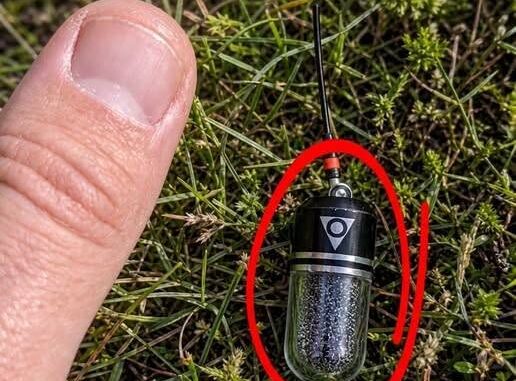
Then I noticed something small partially hidden near the ground.
It appeared to be a tiny transparent capsule with a thin wire-like piece extending from one end.
It looked completely out of place.
I didn’t want to pick up an unfamiliar object, so I stayed where I was and used my phone to take a closer look.
The more I examined it, the more it reminded me of a small electronic tracking device.
My imagination immediately started running.
Could it be some kind of surveillance equipment?
Was it part of a research project?
Or was it simply a harmless piece of technology that someone had accidentally dropped?
I obviously couldn’t tell just by looking at it.
But the object’s size and design reminded me of the tracking equipment sometimes used by wildlife researchers to monitor animals.
That possibility made the discovery much more interesting.
Wildlife researchers can use tracking devices to learn about the movements of animals without having to observe them constantly. Depending on the equipment and species being studied, researchers may be able to gather information about where an animal travels, how large its territory is, or which areas it uses for shelter and food.
Urban parks can be particularly interesting places for this kind of research.
Cities aren’t completely separate from nature. Birds, bats, foxes, squirrels, deer, and countless smaller creatures can live surprisingly close to people.
Researchers studying these animals can learn a great deal by understanding how wildlife navigates parks, gardens, wooded areas, and other green spaces.
So I began wondering whether the little object in the grass had once been attached to an animal.
Perhaps a tracking device had come loose.
Perhaps someone had dropped a piece of equipment during a research project.
Or perhaps it had absolutely nothing to do with wildlife research at all.
Without knowing its origin, there was no responsible way for me to identify it with certainty.
That was also why I decided not to touch it.
I didn’t want to accidentally damage someone’s equipment, interfere with a research project, or handle an object that might have some other purpose.
Buster, meanwhile, was still extremely interested.
He kept looking toward the grass as though he’d discovered the greatest mystery of his life.
I gave him a gentle tug on the leash.
“Come on, buddy.”
He looked at me.
Then back at the mysterious object.
Then at me again.
Eventually, he gave in.
We continued along the trail.
As we walked, I couldn’t stop thinking about what we’d seen.
It was fascinating to realize that something so small could potentially be connected to a much larger story.
If it really was wildlife-monitoring equipment, it could have been part of an effort to understand animals living in or around the park.
A tiny device might help researchers build a picture of an animal’s movements over time.
That information can be useful when studying habitats, migration patterns, feeding areas, and the ways wildlife responds to changes in its environment.
Of course, I couldn’t confirm any of that from the object alone.
That’s an important lesson I took from the experience.
When you discover something unfamiliar, especially something electronic or potentially connected to research, it’s better not to jump immediately to the most dramatic explanation.
Sometimes a strange-looking object has a perfectly ordinary purpose.
And sometimes you simply don’t have enough information to know what it is.
In my case, the mystery remained unsolved.
But that almost made the walk more memorable.
Before that evening, I’d rarely thought about how much activity could be happening in the park after people go home.
Animals were moving through the trees.
Birds were settling into their nighttime routines.
Small creatures were searching for food.
And perhaps somewhere among them was an animal whose movements were being studied by someone trying to understand the hidden wildlife of the area.
All of that could be happening while people simply walked past without noticing.
Buster had noticed, though.
He had stopped at exactly the right patch of grass and turned an ordinary walk into a little mystery.
I still don’t know exactly what that tiny device was.
Maybe it really was connected to wildlife research.
Maybe it was an old piece of equipment.
Maybe it was something far more ordinary.
But the discovery reminded me that interesting things can be hiding in plain sight.
You don’t always need a dramatic event to make an evening memorable.
Sometimes all it takes is a curious dog, a patch of grass, and one tiny object that makes you stop and wonder.
And honestly, that’s one of the things I love most about walking with Buster.
He notices things I would probably walk right past.
That evening, he didn’t just find something in the grass.
He gave me a reason to look closer at the world around me.
Leave a Reply