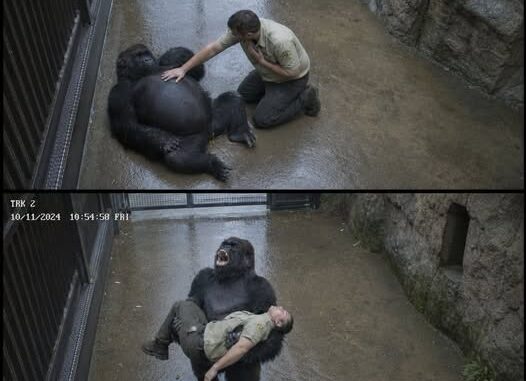
For years, the bond between Julius and his caretaker had been built through something remarkably simple: consistency. Day after day, the caretaker arrived with food, patience, and a familiar presence. There were no grand gestures or expectations. Instead, their relationship developed through small routines—the sound of familiar footsteps, a calm voice, a reassuring touch, and gentle interaction through the sanctuary enclosure.
To Julius, those moments appeared to become part of his everyday world.
Then, one day, everything changed.
During a routine visit, the caretaker suddenly collapsed. What had been an ordinary interaction became a frightening emergency in a matter of seconds. While the people around him might have been caught off guard by the situation, Julius appeared to recognize that something was seriously wrong.
His reaction was not the kind of dramatic rescue often portrayed in movies. Instead, the gorilla became focused and persistent. He moved toward the caretaker, nudged him, shifted his position, and continued making sounds that eventually attracted the attention of other people nearby.
Those actions may have seemed simple, but they helped bring attention to the situation when every second mattered.
A Routine Visit Takes an Unexpected Turn
Animal caretakers often develop strong relationships with the animals they look after. Daily routines provide familiarity and can help animals recognize individual people, voices, movements, and patterns.
That appeared to be the case with Julius.
Over time, the caretaker had become a recognizable part of his environment. Meals, cleaning routines, gentle interactions, and regular visits created a predictable relationship. Julius may not have understood the responsibilities of a caretaker in human terms, but he could recognize a familiar person and respond to changes in their behavior.
That familiarity became especially important when the caretaker suddenly collapsed.
Instead of simply moving away or ignoring what had happened, Julius remained engaged with the person. His behavior drew attention to the unusual situation and encouraged others to investigate.
For the people who witnessed the incident, it was a powerful reminder that animals can sometimes respond to changes in human behavior in ways that are difficult to anticipate.
Julius Didn’t Need to Understand the Emergency
One of the most remarkable aspects of the story is that Julius did not need to understand what was happening medically.
A gorilla does not need to know what a heart attack is, what an ambulance does, or why a person might suddenly lose consciousness. Animals can nevertheless notice changes in movement, sound, posture, and responsiveness.
The caretaker had suddenly gone from being active and familiar to being unusually still.
That difference may have been enough for Julius to recognize that something was wrong.
His response was persistent rather than theatrical. He interacted with the caretaker, made vocalizations, and continued until people noticed the situation.
In an emergency, that kind of attention can be extremely important. The difference between someone noticing a medical crisis immediately and discovering it several minutes later can sometimes have serious consequences.
When Every Minute Matters
According to the account, medical professionals later emphasized how important the timing was.
Emergency medical situations can develop quickly, and early recognition often gives people a better opportunity to receive appropriate treatment. In this case, Julius’s unusual behavior helped ensure that the caretaker’s condition was not overlooked.
Once other people became aware of the situation, medical assistance could be sought.
The gorilla did not call emergency services. He did not understand medical treatment. He simply reacted to something that seemed wrong in his surroundings.
That distinction makes the story even more meaningful.
Rather than viewing Julius as a trained rescue animal, those close to the situation saw his actions as an example of how familiarity and social awareness can influence animal behavior.
A Relationship That Went Both Ways
Caretakers spend their days looking after animals.
They provide food, maintain enclosures, monitor behavior, support medical care, and create environments where the animals can remain healthy and comfortable. Because of this, relationships between animals and their human caregivers can become remarkably familiar.
But people do not always think about what animals may notice in return.
Julius’s response offered a different perspective.
For years, his caretaker had been the person providing attention and care. Yet when the human suddenly became vulnerable, the gorilla appeared to respond with concern and persistence.
The relationship was no longer simply about one person caring for an animal.
In that moment, the animal appeared to recognize that something had changed and reacted accordingly.
That does not mean Julius understood the medical details of the situation. It simply suggests that the bond developed through years of repeated interaction may have mattered when something unusual happened.
Animals Can Notice More Than We Realize
Stories involving animals often encourage people to think about intelligence in broader terms.
Humans tend to measure intelligence through language, problem-solving, mathematics, or other abilities that are easy for us to understand. But animals communicate and interpret their surroundings differently.
Gorillas are highly social animals. They can recognize individuals, remember experiences, respond to social signals, and develop relationships with members of their social groups.
Their understanding of the world is not identical to ours, but that does not mean their behavior is random.
A familiar person behaving differently can be a significant change.
In Julius’s case, the caretaker’s sudden collapse represented a dramatic break from the normal routine. The gorilla’s reaction suggested that he noticed the difference and was unwilling to simply ignore it.
The Emotional Impact on the Sanctuary Staf
For the sanctuary staff, the incident had an impact that went beyond the immediate medical emergency.
They had watched the relationship between Julius and his caretaker develop over time. The daily interactions may have seemed ordinary: feeding, cleaning, talking, touching, and spending time together.
But those ordinary moments had apparently created something meaningful.
When the caretaker needed help, the gorilla’s reaction gave those everyday interactions a new significance.
The staff were reminded that animals can form strong associations with the people who care for them. Familiarity can develop slowly, through hundreds or thousands of repeated interactions.
A gentle voice heard every day can become recognizable.
A familiar person appearing at a certain time can become part of an animal’s expectations.
A particular routine can create a sense of security.
And when that routine suddenly changes, an animal may respond.
More Than a Story About a Rescue
It would be easy to describe Julius as a hero and leave the story there.
But the deeper lesson is more interesting.
The incident demonstrates how relationships between humans and animals can develop through patience and repeated positive interactions. The caretaker did not necessarily expect anything in return for the years of attention given to Julius.
Yet those interactions may have helped establish a level of familiarity that became significant during an unexpected emergency.
The story is therefore not only about one dramatic moment.
It is also about everything that happened before it.
The quiet routines.
The familiar voice.
The repeated visits.
The trust developed over time.
Those details may seem insignificant when viewed individually. Together, however, they formed the foundation of a relationship that appeared to matter when circumstances suddenly changed.
A Reminder That Kindness Can Come Full Circle
There is something deeply touching about the idea that care can sometimes return in an unexpected way.
The caretaker had spent years looking after Julius without knowing whether the gorilla could ever understand the significance of those efforts.
Then, when the caretaker suddenly needed assistance, Julius responded to the change around him.
Whether viewed through the lens of animal behavior, emotional connection, or simply an extraordinary coincidence, the moment left a lasting impression.
It also offers a simple lesson for people who work with animals: relationships matter.
Animals may not communicate gratitude in the same way humans do, but familiarity, trust, and positive experiences can shape their behavior.
The Lasting Lesson From Julius
The most memorable part of Julius’s story is not that he performed a complicated act of rescue.
He didn’t.
Instead, he noticed that something was different and refused to ignore it.
His nudging, movement, and vocalizations helped draw attention to a person who had suddenly become unresponsive. Medical professionals later indicated that the timing of the response was important.
For the sanctuary staff, the experience changed the way they viewed an already meaningful relationship.
The caretaker had spent years giving Julius food, attention, patience, and affection. In a moment of crisis, the gorilla appeared to respond to the person who had become such a familiar part of his life.
It is a powerful reminder that some of the strongest bonds are built quietly.
They develop through ordinary days rather than extraordinary events. A routine visit, a familiar voice, or a gentle interaction may not seem important at the time. But over months and years, those moments can create recognition and trust.
And sometimes, when something goes unexpectedly wrong, that bond can reveal itself in a way nobody anticipated.
Leave a Reply