This wasn’t just Christmas candy.
It was tradition poured into a pan.
It was the dessert everyone waited for all year long, the one relatives searched for the second they walked through Grandma’s front door while snow melted off their boots and holiday music drifted softly from another room. Before coats were even hung up properly, someone would already be lifting foil from the tray on the kitchen counter, hoping to steal the first square before dinner.
And somehow, no matter how many times people asked, Grandma never fully wrote the recipe down.
“Oh, it’s simple,” she’d say with a wave of her hand, as if magic could be measured casually with ordinary cups and spoons.
But it never tasted the same when anyone else tried.
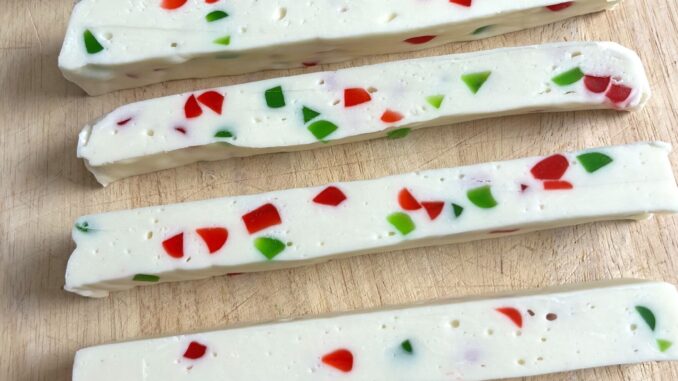
Every December, the candy appeared almost mysteriously. White as fresh snow, soft and chewy, scattered with glowing red and green gumdrops that looked like tiny Christmas lights trapped inside creamy clouds. It sat in neat little squares on festive plates while laughter filled the house and wrapping paper gathered around overflowing trash bags nearby.
Children loved it because it was sweet.
Adults loved it because it tasted like memory.
Now, years later, the recipe survives only through fragments.
A stained index card with half the ingredients missing.
An aunt insisting Grandma used more butter than anyone remembers.
Someone else swearing she chilled it overnight instead of just a few hours.Tiny details floating through family conversations like pieces of a song nobody completely knows anymore.
And somehow, that uncertainty makes the recipe feel even more precious.
Because the candy was never only about ingredients.
It was about the ritual surrounding it.
The sound of gumdrops being chopped on old cutting boards scratched from decades of use. The smell of melting butter and white chocolate slowly filling the kitchen while fog gathered on the windows from the warmth inside. The way Grandma stirred patiently, never rushing, wooden spoon moving in steady circles while grandchildren hovered nearby pretending not to wait impatiently for the bowl scrapings.
The process itself felt comforting.
Predictable.
Safe.
Mini marshmallows disappeared into the warm mixture first, melting slowly into silky sweetness alongside the butter and white chocolate chips. Everything softened together gradually until the mixture turned smooth, glossy, and rich enough to make the entire kitchen smell like Christmas itself.
Then came the gumdrops.
Bright red and green jewels folded carefully into the creamy base once it cooled slightly, each piece adding bursts of color against the pale candy like stained glass scattered across snow. Grandma always mixed them in gently, never crushing them, as though even the candy deserved patience and care.
Poured into parchment-lined pans, the mixture rested quietly in the refrigerator for hours while the rest of the holiday continued around it.
Presents wrapped.
Old movies played.
Family stories repeated for the hundredth time.
And somewhere between all of it, the candy slowly transformed from warm sticky mixture into firm little squares carrying entire childhoods inside them.
There was always a moment later that evening when someone finally lifted the candy carefully from the pan and cut the first pieces.
That moment mattered.
The kitchen would grow strangely quiet for a second, everyone pretending not to hover too close while secretly waiting for a taste. Then hands reached in almost all at once, eager and smiling, because some traditions survive precisely through repetition.
One bite and suddenly people remembered things they had forgotten all year.
Grandpa laughing too loudly at his own jokes.
The smell of pine needles near the fireplace.
The sound of cousins running down hallways.
The warmth of crowded dining rooms glowing against winter darkness outside.
That is the real power of recipes passed through families.
They preserve emotion as much as flavor.
Food becomes memory you can hold.
Proof that people we loved once stood exactly where we stand now, stirring bowls, measuring ingredients imperfectly, creating comfort without realizing how deeply it would stay with us later.
And maybe that is why losing family recipes feels strangely heartbreaking sometimes.
Because it is never only about food disappearing.
It is the fear of losing voices.
Routines.
Tiny acts of love repeated so often they became invisible until suddenly the person who carried them is gone.
Now every recreated batch becomes its own act of remembrance.
A careful attempt not only to make candy, but to pull the past gently back into the room for a little while longer.
And when the finished squares finally sit on the counter again — white, soft, sparkling with red and green — it almost feels like Grandma found her way back into the kitchen beside you, quietly reminding everyone that the sweetest things families pass down are rarely written perfectly on paper.
Leave a Reply