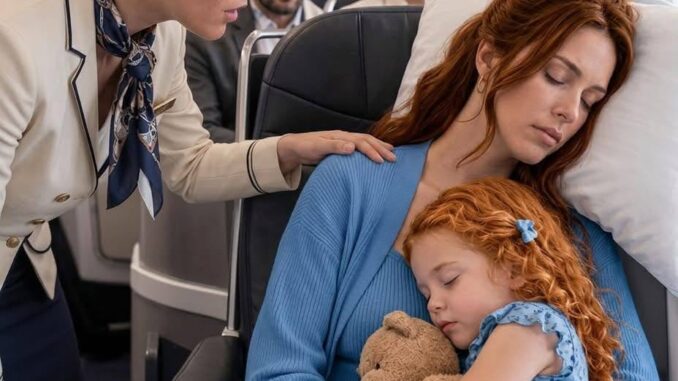
Some two hours into an average red-eye flight from New York to Madrid, the speaker on board switched on, and the voice of the captain rang through the sound of the aircraft’s engines.
The captain didn’t sound panicked, just sharp. He asked anyone with a military fighter pilot background to let a flight attendant know right away.
People started shifting in their seats, looking around at each other, totally confused. No one expects a commercial airliner to need a tactical pilot while flying over the middle of nowhere. Naturally, no one gave a second thought to the woman sleeping in seat 8A with a woolen sweater over her legs.
Her name was Laura Vance. Eighteen months ago, she would have been the one flying lead. Now she just wanted to disappear.
She used to strap herself into an F-16 and make split-second calls that kept people alive, right up until the day she couldn’t. The Air Force gave her medals and a clean discharge; she left them in a box in the back of a closet and walked away from the noise, the pressure, and the uniform. All she wanted was to be invisible. That was why she always booked the back row, buried her face in a sweater, and let the rest of the world forget she existed.
When the captain came back on the intercom, his voice tighter and more anxious this time, a flight attendant hurried down the aisle, panic written all over her face as she scanned the rows. Laura kept her eyes shut, trying to tune it out. She had sworn to herself she was done living a life where everyone else’s survival depended on her.
Then the flight attendant stopped right beside her row, leaning in to ask if anyone nearby had a background in military aviation. Laura opened her eyes and looked down the aisle and all she could see were families, couples holding hands, kids sleeping thousands of feet above the dark, freezing ocean. And then out of nowhere, that old, deep-seated instinct just overrode everything else. A pilot doesn’t walk away when people are in trouble.
She probably did hesitate for a split second, but then she unfastened her seatbelt and said, “Maybe I could help.”
The moment she stepped into the cockpit, she could sense the smell of burning electronics, stale air, and old coffee.
Captain Andrew Vance was white-knuckling the controls, while his co-pilot slumped unconscious in the right seat with an oxygen mask strapped to his face. Andrew took one look at her civilian clothes, frowned, and asked when she’d last flown an F-16. When she told him it was eighteen months ago, he clearly thought she was way too rusty, but right as he opened his mouth to argue, the whole plane shuddered violently.
Laura’s attention locked onto the instrument panel. There was no time for chit-chat. She cut straight to the point, asking how long ago the controls started acting up and why the autopilot dropped. Andrew pointed out the bizarre errors flooding the screens, explaining that his first officer had suddenly lost feeling in his arm before passing out. Put that together with the co-pilot’s missing travel mug, and it didn’t take a genius to realize this wasn’t a random medical emergency. Someone had clearly poisoned him.
She leaned over the console, telling Andrew exactly which circuit breakers to yank and how to override the flight computer fighting their controls. Outside the windscreen, a heavy storm cell was chewing up the horizon, fuel was draining into the red, and the gear wasn’t locking. She kept her voice flat and steady, guiding his hands on the yoke and managing the throttles until the wheels slammed hard against the Spanish runway.
People in the back were crying, clapping, shaking. Laura didn’t care. She was already watching the flashing blue lights swarming the tarmac.
Spanish federal police boarded before the engines even spooled down. They hauled Richard Sterling out of first class in handcuffs, the executive who had tried to muscle his way to the flight deck. It didn’t take long for the rest of it to drop: Sterling hadn’t just embezzled airline funds. He’d bought cheap counterfeit parts, poisoned the co-pilot, and tried to ditch a commercial airliner over the Atlantic just to bury the audit.
For Laura, the betrayal cut way deeper than corporate greed. The counterfeit parts tracing back to Sterling were the exact same faulty equipment linked to her old squadron, the crash that killed her closest wingman, Gabriel. For eighteen months, she had carried a crushing load of guilt, convinced she could have saved him if she’d reacted faster.
But the recovered flight data logs cleared her name, proving his controls had completely locked up on him. Reading that truth shattered the walls she had built around herself, finally letting her grieve. When she flew to Texas afterward to see Gabriel’s mother, the older woman didn’t offer pity, she just reminded her that she needs continue living her life.
While Sterling traded his high-end suits for a federal prison cell, Laura took a completely different path. She didn’t reenlist or go back to flying combat jets. Instead, she took a job teaching at a commercial aviation school. On her very first day, she placed her old fighter helmet right in the middle of her desk, looked at her students, and told them the truth: being a hero doesn’t mean a damn thing when an emergency hits. Only common sense, humility, and teamwork will keep you alive.
Laura still hated being called a hero for saving that transatlantic flight; she figured she just did what needed to be done. But a few months later, she got a handwritten letter in the mail. It was from a young boy who had been sitting a few rows behind her on the plane, writing to tell her that a simple nod from her as she walked past had given him the courage he needed. Because of that, he was writing to let her know he was taking his very first flight lesson.
And that moment, it was all she needed to hear.
Leave a Reply