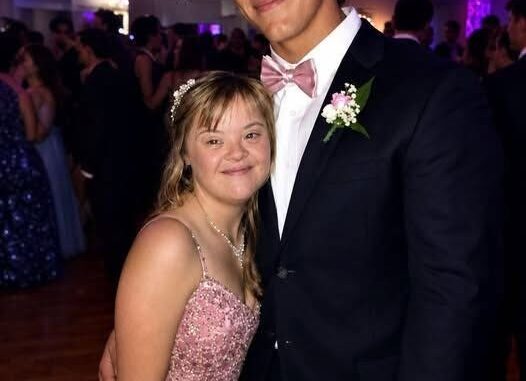
For several weeks, Rosie had been practicing dance moves in her kitchen.
“One, two, three… turn.”
Sometimes she got the steps right. Other times, she laughed, started over, and tried again.
To Rosie, prom was more than just another school event. It was something she had imagined for years—a chance to dress up, spend time with friends, dance, and create memories like any other student.
Rosie was eighteen and had mosaic Down syndrome. She sometimes faced challenges at school, including moments when other students underestimated her or made her feel different.
Her mother had seen those experiences firsthand.
So when Rosie came home one afternoon with exciting news, her mother was thrilled.
“Steven asked me to prom!”
Steven was the school’s football captain. He was well known among students, confident, athletic, and popular.
Rosie’s mother was surprised but immediately happy for her daughter.
“Did you say yes?”
Rosie grinned.
“Of course!”
From that moment, preparations began.
Mother and daughter searched for the perfect dress, chose a pair of silver shoes, and talked about hairstyles. Rosie continued practicing her dancing every evening.
Her mother reminded her that she didn’t need to be perfect.
“You just need to have fun.”
And that was exactly what Rosie planned to do.
The Big Night
When prom finally arrived, Rosie stood in front of the mirror wearing her dress and silver shoes.
“Do I look okay?”
Her mother smiled.
“You look beautiful.”
At the school, the ballroom was filled with music, decorations, photographs, and excited students.
At first, Rosie stayed close to her mother. She was happy but understandably nervous.
Then Steven approached.
“Would you like to dance?”
Rosie smiled and accepted his hand.
They walked onto the dance floor together.
As the music played, Rosie followed the steps she had practiced so many times at home. When she missed one, she laughed.
Steven simply smiled and helped her find the rhythm again.
Her mother watched from nearby, relieved to see her daughter enjoying herself.
Then something unexpected happened.
The Mysterious Envelope
Later in the evening, Steven placed his jacket over a chair.
When it slipped onto the floor, Rosie’s mother picked it up.
She noticed something inside one of the pockets: a small USB drive and an envelope.
The envelope had Rosie’s name written on it.
Naturally, she wondered what it was.
Steven noticed the envelope in her hand.
“I was hoping you wouldn’t see that yet,” he said with a smile.
His comment made her curious.
“What is it?”
Steven explained that he had prepared something special for Rosie.
He had noticed that some students sometimes made assumptions about her because of her disability. He wanted to remind her that she was appreciated for much more than that one part of her identity.
The USB drive contained messages from classmates, teachers, and other students who knew Rosie.
They talked about her sense of humor, determination, kindness, enthusiasm, and willingness to help others.
The envelope contained photographs and handwritten notes.
Steven had organized everything because he wanted Rosie to understand something important.
She was valued.
And he didn’t want the gesture to feel like pity.
“I wanted her to know that people genuinely like her,” he explained.
Rosie’s mother was deeply touched.
A Surprise for Rosie
Steven returned to the ballroom and approached the DJ.
He asked if he could make a short announcement.
The music stopped.
“Rosie, could you come up here for a moment?”
Rosie walked toward the stage, unsure what was happening.
Steven connected the USB drive to the school computer.
A photograph appeared on the screen.
It showed Rosie helping another student with a project.
Then another picture appeared.
Rosie laughing with friends.
More photographs followed.
Soon, short messages began playing.
One student thanked Rosie for being there during a difficult time.
Another described her as one of the funniest people in the class.
A teacher spoke about her determination and effort.
Finally, several students appeared together.
“We’re glad you’re here.”
Rosie covered her mouth as tears filled her eyes.
The room became quiet for a moment.
Then someone began applauding.
More students joined.
Soon, the entire ballroom was filled with applause.
Rosie looked at Steven.
“You did this?”
He nodded.
“I wanted you to know that you belong here.”
Rosie smiled.
“So do you.”
A Mother Sees Things Differently
Watching from across the room, Rosie’s mother became emotional.
For years, she had worried about her daughter being excluded or treated differently.
That night, she realized something important.
Rosie didn’t need everyone to treat her as fragile.
She needed to be treated with respect.
She was a daughter, friend, student, dancer, and young woman with dreams of her own.
Her disability was part of her life, but it wasn’t the definition of her entire identity.
Steven seemed to understand that.
His gesture wasn’t about making Rosie feel different.
It was about reminding her that she was part of the school community.
The Dancing Continued
After the presentation, the music started again.
Rosie returned to the dance floor.
Steven joined her.
“One, two, three…”
Rosie turned.
This time, she got the step exactly right.
Soon, several classmates joined them.
The moment wasn’t about disability anymore.
It was simply a group of young people enjoying their prom together.
And for Rosie, that was perhaps the best gift of all.
What Happened Next
The experience didn’t magically eliminate every challenge Rosie faced at school.
She still had difficult days.
She still encountered situations that required patience and support.
But she returned to school with greater confidence.
The prom project also encouraged students and teachers to talk more openly about inclusion, accessibility, and respectful behavior.
The school began looking for more ways to ensure students with different abilities could participate in activities and feel welcome.
One evening hadn’t solved everything.
But it had started an important conversation.
The Bigger Lesson
True inclusion isn’t simply about allowing someone into the room.
It’s about making sure they feel that they genuinely belong there.
Everyone has qualities that make them unique. Focusing only on differences can prevent us from seeing the person behind them.
Rosie didn’t need people to ignore her disability.
She needed people to see the whole person.
And on one memorable prom night, her classmates gave her a reminder that she would likely carry with her for years:
Sometimes, the most meaningful gesture isn’t doing something extraordinary for someone.
It’s simply making sure they know they matter.
Leave a Reply