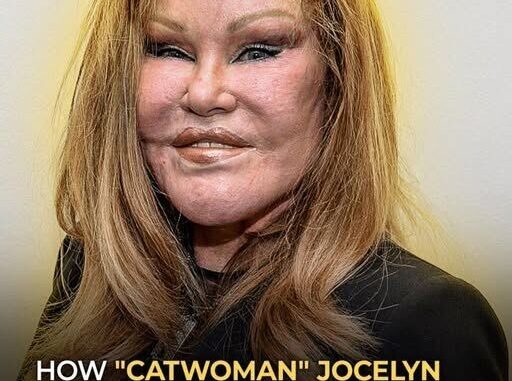
An unquenchable, very toxic fixation with the bodily changes of the world’s most elite people has long existed in the turbulent, merciless realm of high society and international tabloid culture. For several decades, prominent socialites have been turned into sensationalized cautionary stories for public amusement by mainstream media outlets, which have methodically reduced complicated human lives into shallow caricatures. The mysterious figure of Jocelyn Wildenstein, whose remarkable, feline physical attributes won her the unwavering worldwide moniker Catwoman, served as the final inspiration for this intense pattern of public scrutiny and uncompromising media criticism. Although her dramatic, widely reported appearance was frequently used as a weapon by the international community to paint her as an eccentric symbol of extreme wealth and surgical obsession, her actual trajectory reveals a complex, multi-layered story of identity, extreme financial betrayal, and a fierce determination to live life entirely on her terms.
Jocelyn’s life started in a state of peaceful, unglamorous simplicity amid the picturesque landscapes of Switzerland, long before her name became inextricably linked with lavish New York divorces and dramatic stylistic changes. She was raised in a modest home and had a deep love of the natural world and an insatiable curiosity. From an early age, she had a strong desire to see the huge continent of Africa. As a young adult, her refined tastes and innate charm eventually led her to the cultural hub of Paris, France, where she easily assimilated into elite intellectual and artistic circles and developed a highly independent spirit that would propel her through the highest levels of global society. Alec Wildenstein, a ferociously powerful billionaire art dealer and scion of one of the richest families on the planet, and her destiny irreversibly collided on an exciting, high-stakes trip to a vast wildlife estate in Kenya.
Following their marriage, Jocelyn was thrust into a glittering, blinding spotlight of unheard-of luxury, complete with private jet trips, multimillion-dollar art purchases, and a highly publicized lifestyle that enthralled the international media. But in the late 1990s, the delicate structure of their lavish marriage fell apart, leading to one of the most violent, contentious, and extraordinarily costly divorce processes in human history. Alec Wildenstein aggressively launched a massive media campaign, claiming that Jocelyn had undergone an excessive, deeply unnatural volume of invasive plastic surgery in a desperate, bizarre attempt to mimic the physical characteristics of a wild jungle cat, in an attempt to ruthlessly destroy his wife’s public reputation and minimize his financial liabilities. Jocelyn vehemently and persistently defied the corporate narrative, fervently claiming that her striking, elongated eyes and sharp, high cheekbones were entirely natural, inherited traits derived from her distinctive European ancestry. This led to a heated international discussion about the limits of cosmetic reality that continues to this day.
As the years went by, the public’s fascination with Jocelyn’s facial structure reached a fever pitch. Tabloid columnists dissected, examined, and exaggerated every public appearance, claiming that her extreme cat-like features and tightened skin were the direct result of numerous medical procedures. Recently, a massive digital phenomenon emerged from the true depth of this collective obsession: modern artificial intelligence engineers used sophisticated generative algorithms to create a series of gorgeous, highly simulated images that showed what the famous socialite would have looked like if she had aged completely naturally. With normal, graceful wrinkles and real age patterns in place of the harsh, severe lines of her distinctive style, the widely shared AI photos provided a profoundly poignant, softer alternative reality. Interestingly, the simulations showed that her fundamental bone structure and powerful facial emotions remained incredibly strong and distinctive even in the absence of a single hypothetical treatment, demonstrating that her underlying unusual appearance was always an essential component of her natural identity.
Jocelyn’s life saw a series of catastrophic financial changes that perfectly mimicked the turbulent plot of a dramatic Hollywood movie, aside from the unrelenting, obsessive concentration on her physical beauty. Her enormous financial empire later experienced a startling, well reported fall, even though she was able to get a historic, stratospheric multi-billion dollar divorce deal that originally protected her within a fortress of absolute wealth. The renowned socialite was forced to formally file for bankruptcy protection after a string of intricate legal disputes, predatory asset managers, and high-interest liabilities. This revealed a startling reality in which she had little liquid cash resources despite still owning extremely valuable luxury properties and high-end automobile assets. Her public narrative changed from a shallow tale of elite cosmetic vanity to a meaningful and captivating examination of tremendous material loss, resiliency, and ongoing structural reinvention as a result of this abrupt financial dislocation.
Sadly, the enormous media apparatus that constantly made money off of her financial difficulties and remarkable facial traits persistently decided to overlook a very admirable and significant aspect of her worldwide legacy. Jocelyn quietly devoted a significant amount of her long life and enormous wealth to pioneering wildlife conservation projects deep within Kenya’s wilderness, far away from the poisonous flashbulbs of Manhattan and the condescending criticism of television talk programs. She established crucial educational and economic lifelines for nearby indigenous villages while independently funding large-scale structural building projects intended to conserve endangered apex predators. In the end, the intricate story of Jocelyn Wildenstein stands as a magnificent, unforgettable monument to the power of individual autonomy. It depicts a fiercely defiant woman who chose to navigate a lifetime of extraordinary highs and devastating lows entirely on her own unyielding terms, refusing to allow public judgment or corporate standards of beauty to dictate her identity.
Leave a Reply