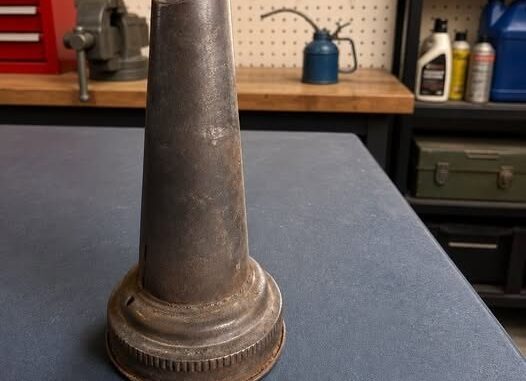
At first glance, this unusual metal object looks as though it came from an old workshop, farm, machine shop, or collection of vintage tools.
Its heavy construction, weathered surface, tapered tube, and broad circular base suggest that it was made for a practical purpose rather than decoration. But identifying an antique object from appearance alone can be difficult, especially when its original equipment is no longer available.
The most likely explanation is that it is some type of funnel, spout, nozzle, or specialized mechanical fitting designed to direct or transfer a material.
Here are some of the clues that can help narrow down its original purpose.
The Long Tapered Tube
The most noticeable feature is the elongated metal tube extending from the base.
Its tapered shape appears designed to guide material toward a narrower opening. Similar designs have been used in equipment intended to move liquids, powders, grain, oil, fuel, and other materials.
However, the shape by itself isn’t enough to establish exactly what the object was used for.
Older manufacturers often created specialized components for particular machines, and several different tools can have surprisingly similar shapes.
Size is one of the most important missing clues.
A small fitting that can be comfortably held in one hand could have belonged to household or workshop equipment. A much larger version might have been associated with agricultural or industrial machinery.
The Wide Circular Base
The circular section at the bottom provides another important clue.
It appears considerably wider and heavier than the tapered tube, and its textured or ridged edge may have helped with handling or attachment.
Depending on the object’s original design, the base could have been intended to:
- Connect to another component
- Provide stability
- Allow the object to be tightened or loosened
- Help secure it to a machine
- Create a broader mounting surface
This feature makes the object look less like an ordinary household funnel and more like a purpose-built component.
If the base contains threads, holes, grooves, or another attachment mechanism, those details could be particularly useful in identifying it.
The Weathered Metal Surface
The dark gray, brown, and black appearance is consistent with an older iron or steel component, although the exact material cannot be confirmed simply from a photograph.
Surface oxidation and discoloration are common on older metal objects that have been exposed to air, moisture, dirt, and repeated handling.
The wear can sometimes provide useful information.
For example, areas that appear smoother or more polished may have experienced repeated contact with hands or another component. Scratches, dents, and worn edges can also indicate how an object was handled or installed.
Importantly, corrosion doesn’t necessarily mean the object was poorly maintained. A working tool could naturally acquire substantial surface wear after years of use.
Could It Have Been Used on a Farm?
Agricultural equipment is one possibility worth considering.
Older farms relied on numerous specialized metal components for transferring liquids, handling grain and feed, maintaining machinery, and performing other routine jobs.
Equipment was also commonly repaired instead of immediately replaced. A broken machine might receive a new fitting or replacement component, allowing individual parts to remain in use for many years.
That means an unusual metal piece found today could potentially be the surviving part of a much larger machine.
Its original equipment may have disappeared long ago.
Could It Have Come From a Workshop?
A workshop or machine shop is another possibility.
Industrial equipment often used metal nozzles, chutes, adapters, fittings, and other components designed to control the movement of materials.
Some of these pieces were manufactured for very specific machines, which can make modern identification challenging.
The object may therefore look familiar without matching any common household tool exactly.
What Would Confirm the Identification?
A photograph provides useful clues, but a definitive identification would require more information.
The most helpful details would include:
Measurements:
Knowing the object’s overall length, diameter, and weight could eliminate many possibilities.
The underside:
The bottom of the circular base may reveal threads, mounting holes, markings, or other features that aren’t visible from the top.
Manufacturer marks:
Numbers, letters, logos, or stamped symbols can sometimes connect an old component to a particular manufacturer or machine.
Interior details:
Examining the inside of the tube may reveal whether it was designed for liquids, powders, grain, or another material.
Additional photographs:
Pictures from the side, bottom, and interior would make comparison with historical tools and machinery much easier.
An Interesting Piece of Everyday History
Even if its exact purpose remains uncertain, the object illustrates how much information can be hidden in an apparently ordinary piece of old metal.
Before modern materials and mass-produced plastic components became widespread, many practical tools and fittings were manufactured from durable metals.
Some were simple household implements. Others were highly specialized parts designed to perform one particular job.
After decades of use, those objects can survive long after the equipment they belonged to has disappeared.
So, What Is It?
Based on its apparent shape and construction, the object could be an old metal funnel, spout, nozzle, or specialized fitting, possibly associated with workshop, agricultural, or industrial equipment.
But it would be misleading to claim an exact identification without seeing additional details such as its dimensions, underside, markings, and connection mechanism.
And that’s what makes old objects like this so interesting.
A seemingly mysterious piece of metal may be the surviving clue to a machine, trade, or everyday task that has largely disappeared from modern life.
Sometimes the smallest surviving parts can tell the biggest stories about how people worked in the past.
Leave a Reply