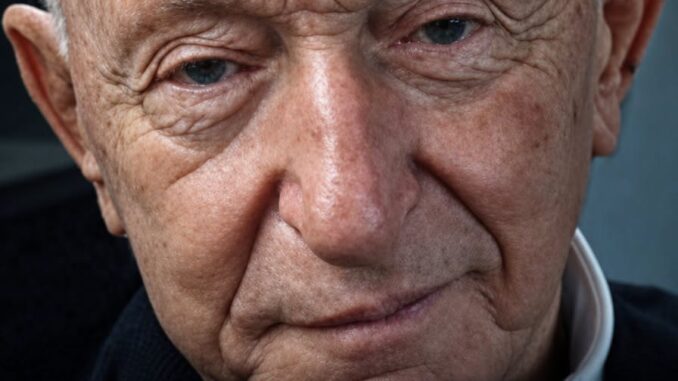
Yehuda Aharon Widawski, who survived the Holocaust and spent much of his later life preserving the memory of Jewish communities destroyed during the Second World War, has died at the age of 107.
Widawski’s life spanned some of the darkest chapters of 20th-century European history and the rebuilding of Jewish life in the decades that followed. Born in 1919 in Turek, Poland, he later moved with his family to Łódź, a major center of Jewish life before the Holocaust. There, he experienced the Nazi persecution that would ultimately destroy much of his family and community.
Yet Widawski’s story did not end with liberation. After surviving forced labor and the Nazi concentration camp system, he returned to Poland, eventually immigrated to Israel, raised a family and devoted decades to preserving the memory of Jews who had been murdered during the Holocaust.
His work restoring Jewish graves became a central part of that mission. Over the years, he helped identify and restore more than 3,000 graves, particularly in Łódź, while traveling throughout Poland to document and protect Jewish burial sites that had been neglected, damaged or destroyed.
For Widawski, preserving those graves was more than an act of historical conservation. It was a way of restoring dignity to people whose lives and identities the Nazis had attempted to erase.
Childhood in Poland
Widawski was born in 1919 in Turek, Poland, only a few years after the First World War. He later lived in Łódź, where he grew up as part of a vibrant Jewish community.
Before the Holocaust, Poland was home to one of the world’s largest Jewish populations. Jewish communities existed throughout the country, with their own synagogues, schools, cultural organizations, businesses and cemeteries. Łódź was one of the most important Jewish centers in Poland.
That world was shattered after Nazi Germany invaded Poland in September 1939.
The German occupation brought increasingly harsh restrictions against Polish Jews. Jewish families were stripped of their property and rights, forced to wear identifying marks and subjected to hunger, forced labor, violence and deportation.
Widawski and his family were eventually forced into the Łódź Ghetto.
Life in the Łódź Ghetto
The Łódź Ghetto was established by the German occupation authorities in 1940. Hundreds of thousands of Jews from Łódź and other areas were confined there over the course of the war.
Conditions were catastrophic. Residents faced overcrowding, inadequate food, disease and forced labor. The ghetto was also used as a source of labor for the German war effort.
For families like the Widawskis, survival became a daily struggle.
The ghetto was eventually liquidated as the Germans intensified their program of deportation and mass murder. In August 1944, Widawski and members of his family were deported to Auschwitz-Birkenau, the largest Nazi concentration and extermination camp complex.
For those arriving at Auschwitz, the journey frequently ended with a selection process in which German authorities determined who would be sent directly to the gas chambers and who might be temporarily spared for forced labor.
Widawski and his brother Yehoshua survived the selection.
Their parents and several siblings did not.
Auschwitz and Forced Labor
Auschwitz-Birkenau became one of the central sites of the Holocaust. More than a million people were murdered there, the overwhelming majority of them Jews.
Widawski and his brother were among those selected for forced labor rather than immediate murder. Their survival, however, did not mean that they escaped the brutality of the Nazi system.
The brothers were later sent to Friedland, where they were forced to work assembling aircraft parts.
The German war machine depended heavily on forced labor, exploiting prisoners and civilians in factories, mines, construction sites and other facilities. For prisoners, working conditions were frequently dangerous and exhausting, while food, medical care and basic necessities were severely limited.
Widawski endured those conditions until the final months of the war.
In May 1945, Soviet forces liberated the camp.
After years of persecution, deportation, forced labor and the loss of much of his family, Widawski was finally free.
Returning to Poland
Liberation did not erase what had happened.
Like many Holocaust survivors, Widawski returned to a country profoundly changed by the war. Millions of Polish citizens had been killed, including approximately three million Polish Jews.
Jewish neighborhoods that had once been filled with families, businesses, religious institutions and cultural life had largely disappeared. Many survivors returned to find that their homes were gone or occupied by others and that relatives, friends and entire communities had been murdered.
Widawski returned to Łódź after the war. He married and began rebuilding his life.
In 1950, he and his family immigrated to Israel and settled in Tel Aviv.
There, he built a new life in the Jewish state, thousands of miles from the places where he had endured Nazi persecution.
But Poland remained part of his memory.
Decades later, that connection would lead him back.
A Search for a Grandmother’s Grave
In 1978, Widawski returned to Poland to search for his grandmother’s grave.
What he encountered during that journey had a profound impact on him.
Jewish cemeteries across Poland had been neglected, damaged and, in some cases, destroyed. The Nazi destruction of Jewish communities had been followed in many places by decades during which Jewish burial grounds received little care.
For Widawski, the condition of those cemeteries represented another form of disappearance.
The people buried there had names, families and histories. Their gravestones were physical evidence that Jewish communities had existed for generations before the Holocaust. When graves were abandoned or destroyed, an important connection to that history was lost.
Widawski decided to do something about it.
What began as a personal search became a decades-long mission.
Preserving the Dead and Remembering the Living
Widawski devoted himself to identifying and restoring Jewish graves throughout Poland.
He helped locate burial sites, identify graves and preserve cemeteries that had been neglected or damaged. His work focused particularly on Łódź, the city where he had lived before the war, but his efforts extended beyond it.
Over the course of his work, he helped identify and restore more than 3,000 graves.
The scale of that work was significant, but the meaning of each grave was personal.
A gravestone could preserve a person’s name when almost everything else about their life had been destroyed. A cemetery could establish the existence of a community that had been almost completely wiped out.
For a Holocaust survivor, this work also carried a deeply symbolic message.
The Nazis sought not only to murder Jews but to destroy the traces of their existence. Preserving cemeteries and restoring names helped counter that attempt at erasure.
Widawski’s work therefore connected two generations: those who had been murdered and those who survived to remember them.
A Message of Survival
Widawski’s own survival gave particular meaning to his efforts.
He had lost his parents and several siblings. He had witnessed the destruction of his community and endured imprisonment and forced labor. Yet he went on to marry, raise a family and establish a life in Israel.
His story was not simply one of surviving the Holocaust. It was also one of rebuilding after it.
In 2012, Widawski was chosen to light a torch at Israel’s official Holocaust Remembrance Day ceremony at Yad Vashem, Israel’s Holocaust remembrance center in Jerusalem.
The honor recognized both his survival and his decades of work preserving Jewish memory.
At the ceremony, he articulated what he considered his response to the Nazis: they had lost. His people were free, he said, and they would not be destroyed again.
The statement captured the central theme of his life.
The Nazis had attempted to eliminate Jewish communities from Europe. Widawski responded by building a family, living in Israel and dedicating himself to ensuring that the people who had been murdered would not disappear from history.
Memory as a Form of Resistance
Widawski’s work also illustrates the importance of memory in the decades following the Holocaust.
For survivors, remembering could be painful. Many carried memories of relatives and friends who had been murdered and of communities that could never be rebuilt in their original form.
But remembrance also became a way of resisting silence.
The preservation of names, photographs, documents, cemeteries and personal stories has helped historians and later generations understand the human scale of the Holocaust. Every grave restored represents an individual who lived, belonged to a family and formed part of a community.
That perspective was especially important in Poland, where the physical traces of Jewish life had been devastated.
Cemeteries offered tangible evidence of that history.
By restoring graves, Widawski helped ensure that visitors and future generations could still encounter the names of people who lived before the Holocaust.
His work also served as a reminder that Jewish history in Poland did not begin with the Holocaust. Jewish communities had existed there for centuries, developing religious, cultural and economic traditions that became an important part of Polish history.
A Life of Rebuilding
Widawski’s death at 107 marks the passing of someone whose life connected several generations of history.
He was born into a Jewish Poland that was later destroyed by Nazi Germany. He survived the Łódź Ghetto, Auschwitz-Birkenau and forced labor. He lost his parents and several siblings but survived alongside his brother Yehoshua.
After the war, he returned to Łódź, married and started a family. In 1950, he immigrated to Israel and settled in Tel Aviv.
Decades later, he returned to Poland not simply to revisit the places of his youth but to search for a grave.
That search became a calling.
Instead of allowing the destruction he encountered to become another forgotten chapter of history, he spent years working to restore Jewish graves and preserve evidence of communities that had been devastated by the Holocaust.
President Isaac Herzog praised Widawski’s decades of work locating and restoring Jewish graves, describing his life as a testament to survival, memory and rebuilding.
Those three words capture the arc of his life.
Survival was the foundation. Widawski endured persecution and imprisonment when millions of others did not.
Memory became his mission. He devoted decades to ensuring that the people who had been murdered would continue to be remembered by name.
And rebuilding became his answer to the destruction he had witnessed. He created a family, built a life in Israel and helped restore the physical remnants of Jewish communities in Poland.
Remembering Yehuda Aharon Widawski
Holocaust survivors are now disappearing with the passage of time. Each death marks the loss of a direct witness to one of the defining tragedies of modern history.
Widawski’s life, however, left behind more than testimony.
He left behind restored graves, preserved names and a record of determination to ensure that Jewish history would not be erased.
His journey from Turek and Łódź through the Holocaust, liberation, immigration to Israel and decades of preservation work demonstrates how a life can become intertwined with the responsibility to remember others.
The graves he helped restore will remain after him.
So will the names.
And so will the message that shaped his life: the attempt to destroy a people did not succeed.
At 107, Yehuda Aharon Widawski died as one of the last links to a generation that experienced the Holocaust firsthand. But through his work, he helped make sure that the people who did not survive would continue to have a place in the historical record.
His life was a story of loss, survival and rebuilding—and, above all, of refusing to let memory disappear.
Leave a Reply