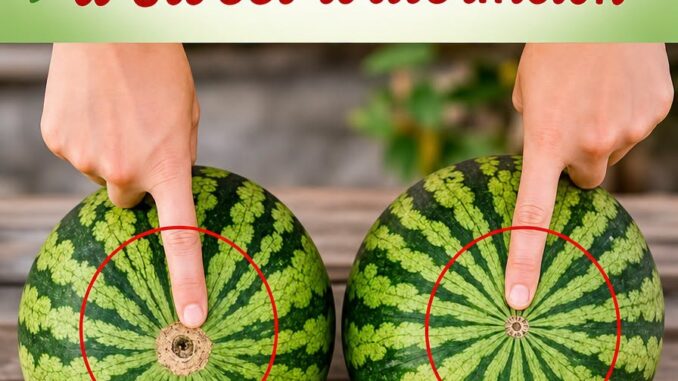
Choosing the wrong watermelon can ruin the whole experience.
You carry that enormous green melon home, clear a space on the kitchen counter, grab your biggest knife, and slice into it expecting a burst of deep red, juicy sweetness. Instead, you find pale flesh, a disappointing texture, and a flavor that seems to have forgotten what watermelon is supposed to taste like.
It happens.
Watermelons can look nearly identical from the outside while tasting dramatically different on the inside. Since you usually can’t cut one open at the grocery store or farmers market before buying it, choosing a good melon requires paying attention to a few clues on the outside.
The good news is that you don’t need special equipment or expert produce knowledge. A few seconds of observation—and sometimes a little lifting—can significantly improve your chances of bringing home a sweet, ripe, juicy watermelon.
No single trick guarantees perfection every time, but several clues used together can give you a much better idea of what you’re buying.
Here are the signs worth checking before you put that watermelon in your cart.
1. Look for a Creamy Yellow Field Spot
One of the most useful clues is hiding on the bottom of the watermelon.
Turn the melon over and look for the large discolored patch where it rested against the ground while it was growing. This is commonly called the field spot or ground spot.
Because that portion of the watermelon wasn’t exposed to sunlight in the same way as the rest of the rind, it develops a different color.
Look for a creamy yellow, yellow-orange, or golden-yellow patch.
A well-developed yellow field spot can be a useful indication that the watermelon spent enough time developing before harvest. The exact shade can vary depending on the variety and growing conditions, so you don’t need to search for one specific color.
What you generally want to avoid is a field spot that is extremely pale or nearly white when other melons have noticeably richer yellow spots.
The field spot isn’t a guarantee of sweetness, but it is one of the easiest visual clues available to shoppers.
And because you don’t need to squeeze, tap, or otherwise manipulate the fruit, it’s also one of the simplest.
2. Pick It Up and Compare the Weight
Here’s one of the easiest tests—and one of the most useful.
Pick up the watermelon.
Then pick up another watermelon that appears to be roughly the same size.
Which one feels heavier?
The heavier melon is often the better bet.
Watermelons contain a lot of water, so weight can give you a rough indication of how much moisture is packed inside. A watermelon that feels surprisingly heavy for its size may have a dense, juicy interior.
You don’t need to know the exact weight.
This is a comparison test.
If you’re choosing between several similarly sized melons, lift a few of them. You may be surprised by how different they feel.
The heavier one isn’t automatically sweeter, but weight combined with other signs can help you narrow down the best choice.
This trick is particularly useful because it doesn’t depend on appearance alone. A beautiful watermelon can still be disappointing inside, while a less impressive-looking melon can be fantastic.
Let your hands provide some information too.
3. Examine the Rind for Damage
Before buying a watermelon, give the rind a quick inspection.
You want the exterior to feel firm and intact.
Avoid melons with large cracks, deep cuts, significant bruises, soft spots, leaking areas, or other obvious damage. A few superficial marks aren’t necessarily a problem, especially because watermelons can pick up minor scratches during growing and transportation.
What matters is the condition of the fruit overall.
If one area feels noticeably soft compared with the rest of the melon, pay attention. Significant softness can indicate damage, deterioration, or an interior that isn’t in ideal condition.
Deep cracks are also worth avoiding.
The rind is the fruit’s protective exterior, so substantial damage can create opportunities for spoilage and make the melon more vulnerable to handling problems.
A good watermelon should generally feel solid and firm when you gently press it.
Don’t squeeze it aggressively. You’re not trying to test whether it can survive a stress test.
A gentle check is enough.
4. Look at the Stem
If the watermelon still has a portion of its stem attached, take a look at it.
A dry, brownish, or somewhat shriveled stem can be a useful indication that the fruit was mature when harvested.
A bright green stem may suggest that the watermelon was harvested earlier in its development.
The stem isn’t a perfect indicator because appearance can change during transportation and storage, and not every watermelon will have an intact stem.
Still, when it’s available, it’s another clue you can add to the others.
Think of watermelon selection as detective work.
You’re collecting evidence.
The field spot tells you one thing. The weight tells you another. The rind provides another clue. The stem adds one more piece of information.
No single clue needs to carry the entire decision.
5. Don’t Be Afraid of a Dull Rind
Many shoppers instinctively reach for the watermelon that looks the most shiny, smooth, and vibrant.
That isn’t necessarily the best strategy.
A mature watermelon can have a somewhat dull or less glossy appearance. As the fruit develops, the rind can lose some of its bright sheen.
Again, this isn’t a guarantee.
Different varieties can look different, and lighting in grocery stores can make the rind appear more or less glossy than it really is.
But if you’re comparing two similar melons, a slightly duller, more mature-looking rind can be one additional clue to consider.
Don’t reject a watermelon simply because it doesn’t look polished.
You’re buying fruit, not a car.
6. Pay Attention to the Shape
Take a look at the overall shape of the watermelon.
Depending on the variety, a good melon may be round, oval, elongated, or somewhere in between. There isn’t one universally correct shape.
What you want is a watermelon that looks reasonably symmetrical and well developed.
Extreme irregularities, large dents, or unusual deformities may indicate that the fruit experienced inconsistent growing conditions or physical damage.
That doesn’t automatically make a watermelon bad.
It simply gives you another reason to compare it with the melons around it.
If one watermelon has a relatively uniform shape while another has obvious irregularities and bruising, the more intact fruit may be the safer choice.
7. Don’t Obsess Over the “Thump” Test
You’ve probably heard that you should knock on a watermelon and listen for a deep, hollow sound.
This is one of the most famous watermelon-selection tricks, but it’s also one of the least straightforward.
People interpret the sound differently, and there is plenty of disagreement about exactly what a “good” watermelon is supposed to sound like.
Some shoppers swear by the technique.
Others find it difficult to distinguish one melon from another.
If you enjoy using the thump test, there’s no reason to stop. Just don’t make it your only method.
A watermelon that sounds good but has a poor field spot, significant damage, and feels unusually light isn’t suddenly a great choice because it made the right noise.
Use sound as a secondary clue.
The field spot, weight, firmness, appearance, and overall condition are more useful when considered together.
8. Compare Several Watermelons
One of the biggest mistakes shoppers make is examining one watermelon and trying to decide whether it’s good in isolation.
Instead, compare.
Look at several melons in the same display.
Which ones have the strongest yellow field spots?
Which ones feel heavier?
Which ones have the most intact rinds?
Which ones have fewer bruises and soft areas?
Which ones look mature rather than unusually pale or glossy?
Once you start comparing, differences that weren’t obvious at first can become much easier to see.
You don’t need to inspect every watermelon in the store.
Just comparing three or four can be enough to make the selection process more informed.
9. Consider the Season
Where and when you buy a watermelon can also influence your chances of getting a good one.
Watermelons are generally associated with warm-weather growing seasons, although modern agriculture and global distribution mean they’re available in many places for much of the year.
During peak local watermelon season, you may have access to fruit that has been harvested relatively close to where it was grown.
Farmers markets and local produce stands can sometimes provide additional information about where the melons came from and when they were harvested.
That doesn’t mean grocery-store watermelon is inferior.
It simply means seasonality can affect availability, freshness, and variety.
If watermelon is particularly important to you, learning when it is at its peak in your region can make a noticeable difference.
10. Don’t Judge Sweetness by Size Alone
It’s tempting to assume that the biggest watermelon must be the sweetest.
That’s not necessarily true.
Size and sweetness aren’t the same thing.
A smaller watermelon can be exceptionally flavorful, while a giant one can be disappointing. Different varieties naturally grow to different sizes, and growing conditions also influence fruit development.
Instead of automatically choosing the biggest melon, choose one that combines the other desirable characteristics.
If two melons are similar in quality and one is larger, go ahead and choose the larger one if you want more fruit.
But don’t assume size itself is proof of sweetness.
Why Is Choosing a Good Watermelon So Difficult?
Watermelon is a particularly challenging fruit for consumers because most of the information we care about is hidden inside.
You can’t easily determine sweetness by looking at the exterior.
You can’t smell the flesh through an intact rind the way you can with some other fruits.
You can’t squeeze it like a peach.
And unless you’re willing to buy the entire thing, cut it open, and accept the consequences, you can’t taste it before purchasing.
That’s why shoppers have developed so many selection techniques over the years.
Some are useful.
Some are questionable.
Most work best when combined rather than treated as guaranteed formulas.
The goal isn’t to find a magical trick that predicts the exact flavor of a watermelon.
The goal is to improve the odds.
What If You Buy a Bad Watermelon?
Even with all these tricks, you can still occasionally choose a disappointing watermelon.
That’s simply part of buying produce.
Agricultural products aren’t perfectly predictable. Growing conditions, variety, harvesting time, transportation, and storage can all influence the final fruit.
If you cut open a watermelon and find pale flesh or a less-than-sweet flavor, there are still ways to use it.
You can add it to a fruit salad, blend it into a smoothie, freeze pieces for later, or combine it with other strongly flavored ingredients.
But ideally, a few seconds of careful selection can prevent the disappointment in the first place.
How to Store Your Watermelon
Once you’ve picked the right watermelon, storage matters too.
An intact watermelon can generally be kept at room temperature for a period of time, particularly if you’re planning to eat it soon. Once you cut it, however, refrigeration becomes important.
After slicing, place the pieces in a clean, covered container or wrap them appropriately and refrigerate them.
Cut watermelon is perishable, so don’t leave it sitting at room temperature for extended periods.
For the best flavor, many people prefer watermelon chilled.
There’s something particularly satisfying about biting into a cold slice on a hot day. The fruit’s natural sweetness and high water content make it an ideal warm-weather snack.
Should You Wash the Watermelon Before Cutting It?
Yes, washing the outside before cutting is a sensible food-safety habit.
Even though you’re not eating the rind, your knife can transfer dirt or microorganisms from the outside surface into the flesh as it cuts through.
Rinse the whole watermelon under running water and gently rub the exterior with clean hands. You don’t need to use soap or household cleaning products.
Once the outside is clean, dry it if necessary and then cut it with a clean knife on a clean surface.
This simple step can help reduce the chance of transferring unwanted material from the rind to the edible interior.
The Best Strategy Is to Combine Clues
If there’s one thing to remember, it’s this: don’t rely on a single watermelon myth.
Instead, combine several observations.
Look for a creamy yellow or golden field spot.
Pick up the watermelon and compare its weight with other melons of similar size.
Check the rind for deep bruises, cracks, cuts, and soft areas.
If a stem is present, look for one that appears dry rather than bright green.
Consider the overall shape and appearance.
Don’t automatically reject a melon simply because its rind looks dull.
And if you like the traditional thumping technique, use it as an extra clue rather than the deciding factor.
Together, these observations can give you a much better chance of selecting a watermelon that is ripe, juicy, and flavorful.
The Final Test Happens at Home
Eventually, of course, there is only one way to know for sure.
You have to cut it open.
That’s when you finally discover whether your careful inspection paid off.
The knife slides through the rind. The interior opens up. Ideally, you’re greeted by vibrant red or pink flesh, a fresh aroma, and plenty of juice.
Then comes the first bite.
If you’ve chosen well, the texture should be crisp and juicy, with enough sweetness to make you immediately understand why watermelon is such a popular summer fruit.
And if it’s not perfect?
Don’t worry.
Next time, you have more information.
The important thing is that choosing a watermelon doesn’t have to be a complete guessing game. The fruit may keep its secrets beneath a thick green rind, but it still leaves clues on the surface.
So the next time you’re standing in front of a pile of watermelons at the grocery store, don’t simply grab the biggest one or the one that looks prettiest.
Take a few seconds.
Check the field spot.
Lift it.
Feel the rind.
Look for damage.
Inspect the stem if it’s still attached.
Compare it with the melons around it.
Those few extra moments could be the difference between bringing home an ordinary watermelon and finding one that is sweet, crisp, and ridiculously juicy.
And when you finally cut it open and take that first cold, refreshing bite, you’ll know the selection process was worth it.
Leave a Reply