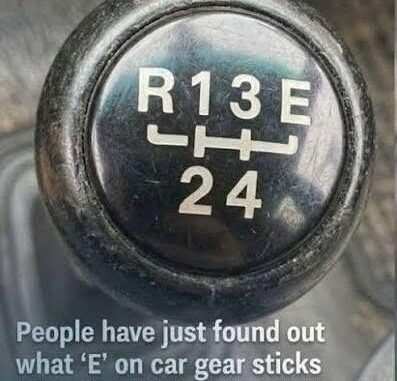
If you’ve ever looked inside an older car, you may have noticed something unusual on the gear selector.
Alongside the familiar P, R, N and D, there might be another letter that seems completely out of place:
E.
For drivers who grew up with modern vehicles, the letter can be confusing.
Does it stand for Electric? Emergency? Engine?
In some older vehicles, the answer was much simpler.
E could indicate an Economy setting designed to favor fuel efficiency over performance.
The feature is a fascinating reminder of how automakers were trying to improve fuel economy decades before modern cars introduced sophisticated electronic driving modes.
What Did the “E” Setting Do?
The exact function depended on the vehicle, transmission and manufacturer, but an Economy setting generally changed the way the automatic transmission behaved.
Instead of prioritizing quick acceleration, the system could encourage earlier gear changes and lower engine speeds.
The basic idea was straightforward:
-
Keep engine RPM relatively low.
-
Encourage more economical driving.
-
Reduce unnecessary high-revving.
-
Give fuel efficiency greater priority than rapid acceleration.
The trade-off was that the vehicle could feel less responsive.
When you pressed the accelerator, the transmission might not hold a lower gear as readily as it would in its normal driving setting.
For drivers trying to conserve fuel, however, that could be a worthwhile compromise.
Why Fuel Economy Became So Important
To understand why features like this appeared, it helps to look at the automotive industry of the 1970s.
The oil shocks of the decade dramatically changed the way consumers and manufacturers thought about fuel.
Fuel prices became a major concern, and motorists in some areas experienced long lines at gas stations.
Large, powerful vehicles that had once been popular suddenly faced a new challenge.
Drivers wanted better mileage.
Automakers responded in numerous ways.
They developed smaller engines, improved transmissions, adopted more efficient fuel systems and experimented with different methods of reducing fuel consumption.
Economy-oriented transmission settings were part of that broader effort.
How Economy Settings Could Change Driving
A traditional automatic transmission had to balance several competing priorities.
Drivers wanted smooth shifts, reasonable fuel consumption and enough power when accelerating.
An Economy setting could shift that balance toward efficiency.
Depending on the vehicle, selecting the setting could encourage the transmission to shift at lower engine speeds or use higher gears during appropriate driving conditions.
The result could be a calmer driving experience, particularly during steady cruising.
However, that didn’t mean the car suddenly became dramatically more fuel-efficient.
The effect varied from one vehicle to another, and the driver, road conditions, engine and transmission all influenced actual fuel consumption.
Why the Car Might Feel Slower
There was a reason some drivers preferred the normal Drive setting.
Imagine you’re trying to accelerate quickly.
A transmission programmed with performance in mind may keep the engine in a lower gear for longer, allowing it to build more power before shifting.
An Economy setting may be more eager to move into a higher gear.
That can reduce engine speed and potentially improve efficiency, but it can also make acceleration feel less immediate.
For relaxed cruising, that might be perfectly acceptable.
For climbing a steep hill or accelerating onto a busy road, drivers might prefer the standard setting.
The Influence of the 1970s and 1980s
The push for greater efficiency didn’t result in just one technology.
During this period, the automotive industry was experimenting with a wide range of ideas.
Overdrive transmissions became increasingly important.
Engines became more efficient.
Fuel-delivery systems improved.
Vehicle designs began changing.
Manufacturers also developed different transmission strategies to help drivers get more distance from each gallon of fuel.
Some vehicles used letters or buttons associated with economy driving, while others used different terminology.
That’s why it’s important not to assume that every vintage car with an “E” had exactly the same system.
The owner’s manual is usually the best source for determining what a particular selector position actually did.
Why Did the “E” Setting Eventually Disappear?
As automotive technology advanced, transmission control became increasingly sophisticated.
Electronic controls allowed a vehicle to monitor factors such as speed, throttle input and engine conditions and adjust transmission behavior automatically.
Drivers didn’t necessarily need a dedicated Economy position anymore.
The vehicle could make many of those decisions itself.
At the same time, other improvements were transforming everyday driving.
Fuel injection became widespread.
Automatic transmissions gained more gears.
Electronic engine management became increasingly capable.
Overdrive became common in many vehicles.
Together, these developments reduced the need for some of the simpler economy-focused controls found on older cars.
The Funny Thing Is: Eco Mode Came Back
Although the old-style Economy setting became less common, the basic idea never disappeared.
In fact, modern vehicles have brought the concept back in a much more sophisticated form.
Today, many cars offer an Eco or Economy driving mode.
Instead of relying on a simple mechanical or early electronic strategy, modern systems can coordinate multiple vehicle functions.
Depending on the model, an Eco setting may influence:
-
Throttle response
-
Transmission shift behavior
-
Climate-control operation
-
Cruise-control strategy
-
Hybrid power management
-
Regenerative braking
The technology is considerably more advanced than it was decades ago.
But the philosophy remains familiar:
Use the vehicle’s systems in a way that prioritizes efficiency.
Other Old Gear-Selector Letters
The “E” isn’t the only transmission marking that can confuse modern drivers.
Older vehicles sometimes featured selector positions that aren’t immediately familiar today.
For example, you might encounter:
-
L: Often used to keep the transmission in lower gears.
-
2: Could limit the transmission to lower gears, depending on the vehicle.
-
1: Typically provided an even lower gear range.
-
S: Often associated with sportier transmission behavior.
-
O/D: Usually referred to overdrive.
-
M: On some newer vehicles, allows manual gear selection.
However, the meaning of a particular letter or position can vary between vehicles.
A symbol on an old gear selector shouldn’t be interpreted solely based on what the same letter means in a modern car.
Should You Use an Economy Setting Today?
If you own an older vehicle with an Economy setting, the best approach is to follow the manufacturer’s instructions.
In general, an economy-oriented setting was intended for situations where smooth, relaxed driving was more important than maximum responsiveness.
Steady cruising on relatively flat roads could be a natural use case.
Situations requiring stronger acceleration might call for a different setting, depending on the vehicle.
The important thing is that there is no universal rule for every car.
Vintage transmissions can operate very differently from one another, so the owner’s manual is your best guide.
Why Young Drivers Find These Features Fascinating
A generation accustomed to digital dashboards, touchscreen controls and selectable driving modes may find an old gear selector surprisingly interesting.
The controls tell a story about the problems engineers were trying to solve at the time.
A letter such as “E” wasn’t necessarily a mysterious secret feature.
It was often an example of engineers trying to give drivers another way to balance performance and efficiency.
Today, we accomplish many of the same goals with computers and sensors.
Back then, the solutions could be considerably simpler.
Leave a Reply