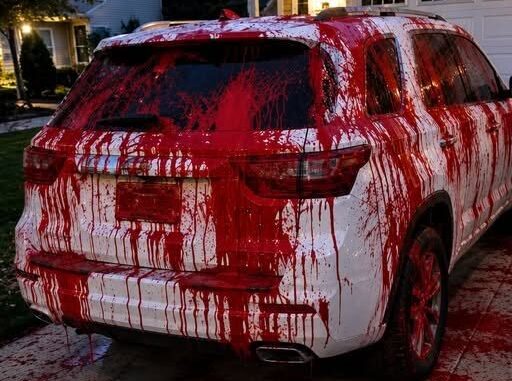
At exactly 2:13 that morning, a loud metallic crash outside my bedroom window pulled me out of sleep.
At first, I was annoyed.
Then I looked outside.
Linda was running across my yard.
She disappeared toward her house before I could fully understand what I had just seen. I threw on a robe, hurried downstairs, and stepped outside.
An empty bucket sat beside my SUV.
Red paint covered the hood, windshield, driver’s-side door, and part of the rear quarter panel.
For a few seconds, I simply stared at it.
Then, strangely enough, I laughed.
The whole thing was so ridiculous that my brain didn’t seem to know how else to react.
Linda and I had been fighting over my driveway for nearly six months.
The narrow strip beside my garage legally belonged to me. It was clearly inside my property line, and I used it whenever I needed to park my SUV outside the garage.
Linda had apparently decided that it was basically a shared parking space.
Whenever she had guests, she’d use it.
Sometimes her adult son, Tyler, would leave his truck there.
Once, I even came home to find a landscaper Linda had hired using the space to unload equipment.
At first, I tried to keep things civil.
“Linda, would you mind moving your car?”
She would sigh.
“You aren’t even parking inside your garage.”
“That isn’t the point.”
“Then what is the point?”
“It’s my driveway.”
That never seemed to satisfy her.
Eventually, I put up a small sign near the property line.
PRIVATE DRIVEWAY.
Linda looked at it and laughed.
“You’re being ridiculous.”
“I’ve asked you six times.”
“You have plenty of room.”
“So do you.”
She did.
Her own driveway was actually much larger than mine.
That was what made the entire argument so frustrating.
It wasn’t about space.
It was about Linda believing she could use whatever she wanted simply because nobody had stopped her before.
Then, the previous week, I finally stopped asking.
I came home from work and found her SUV parked beside my garage again.
Linda wasn’t around.
So I called a towing company.
Forty minutes later, her SUV was gone.
About an hour after that, she came back.
I heard her yelling before I even saw her.
“What did you do?”
I stepped outside.
“I had your car towed.”
Her face turned bright red.
“You actually towed my car?”
“It was illegally parked on my property.”
“You could have called me!”
“I’ve called you plenty of times.”
“I mean today!”
“I didn’t know where you were.”
She pointed a finger at me.
“You’re going to regret this.”
At the time, I thought it was just an angry neighbor making an empty threat.
Six nights later, I woke up to that metallic crash.
And Linda was running away from my SUV.
I didn’t have security cameras pointed at the driveway.
There were no witnesses.
All I had was what I’d seen through my upstairs window.
So I took pictures.
Lots of them.
I photographed the paint, the empty bucket, the damage—everything.
I planned to call the police when the station opened. There wasn’t much point in expecting an immediate response at 2:30 in the morning unless the person responsible was still standing outside.
But by 7:20, I didn’t need to call them.
Someone was pounding on my front door.
I assumed Linda had come over to argue.
Instead, when I opened the door, I saw three police cars parked outside her house.
Two officers were moving in and out of her garage.
Linda stood barefoot on her lawn in pink pajamas, screaming.
“I didn’t commit any crime!”
I stepped onto my porch.
One of the officers noticed me and walked toward my SUV.
“Ma’am, is this your vehicle?”
“Yes.”
He studied the red paint.
“Don’t wash it.”
“I wasn’t planning to.”
“Good.”
I looked toward Linda’s house.
“Why are you searching her property?”
He glanced back at the garage.
“That’s a separate matter.”
Before I could ask anything else, another officer came out carrying a half-empty can of red paint.
It was the exact same color covering my SUV.
I laughed under my breath.
“Well, I guess that’s pretty definitive.”
Neither officer smiled.
Instead, one of them looked at the paint.
Then at my SUV.
Then back at the paint.
“This isn’t about your car,” he said.
I frowned.
“What isn’t?”
He ignored the question.
The senior officer walked around the rear of my SUV.
“When did you buy this?”
“About three years ago.”
“New?”
“No. Used.”
“Where?”
“A dealership off Route 8.”
He kept walking.
Then he stopped.
Something had caught his attention.
The red paint had reacted with the SUV’s finish, dissolving part of the newer white paint underneath.
I hadn’t noticed it in the darkness.
But beneath the newer coat was another layer of white.
And beneath that were markings.
Letters.
Numbers.
The officer crouched down.
He wiped away some grime with a small cloth.
More markings appeared.
Two letters.
A number.
Then part of another marking near an old repair seam.
His entire expression changed.
He immediately reached for his radio.
“Get her away from the vehicle.”
My stomach dropped.
“What?”
The younger officer stepped toward me.
“Ma’am, please step back.”
“Why?”
“Just step back.”
I did.
The senior officer spoke quietly into his radio.
Then I heard him mention something that made no sense to me at the time.
A cold case.
I stared at him.
“What is happening?”
He looked at me.
“What’s your name?”
“Claire.”
“Claire, have you ever had bodywork done on this vehicle?”
“No.”
“Repainted?”
“Not since I bought it.”
“Do you still have the original purchase documents?”
“I think so.”
“Go get them. And don’t touch or move the vehicle.”
I hurried inside.
My hands were shaking as I searched through the filing cabinet.
I found the bill of sale, dealership documents, financing paperwork, and a copy of the title.
When I returned outside, more police cars had arrived.
Linda had stopped yelling.
She stood near her porch with her arms crossed, looking terrified.
I handed the folder to the senior officer.
He introduced himself as Detective Harris.
He went through the paperwork carefully.
Then he looked up.
“Is the dealership still operating?”
“Yes.”
He nodded.
“There’s something I need to explain.”
Six years earlier, a nine-year-old boy named Caleb had been struck and killed while crossing a residential street about fifteen miles away.
The driver never stopped.
Police had recovered traffic-camera footage from two intersections away, but it was nighttime and the footage was poor.
Still, investigators had been able to identify a white SUV that appeared to match the vehicle involved.
There had also been a partial commercial fleet marking on the rear panel.
Harris pointed toward the markings that had just been exposed on my SUV.
“We believe this could be that vehicle.”
I stared at him.
“You’re saying my car was involved?”
“We’re saying there’s a strong possibility.”
The damage underneath the paint matched the area investigators believed had been struck during the collision.
The old markings appeared consistent with a commercial fleet logo seen in the original footage.
Harris had been the lead investigator on the case.
For six years, they had searched dealerships, repair shops, salvage yards, and other businesses.
Nothing.
Until now.
“If someone repainted the vehicle and altered the paperwork,” Harris explained, “that could explain why it disappeared from the investigation.”
I looked at my SUV.
I’d driven that vehicle everywhere.
To work.
To the grocery store.
On vacations.
I’d washed it.
Vacuumed it.
Changed the tires.
Complained about its gas mileage.
And all that time, it might have been connected to a child’s death.
I felt sick.
“Am I in trouble?”
Harris immediately shook his head.
“Not based on what you’ve told us.”
“I bought it legally.”
“We’ll verify everything.”
Then I remembered Linda.
“What about her?”
Harris looked toward her house.
“Her son was arrested last night.”
“Tyler?”
“Yes.”
“For what?”
“Stolen property.”
Apparently, Tyler worked at a large construction site nearby.
For months, expensive materials had been disappearing—copper wiring, specialty cables, metal fittings, and other equipment worth thousands of dollars.
Police had been watching him.
He was eventually caught trying to sell some of the stolen material.
After his arrest, he confessed.
He told police the rest of the stolen goods were inside Linda’s garage.
That’s why the officers had arrived before I ever reported the paint.
They already had a search warrant.
Inside Linda’s garage, they found the stolen materials.
And the can of red paint.
The same color now covering my SUV.
“So she really did it,” I said.
Harris looked at the paint.
“Laboratory testing will confirm it, but it appears that way.”
Linda was arrested later that morning for vandalism.
Tyler was already in custody.
And my SUV was taken away on a flatbed.
Not because I had done anything wrong.
Because it had suddenly become important evidence.
The strangest part was looking at my empty driveway afterward.
By noon, Linda’s property was quiet.
And I was sitting at my kitchen table trying to understand how a stupid argument over a parking space had turned into something connected to a six-year-old child’s death.
The investigation continued for weeks.
Detectives questioned me twice.
They contacted the dealership.
At first, the dealership owner insisted there was nothing unusual about the vehicle’s history.
Then investigators subpoenaed older sales records.
That’s when things became much darker.
The SUV had entered the dealership’s inventory shortly after Caleb’s death.
The previous owner had sold it for a fraction of its value in a quick cash transaction.
The dealership records described it as having “cosmetic body damage.”
But investigators discovered that the damage had actually involved structural repairs and a complete repaint of the rear quarter panel.
Then Harris called me.
“We found the previous owner.”
His name was Darren.
He had owned the SUV six years earlier.
He also had ties to a contracting company that used commercial fleet markings on its vehicles.
The markings beneath my SUV’s paint matched that company’s branding.
Even more disturbing, the old repair marks lined up with the area investigators believed had struck Caleb.
Then came the breakthrough.
After being questioned, Darren confessed.
He had been driving the SUV that night.
He claimed Caleb suddenly ran into the road.
Darren panicked.
Instead of stopping, he kept driving.
He told himself he would report the accident later.
He never did.
Instead, he hid the SUV on a friend’s rural property.
Weeks later, he sold it to a dealer known for buying damaged vehicles cheaply and asking few questions.
The dealer repaired the damaged panel and repainted the vehicle.
The paperwork was altered enough to make the SUV appear ordinary.
Years later, I bought it.
When Harris told me everything, I started crying.
I had never met Caleb.
I didn’t know his parents.
But hearing what happened still broke something inside me.
A nine-year-old boy had died.
His parents had spent six years not knowing who was responsible.
And the answer had been sitting in my driveway.
Harris told me Caleb’s parents had been informed before Darren’s arrest became public.
“They finally have the truth,” he said.
I asked him whether knowing would make things easier.
He paused.
“Not nearly enough.”
He was right.
Nothing could bring Caleb back.
But the uncertainty had been its own kind of suffering.
At least now they had an answer.
There would be charges.
There would be a courtroom.
There would finally be accountability.
The dealership was also investigated for problems involving vehicle titles and repair records.
Because I had bought the SUV in good faith, my attorney helped me pursue compensation.
Eventually, a settlement was reached.
The SUV never came back to me.
It remained in police custody as evidence and later became part of the trial.
Honestly, I didn’t want it anymore.
The idea of sitting behind that steering wheel again made me sick.
Linda eventually pleaded guilty to vandalism.
She received fines, restitution, and community service.
Tyler faced much more serious consequences for the stolen construction materials and eventually served time in prison.
Linda blamed almost everyone for what happened.
The police.
His employer.
Other people she claimed had influenced him.
At one point, she even blamed me.
I never understood that part.
She never parked in my driveway again, though.
Mostly because she barely spoke to me after everything happened.
I was perfectly fine with that.
About eight months later, I ran into Detective Harris at a grocery store.
He recognized me.
“Claire.”
“Detective.”
We stood there awkwardly beside a display of canned soup.
Eventually, I asked the question I’d been afraid to ask.
“How is Caleb’s family?”
Harris paused.
“They’re doing as well as they can.”
“Was there a conviction?”
“Yes.”
Darren accepted criminal responsibility as part of a plea agreement and was sentenced.
Caleb’s parents gave victim-impact statements.
I swallowed.
“I hope it gave them some peace.”
Harris looked at me.
“His mother said something after the hearing.”
“What?”
“She said she could finally stop looking at every white SUV driving down the highway.”
Those words stayed with me.
I imagined her doing exactly that for six years.
Watching traffic.
Looking for clues.
Wondering whether one of those vehicles held the answer.
When I got home, I cried again.
Eventually, I bought another car.
Nothing expensive.
Nothing impressive.
Just a simple gray sedan with good fuel economy.
The salesman tried several times to convince me to upgrade.
Leather seats.
A stronger engine.
More technology.
I said no every time.
I wanted ordinary.
After everything that had happened, ordinary felt wonderful.
I still live in the same house.
Linda is still my neighbor.
Now, when we pass each other, we mostly exchange a brief nod.
My driveway is still mine.
Sometimes I think about how strange the entire chain of events was.
If Linda hadn’t parked in my driveway, I never would have called the tow company.
If I hadn’t called the tow company, she might never have become angry enough to vandalize my SUV.
If she had used a different kind of paint, the hidden layer underneath might never have been exposed.
And if those markings had remained hidden, Darren might still be walking free.
None of that excuses what Linda did.
She destroyed my property out of anger.
But sometimes consequences travel in directions nobody expects.
Linda thought she was ruining my week.
Instead, her actions exposed hidden evidence connected to a six-year-old child’s death.
I lost my SUV.
The dealership had to compensate me.
Linda was ordered to perform community service.
Tyler went to prison.
Darren finally faced the consequences of what he had done.
And Caleb’s parents finally received the answer they had been waiting six years to hear.
All because of one bucket of red paint.
Even now, I still have trouble believing it happened that way.
Leave a Reply