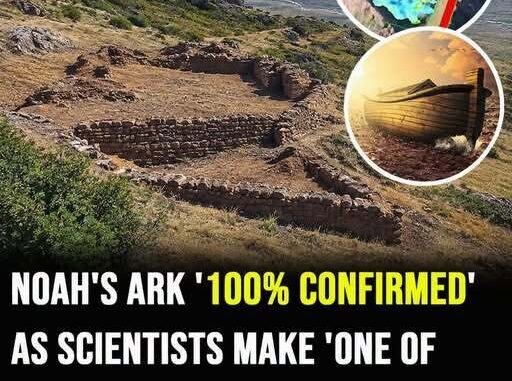
A boat-shaped formation in eastern Turkey is attracting renewed attention as researchers investigate whether its underground features could reveal evidence of an ancient vessel.
Known as the Durupınar formation, the site has long been associated by some explorers with Noah’s Ark. Its unusual outline has inspired decades of investigation, debate, and speculation.
Now, a new drilling program is collecting material from beneath the surface. Supporters hope laboratory analysis will provide stronger evidence for their interpretation of the site.
However, claims that Noah’s Ark has been “100% confirmed” go beyond what the available findings establish. The current work is an investigation, and the identity of the formation remains disputed.
The important question is not whether the site looks intriguing. It is whether physical evidence can demonstrate what created it.
What the Research Team Has Reported
In a September 23, 2026 announcement, the organization Noah’s Ark Scans reported that researchers had begun recovering core samples from depths of up to 18 meters.
The announcement also outlined plans for a camera-equipped device to examine accessible underground spaces. These are reports from the organization conducting and promoting the investigation, rather than independent confirmation that the formation contains a ship.
Collecting samples is a meaningful step because it allows researchers to examine actual material instead of relying entirely on surface appearance or interpretations of underground scans.
Still, obtaining a sample and identifying its origin are separate achievements.
Why the Formation Attracts Attention
The appeal of Durupınar begins with its shape. To many observers, its elongated outline resembles the hull of a large vessel.
But appearance alone cannot establish that an object was built by people.
A geoloical formation may resemble a familiar structure without sharing its origin. The task of an investigation is therefore to determine whether the similarities extend beyond the outline.
Evidence of construction would need to be distinguishable from naturally occurring layers, fractures, mineral deposits, and other geoloical features.
The strongest case would come from several kinds of evidence supporting the same explanation, with independent specialists able to examine the findings.
The Geological Explanation
The interpretation of Durupınar as an ancient vessel has faced substantial criticism.
That published work remains an important part of the scientific background to the current debate. New findings would need to address its conclusions with testable evidence rather than simply repeat the formation’s resemblance to a boat.
Earlier research does not prevent additional investigation. Science allows explanations to be revised when convincing new evidence becomes available.
But a proposed revision must explain why the new interpretation fits the observations better than the existing one.
Organic Material Is a Clue, Not an Identification
The reported presence of organic material has generated particular excitement.
In the supplied account, researchers hope that such material could help clarify what lies beneath the formation. Yet the phrase “organic material” does not identify a wooden vessel.
Before drawing that conclusion, investigators would need to establish exactly what the material is, how it reached its location, and whether it belongs to a coherent structure.
Even a verified piece of ancient wood would leave further questions. Was it part of a constructed object? Was it deposited naturally? Does it belong to the same period as surrounding material?
Those questions illustrate why a promising sample is the beginning of an analysis.
A discovery becomes more persuasive when its context supports its identification. Material recovered from a clearly documented structural feature would carry different significance from an isolated fragment with an uncertain origin.
What Underground Cavities Might Mean
Descriptions of underground spaces as “corridors” or “decks” can create a vivid picture of a buried ship.
Such words also contain an interpretation. A cavity is an observation; calling it a corridor suggests that people designed it for a particular purpose.
Researchers therefore need to distinguish what their instruments detect from what they believe those detections represent.
Direct imaging and carefully documented sampling could help clarify the shape and composition of accessible spaces. However, even a regular-looking feature would need to be examined alongside the surrounding geology.
The same caution applies to a hard layer encountered during drilling. Resistance tells researchers something about the conditions they have reached, but does not by itself identify the material.
Laboratory examination must do that work.
Why Testing and Independent Review Matter
The supplied account suggests that further analyses may extend into 2027. That should be understood as a possible research timeline, not a promise that the Ark will be confirmed by a particular date.
A credible investigation should make its methods clear. Specialists need to know where samples came from, how they were handled, which tests were performed, and what uncertainties remain.
Independent review is equally important. Researchers who were not involved in developing the original claim should be able to assess whether the conclusions follow from the evidence.
Results might support part of the proposed explanation while leaving other questions unanswered. They could also strengthen a natural geological interpretation.
Either outcome would contribute knowledge about the site.
Respecting Faith While Examining Evidence
For many readers, Noah’s Ark has religious significance that extends beyond any archaeological investigation.
Scientific testing asks a narrower question: what is this particular formation, and what evidence supports its identification?
That question can be examined respectfully without treating belief as a substitute for physical evidence or dismissing the cultural importance of the story.
The distinction also helps prevent disappointment caused by exaggerated headlines. Describing preliminary findings accurately allows people to follow the investigation without being told that an unresolved question has already been settled.
A Fascinating Investigation With an Uncertain Outcome
The renewed work at Durupınar offers an opportunity to examine a much-discussed site more closely. Samples and possible underground imaging may help researchers understand its composition and structure.
For now, however, the available material does not justify declaring Noah’s Ark definitively discovered.
The story remains compelling without that claim: an unusual formation, competing explanations, and an investigation whose conclusions must depend on evidence.
What happens next should be measured by the quality of the results and the strength of their independent assessment.
Leave a Reply