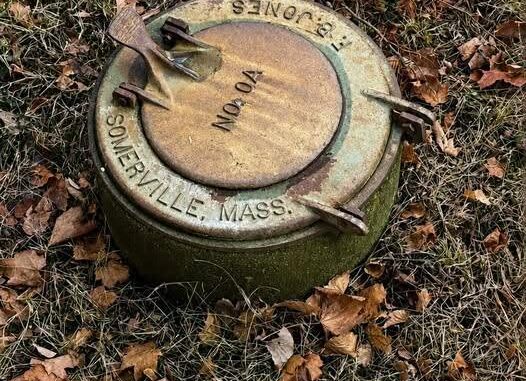
Sometimes, the most interesting pieces of history aren’t displayed in museums. They can be sitting quietly beneath an ordinary backyard, hidden under grass, leaves, soil, or an old metal cover.
That’s exactly what happened when a homeowner discovered a strange, weathered metal hatch in the backyard. At first, it was difficult to determine what the object had been used for. It looked old enough to be connected to some forgotten utility system, perhaps a drainage feature or storage container.
After some research, however, its purpose became clearer.
It was an old underground garbage receptacle.
Today, most people are accustomed to wheeled garbage carts, plastic containers, and scheduled curbside collection. But household waste was handled very differently in many communities decades ago. Before modern collection systems became standardized, homeowners and municipalities experimented with various ways to store garbage safely and conveniently.
One solution was surprisingly simple: place the garbage container below ground.
A Different Approach to Household Waste
Older household garbage cans were often large, heavy metal containers. They could be unpleasant to manage, particularly during bad weather.
Animals could knock them over, wind could scatter their contents, and summer temperatures could make odors much worse. Rain and snow also created additional maintenance problems.
An underground container offered a different approach.
A heavy cover could sit close to ground level while the actual receptacle remained below the surface. Depending on the design, the underground space could provide some protection from animals, wind, and extreme temperature changes.
For homeowners, the system also had another advantage: the garbage container was less visually noticeable.
Instead of having a large metal can sitting beside a house or driveway, much of the structure remained hidden beneath the yard.
How the System Worked
The exact designs varied, but the basic concept was relatively straightforward.
An underground container or sleeve was installed below ground, with an accessible opening at the surface. A removable or hinged cover allowed the garbage container to be reached when necessary.
On collection days, sanitation workers could access the receptacle, remove or empty the container, and return it to its underground position.
For the period in which these systems were used, this represented a practical way to deal with an everyday household problem.
It also explains why homeowners today can occasionally encounter unusual metal lids or buried structures while landscaping or renovating older properties.
Why Did Underground Garbage Containers Disappear?
As waste collection systems developed, underground household garbage containers gradually became less common.
Municipal sanitation services increasingly moved toward standardized collection methods. Improvements in trucks, containers, roads, and collection schedules made curbside pickup much more practical.
Lightweight containers and, later, wheeled carts were easier for both residents and sanitation workers to handle.
Underground systems could also create maintenance challenges.
Metal components could corrode after years of contact with moisture and soil. Poor drainage could allow water to collect inside the underground structure. In colder climates, freezing temperatures could create additional difficulties.
Once a system was no longer actively maintained, homeowners often had little reason to keep using it.
Some underground structures were filled with soil. Others were covered, abandoned, or simply forgotten as properties changed hands.
Eventually, an object that had once been an ordinary part of household sanitation could become an invisible piece of neighborhood history.
Finding One Today
An old underground garbage container may not look particularly impressive when first discovered.
A homeowner might notice a heavy metal lid partially covered by grass or leaves. Without historical context, it could easily be mistaken for an old utility access point, drainage feature, or another type of buried structure.
The surrounding property can provide clues.
Older neighborhoods may contain remnants of previous sanitation systems, utility installations, foundations, wells, cisterns, and other structures that are no longer in everyday use.
A municipal marking on a cover can sometimes provide another useful clue about its origin.
However, homeowners shouldn’t automatically assume that every old metal hatch is a garbage container. Before opening or disturbing an unidentified underground structure, it is sensible to determine whether it could be connected to utilities, drainage, fuel storage, septic systems, or other infrastructure.
Giving an Old Relic a New Purpose
Once an abandoned structure has been correctly identified and confirmed to be safe, some homeowners choose to incorporate it into their landscaping rather than removing it.
Depending on its condition and local requirements, an old underground container might inspire a decorative garden feature or become part of a creative backyard project.
Some people enjoy preserving unusual historical objects simply because they provide a connection to the property’s past.
The important thing is to understand what the structure actually is before modifying it.
A Small Piece of Everyday History
Grand historical events often receive most of our attention, but ordinary objects can reveal just as much about how people lived.
An underground garbage container tells a small story about household life, municipal services, engineering, and changing technology.
What once seemed like an ordinary solution to a sanitation problem eventually became obsolete. Decades later, the same object can appear mysterious to a homeowner who discovers it beneath an otherwise familiar lawn.
That is what makes these discoveries so interesting.
They remind us that older properties can contain traces of previous generations that aren’t obvious from the surface.
So if an unusual metal cover turns up while you’re working in an older yard, don’t immediately assume it’s worthless scrap.
It may simply be an overlooked reminder of how differently everyday life once worked.
Sometimes, a piece of local history is hiding just beneath the grass.
Leave a Reply