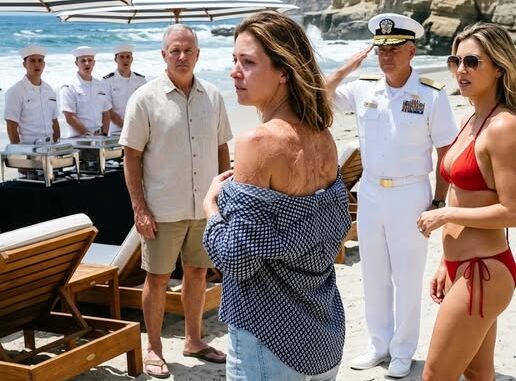
San Diego was pushing ninety-five degrees, the sun beating down on the private stretch of La Jolla sand like a personal vendetta. The heat clung to every surface, and the salty tang of the ocean filled the air. Most people sought refuge in the cool surf, but my day was about to turn entirely icy.
Jessica, my sister, glided toward me in a crimson designer bikini, the predatory curve of her smile perfectly practiced. To her, I was the family disappointment—the daughter who returned early from the Navy, her career halted, her body marred by scars, and her confidence buried beneath long sleeves and quiet restraint. She didn’t just want to tease me; she wanted to dismantle me in front of the Navy officers sunbathing nearby.
Without warning, she yanked the collar of my shirt down, exposing the jagged, rope-like scars that traced the battle I’d survived in a classified extraction mission. The world seemed to pause. Laughter died in midair as the officers’ gazes fell on the wreckage on my back.
“She wasn’t attacked,” Jessica sneered, her voice sharp and rehearsed. “She’s just a failure. Couldn’t handle the pressure. This is what happens when you play hero without the talent to back it up.” Every word was aimed at stripping me of dignity, at twisting my triumphs into evidence of incompetence.
My father stood a few feet away, hands folded, eyes scanning the sand instead of me. The sting of his silence cut deeper than any blade I’d faced overseas. All my life, I had tried to meet his impossible standards, only to be cast aside the moment my reality didn’t align with his carefully curated world.
The memories surged unbidden—the alarms, the smoke, the deafening chaos of that night when I dragged three comrades through debris, taking shrapnel and burns so they could return home to their families. I had survived, stitched together, and come back bearing medals that were buried under bureaucracy, only to face the cruel judgment of someone who had never seen the field of fire.
And then, the air changed. A shadow fell across the sun-drenched sand. A voice, low, commanding, and absolute, cut through the tension:
“That will be enough.”
The crowd parted instinctively. A Navy Admiral strode toward me, his white uniform crisp and immaculate against the golden sand. Officers snapped to attention, their eyes wide, recognizing authority and gravitas instantly. The Admiral ignored the mocking crowd and my sister entirely. He stopped before me, his gaze unwavering.
He lifted a hand in a sharp salute. “Lieutenant Elena Reed,” he said, his voice carrying clearly over the pounding surf. “I’ve been looking for you for five years. The commendation you earned in the field was never delivered. Your record of service and sacrifice was buried in red tape. That changes today.”
Jessica’s face drained of color, her rehearsed sneer replaced by disbelief. My father’s shoulders slumped; the linen of his designer shirt seemed suddenly inadequate to shield him from the truth he had ignored for so long.
The Admiral stepped closer, eyes locking onto mine. “You saved three lives that day, Lieutenant. You didn’t fail. You served with distinction. The country—and this family—is only now beginning to understand the magnitude of your courage.”
I felt the heat of the sun fade from my skin. The scars I had long seen as shame, as a mark of imperfection, no longer felt like a burden. They were evidence of survival, of heroism, of unwavering service. My chest swelled with the first rush of recognition I had ever received from anyone who truly understood what I had endured.
I returned the salute, hand steady, chin lifted. The beach—the officers, my father, even Jessica—dropped away into irrelevance. For the first time, I was seen. Fully, completely, and without caveat. The validation I had craved my entire life didn’t come from family, wealth, or approval—it came from someone who had walked the same path, understood the stakes, and measured the weight of my sacrifice.
Jessica shrank back, caught in the paradox of her own cruelty, realizing too late that the only person who could diminish me had never been her. My father, confronted by his own blindness, could only watch as the Admiral confirmed what I had always known in my own heart: I was enough. More than enough.
The ocean roared in the distance, indifferent to our human drama, but I felt a profound stillness inside. Every sleepless night, every whispered insult, every moment I had doubted myself—none of it mattered anymore. On that stretch of sand, under the blazing sun, I reclaimed what had been taken from me: respect, dignity, and the knowledge that courage never goes unnoticed.
I straightened my shoulders and smiled. For the first time in years, I walked across that beach carrying the weight of my scars not as shame, but as testament. Lieutenant Elena Reed had returned, not for approval, not for pity, but for recognition of a life spent standing in the fire—and surviving.
Leave a Reply