My name is Martha, and for the past two years, I had been learning how to live with less.
Not because I had chosen a simpler lifestyle, but because life had forced me to start over.
After my divorce, I discovered how little I understood about our finances. My former husband, Daniel, had always handled the accounts, mortgage, and paperwork while I focused on our daughter, Lily, and the endless responsibilities that came with raising a family.
For more than twenty years, I thought that arrangement was normal.
Then everything changed.
By the time the divorce was finalized, Daniel had kept the house, and Lily and I were left with limited savings, a car payment, and no permanent home.
I eventually found a small duplex.
It wasn’t fancy, but it was ours.
Our landlord, Grace, had listened to my situation instead of simply looking at my financial history. I have never forgotten that kindness.
The duplex had two bedrooms, a tiny kitchen, and a covered porch that soon became my favorite place.
Lily and I would sit there on warm evenings, eat dinner, and watch the neighborhood settle down.
Our life was smaller than before.
But it was ours.
Two years passed.
Lily was ten, doing well in school and slowly becoming comfortable with our new life.
Then one evening, everything changed again.
A powerful storm moved into town.
The sky darkened. The wind became stronger, and heavy rain began falling.
Lily was spending the weekend with her father, so the house was unusually quiet.
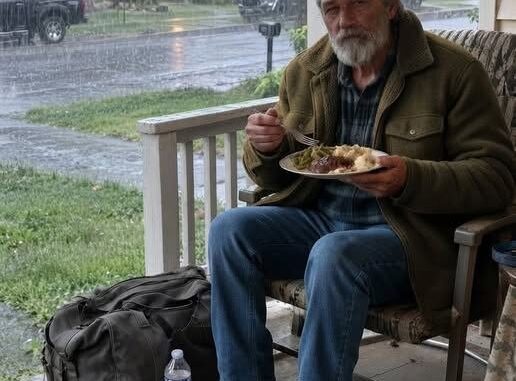
As I walked around closing windows, I noticed an elderly man standing beneath an elm tree across the street.
He looked exhausted.
His clothes were soaked, and he carried an old backpack against his chest.
I opened the front door.
“Sir?”
He looked toward me.
“You can wait here if you’d like,” I said, pointing toward the porch.
He hesitated.
“Are you sure?”
“Yes.”
He slowly crossed the street.
I brought him a towel, two cushions, and a warm blanket.
Then I remembered the soup I had made earlier.
I poured some into a bowl and carried it outside.
He stared at it for a moment.
“You’ve probably got enough problems without worrying about me,” he said.
I smiled.
“Tonight, I have enough for both of us.”
He accepted the bowl.
“My name is Albert.”
“Martha.”
He nodded.
“Thank you, Martha.”
Later that evening, I went inside.
Rain continued hitting the porch roof, but knowing Albert was sheltered made me feel strangely peaceful.
The next morning, I opened the door expecting to see him.
He was gone.
The blanket had been folded neatly on the doormat.
Underneath it was an envelope.
My name was written across the front.
Inside was a letter and an old brass key.
The letter began:
Dear Martha,
Thank you for allowing me to stay on your porch.
Albert explained that he had been moving between shelters and temporary places for several months.
He had once owned a small hardware store.
For decades, he had worked hard, built a modest business, and raised a family.
Then his wife, Estelle, became seriously ill.
Albert eventually sold the store to help cover their expenses.
Estelle passed away two years earlier.
Afterward, his relationship with his son became difficult.
Eventually, Albert found himself without a permanent home.
He didn’t write the letter to make me feel sorry for him.
Instead, he wanted me to understand why he was leaving the key.
Years earlier, he and Estelle had rented a small storage unit.
He had continued paying for it because he couldn’t bring himself to part with her belongings.
Inside was something he believed I might appreciate.
A notebook.
Estelle’s notebook.
The key opened the storage unit.
At the bottom of the letter, Albert wrote:
You gave me a dry place to sleep and a warm meal without asking who I was or what I could give you in return.
I hope what I’m leaving behind helps you in some small way.
Then he added:
I hope your worries get smaller.
I read the letter twice.
Then I drove to the storage facility.
The key worked.
Inside were old chairs, boxes of books, kitchen supplies, photographs, and a sewing machine.
Then I noticed a small wooden box.
Inside was a burgundy-colored notebook.
The first page contained a handwritten message from Estelle:
If you’re reading this, I hope you needed it.
I sat down and began reading.
At first, I expected recipes.
There were plenty of those.
But the notebook contained much more.
Estelle had written practical advice about managing money, stretching groceries, raising children during difficult periods, and surviving seasons when life didn’t go according to plan.
One sentence stopped me:
When you don’t know what comes next, keep moving. Sometimes the next step becomes clear only after you take the first one.
I thought about my divorce.
About the house I had lost.
About the fear I’d carried into our little duplex.
About the nights when I wondered whether I could give Lily the life she deserved.
Then I found another line:
What you lose isn’t always what defines you. Sometimes what you build afterward matters more.
I closed the notebook.
For the first time, I realized that maybe my life wasn’t a failed version of the one I had before.
Maybe it was simply a different chapter.
I took the notebook home.
When Lily returned that weekend, I told her about Albert and showed her Estelle’s book.
She listened carefully.
Then she asked:
“Is Albert okay?”
“I hope so.”
She thought for a moment.
“Shouldn’t we do something for him?”
“What do you mean?”
“Something kind.”
I smiled.
“What kind of thing?”
She pointed toward the notebook.
“Estelle wrote about helping people, right?”
“Yes.”
“So let’s help someone.”
The following week, Lily and I contacted a local shelter.
They told us they could use homemade meals.
So we made soup.
We used one of Estelle’s recipes.
Lily took the job very seriously.
“Needs more time,” she announced while standing beside the pot.
“You think?”
“Yes.”
So we waited.
When the soup was finished, we delivered it to the shelter.
A woman named Ruth thanked us.
Then she looked at Lily.
“You’re welcome back anytime.”
Lily smiled.
“We’ll come back.”
And we did.
Over the next few weeks, something unexpected happened.
The notebook became part of our life.
We tried Estelle’s bread recipe.
Our first attempt was terrible.
The second was better.
By the third, Lily proudly announced that she had finally figured out the right color.
I started writing notes in the margins.
Eventually, Lily did too.
One evening, I wrote:
We met a man during a storm. He gave us a book that reminded us how to keep going.
Beneath it, Lily added:
We made soup.
Then she drew a little heart.
Months later, Ruth called me.
She had found Albert.
He had arrived at the shelter and was helping in the kitchen.
He was safe.
He had a bed.
And, according to Ruth, he made excellent soup stock.
I smiled when I heard that.
Before hanging up, Ruth told me Albert had left a message.
“He said he hopes your worries have gotten smaller.”
I looked around my little kitchen.
The rent still had to be paid.
The car still needed maintenance.
Life was still uncertain.
But something had changed.
I no longer believed that having less meant having nothing.
I had Lily.
I had a home.
I had work.
I had people who had helped me when I needed it.
And I had a notebook filled with the wisdom of a woman I had never met.
I also had something I hadn’t possessed in a long time.
Hope.
A year after the storm, I still keep Estelle’s notebook on my nightstand.
The pages are beginning to fill with our own notes.
Sometimes Lily writes in it.
Sometimes I do.
And every once in a while, we make one of Estelle’s recipes and remember the stranger who arrived on our porch carrying almost nothing.
Albert had come to my home looking for shelter from a storm.
But in the end, he left me something much more valuable than anything money could buy.
He reminded me that kindness doesn’t have to be grand.
Sometimes it’s a blanket.
Sometimes it’s a bowl of soup.
Sometimes it’s simply saying, “You can stay here until the rain stops.”
And sometimes, the person you think you’re helping is actually the person who gives you the strength to keep going.
I thought I was the one who had given Albert shelter that night.
Now I understand.
In his own quiet way, Albert gave me shelter too.
Not from the rain.
From the belief that losing part of your old life means losing your chance at a new one.
And that lesson is something I will carry with me for the rest of mine.
Leave a Reply