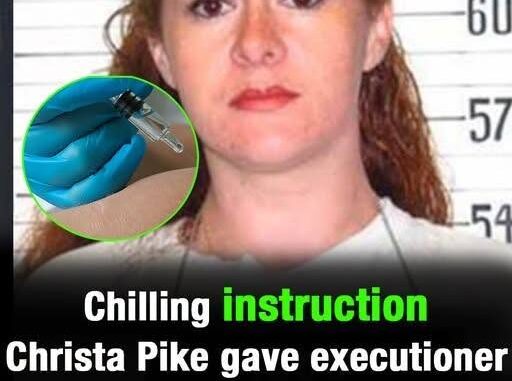
The attempted execution of Christa Pike has drawn renewed attention after officials were unable to complete the procedure, with questions now being raised about what went wrong.
Pike, who had been sentenced to death in Tennessee decades ago, was scheduled for execution at Riverbend Maximum Security Institution in Nashville.
The case became especially complicated in the hours before the scheduled procedure as courts considered additional legal challenges.
A Last-Minute Court Battle
Pike’s execution was initially scheduled for the morning.
However, a federal appeals court temporarily paused the process while it reviewed arguments presented by her defense team.
The legal dispute continued for several hours before the U.S. Supreme Court ultimately lifted the stay, allowing Tennessee officials to proceed with the execution later that day.
The decision brought an end to Pike’s remaining attempts to delay the sentence.
Pike had been convicted in connection with the 1995 killing of Colleen Slemmer, a fellow student at a vocational school in Tennessee.
Her defense attorneys had argued that her history of severe childhood trauma and abuse should be considered when evaluating her case.
Despite those arguments, Tennessee officials declined to stop the execution.
The Procedure Did Not Go as Planned
According to reports, officials attempted to administer a lethal injection using pentobarbital.
However, the procedure did not produce the expected result.
Pike remained alive for an extended period, and officials eventually stopped the execution and transferred her to a medical facility for treatment.
The incident immediately raised questions about whether the state’s execution procedures had been followed correctly.
The Tennessee Department of Correction has maintained that officials followed established protocols.
Pike’s attorney, however, has disputed that account and described significant difficulties during the procedure.
Questions About the IV Access
One of the central issues concerns the difficulty officials reportedly experienced while attempting to establish intravenous access.
Attorney Randy Spivey told The New York Times that multiple attempts were made and that several needles were used.
He also claimed Pike had previously been identified as having medical characteristics that could make establishing IV access more difficult.
According to Spivey, Pike herself attempted to help officials locate a suitable place for the injection.
He said she repeatedly directed officials toward different areas of her upper arm and shoulder in an effort to help them find a workable vein.
The account has added another unsettling dimension to an already unusual execution.
Medical Questions Remain
Dr. Joel Zivot, who had worked with Pike’s defense team, has offered one possible explanation for why the procedure may have failed.
The defense had previously raised concerns about Pike’s thrombocytosis, a condition involving an unusually high platelet count that can affect blood clotting.
Zivot suggested that clotting or problems with the veins could potentially interfere with the delivery of medication.
He also raised concerns about the possibility that some of the medication may have entered surrounding tissue rather than being delivered properly into a vein.
These are medical interpretations, however, and the exact cause of the failed procedure would require a formal investigation and medical review.
A Case That Has Drawn New Attention
Pike’s case has attracted attention for decades because she was convicted in the 1990s and remained on death row for many years before the state attempted to carry out her sentence.
Her defense team has repeatedly emphasized her difficult childhood and history of trauma, arguing that those circumstances played an important role in her development and behavior.
Opponents of clemency, meanwhile, have focused on the seriousness of the crime for which she was convicted.
The failed execution has now added another chapter to the long-running legal and ethical debate surrounding the case.
What Happens Next?
Pike was transported to a hospital following the unsuccessful execution attempt and reportedly remained under medical care afterward.
The circumstances surrounding the procedure are likely to face further scrutiny, particularly regarding medical preparation, intravenous access and whether all established protocols were followed.
For now, many questions remain unanswered.
The incident has also renewed broader discussions about the challenges associated with lethal injection and the importance of medical and procedural safeguards during executions.
Whatever the eventual findings, the failed attempt represents an extraordinary development in a case that has already remained in the public eye for more than three decades.
The full circumstances may become clearer once officials complete their reviews and additional medical and legal information becomes available.
Leave a Reply