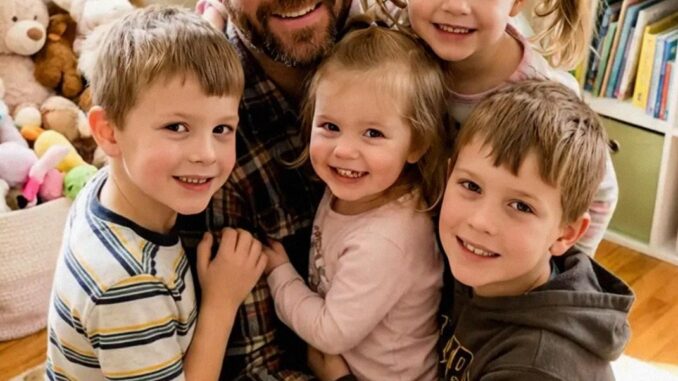
My name is Michael Ross, and for two long years, I lived as a ghost in my own home. My world had effectively ended in a sterile hospital hallway when a doctor uttered those three devastating words: “I’m so sorry.” A drunk driver had stolen my wife, Lauren, and our six-year-old son, Caleb, in an instant. In the aftermath, the silence of our house became a physical weight. Caleb’s sneakers still sat by the door, and his colorful drawings remained pinned to the refrigerator, mocking the stillness of a life that had been so vibrant. I survived on takeout and television static, sleeping on the couch because the bedroom we once shared felt like a tomb. I was forty years old, but I felt like a century had passed since I last felt a sense of purpose.
That changed at two in the morning on a random Tuesday. While scrolling through Facebook in a grief-induced haze, I saw a post that stopped my heart. It was a plea from a local child welfare agency featuring a photo of four siblings: Owen, Tessa, Cole, and Ruby. They were huddled together on a bench, looking less like children and more like refugees of a private war. The caption was a gut punch: “Likely be separated.” Because they were a group of four, ranging from ages three to nine, the system was preparing to split them up into different foster homes. They had already lost their parents to a car accident; now, they were about to lose each other.
I couldn’t sleep. I kept seeing Owen’s arm wrapped protectively around his sisters. I knew what it was like to walk out of a hospital alone, and the thought of these children being torn apart because they were “too much” for the average family made me feel a spark of something I hadn’t felt in years: righteous anger. The next morning, before the sun was fully up, I called the agency. I told the social worker, Karen, that I wanted to take them. Not one of them, not the two youngest—all four.
The process was grueling. I had to prove to therapists and state officials that I wasn’t just trying to fill the hole in my heart left by Lauren and Caleb. I told them the truth: I was still grieving, and I always would be, but I was still here, and I had a house that was far too quiet. When I finally met the kids in a fluorescent-lit visitation room, the tension was thick. They were suspicious, especially seven-year-old Tessa, who watched me like a hawk for any sign of impending rejection. Owen, at only nine, carried the weight of a father on his small shoulders. I told them simply, “I’m not interested in just one of you. I want all of you.”
The transition was a chaotic whirlwind. My house stopped echoing and started vibrating with the sounds of spilled juice, stomping feet, and nightmares. Ruby would cry for her mother in the dead of night, and I would sit on her floor for hours, whispering that she was safe. Cole would shout that I wasn’t his real dad during temper tantrums, and I would calmly agree while still holding the line on his behavior. Slowly, the “me” and “them” became “us.” I stepped on Legos, burned grilled cheese sandwiches, and learned the intricate politics of elementary school social circles. Owen finally called me “Dad” by accident one night, and though he froze in embarrassment, I felt a warmth settle in my chest that told me we were going to be okay.
About a year after the adoption was finalized, just as we had settled into a messy, beautiful routine of soccer games and homework, a stranger arrived at my door. A woman named Susan, dressed in a sharp suit and carrying a heavy leather briefcase, introduced herself as the attorney for the children’s biological parents. My stomach dropped; I feared there was some legal loophole that might take them away. But as we sat at the kitchen table, pushing aside cereal bowls, she revealed a secret that changed everything.
Leave a Reply