At sixty-seven, Judy thought she had finally found a simple solution to her housing problems. After losing her husband and preparing to leave the farmhouse where they had lived for decades, she hoped her daughter’s home might offer comfort and companionship. Instead, the arrangement came with a price she had never expected.
Her daughter, Michelle, and son-in-law, Todd, offered her a basement room for $800 a month, including utilities and groceries. In return, Judy would care for their two young children four days a week.
The proposal left Judy with a difficult choice. Her monthly Social Security income was only $1,640, and paying nearly half of it toward the arrangement would leave little money for medication, insurance, transportation, and other necessities.
What hurt most was not the amount itself. It was the suggestion that she needed to earn her place in her own daughter’s family.
Judy understood that raising children was expensive, and she knew Michelle and Todd were under pressure. Still, she wanted to remain a mother and grandmother, not become someone whose value depended on how much work she could provide.
A Difficult Goodbye to the Farmhouse
For thirty-one years, Judy and her late husband, Dale, had lived in a farmhouse provided through his agricultural job. After Dale passed away, the farm owners generously allowed her to remain there for more than two years.
Eventually, their son needed the house for his growing family. Judy understood their situation and agreed to move before November.
Although she was grateful for their kindness, leaving the farmhouse meant saying goodbye to a place filled with memories. It was where she and Dale had built their life together, raised their daughter, and shared countless ordinary moments.
When Michelle offered the basement, Judy inspected it carefully. The room had a small window near the ceiling, carpeting over concrete, and a dehumidifier running in the corner. The bathroom was upstairs, requiring her to climb thirteen steps whenever she needed it.
She thanked her daughter for the offer but asked for time to think.
A Little House and Two Brass Keys
Instead of accepting the basement arrangement, Judy visited a small rental house near the local grain elevator. The home was modest, with a combined kitchen and living room, one bedroom, a bathroom, and a tiny porch with a swing.
The rent was $550 per month, with electricity and gas paid separately.
The house had its disadvantages. Grain dust gathered during harvest, machinery created noise, and trains passed nearby during the night. Yet Judy saw something more important: a place where she could live independently.
She accepted the rental and paid the first month’s rent.
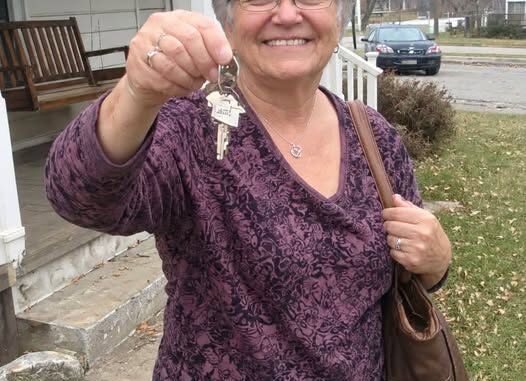
When the landlord handed her two brass keys, Judy felt an emotion she struggled to explain. For most of her life, she had lived under someone else’s roof—as a daughter, then as the wife of a farm employee. Now, for the first time, she had chosen a home entirely for herself.
She moved her furniture, her sewing machine, her late husband’s recliner, and a few treasured belongings into the little house. Though the space was small, it felt peaceful and personal.
She did not immediately tell Michelle about her decision, fearing the conversation would lead to an argument.
A Painful Conversation Between Mother and Daughter
Todd eventually spotted Judy’s car outside the rental house and told Michelle. That evening, Michelle called her mother, upset that Judy had moved without telling her.
When Michelle learned that the rent was $550 rather than the proposed $800, she questioned why her mother preferred paying a landlord instead of living with family.
Judy answered honestly. She appreciated the offer, but she did not want their relationship to become a financial arrangement in which every favor came with expectations.
She would gladly care for her grandchildren out of love. However, being told she needed to earn her keep made her feel as though affection had become an obligation.
Michelle ended the call, and the two women went ten days without speaking.
Those days were difficult for Judy. She enjoyed the privacy of her home, but she missed the children and wondered whether protecting her independence had cost her too much emotionally.
Finding Purpose Through an Unexpected Opportunity
One afternoon, Judy visited the local store owned by her landlord, Mr. Brandt. She found him struggling with a pile of invoices, receipts, and incomplete financial records.
His late wife had managed the business accounts for decades, and he had never fully learned how to handle them himself.
Judy offered to help. She had spent twenty-two years keeping the books at a lumber yard and knew how to organize accounts and track payments.
After several afternoons of work, she balanced the ledger and discovered more than $2,000 in unbilled transactions.
Grateful for her assistance, Mr. Brandt offered her a regular bookkeeping job every Friday. In exchange, he reduced her rent from $550 to $400 per month.
The arrangement made Judy feel respected. She was contributing a valuable skill, receiving fair consideration, and deciding how to spend her time.
For the first time in a long while, she realized that accepting help and offering help did not have to involve shame or obligation.
The Truth Behind the $800 Request
Ten days after their disagreement, Michelle and Todd arrived at Judy’s house. Todd carried a legal pad covered in handwritten figures.
He admitted that he had proposed the $800 payment. Their household income was approximately $5,400 per month, while their expenses reached $5,710. Reduced overtime at work had left them struggling to cover their bills.
Todd had hoped Judy’s contribution and childcare would ease their financial pressure. He knew the arrangement was unfair, but fear had kept him from admitting how desperate their situation had become.
Michelle also apologized. She explained that she had not wanted to make her mother feel like a burden. Instead, she had tried to turn their need for help into a formal agreement so that nobody would feel indebted.
Unfortunately, her choice of words had hurt the person she wanted to protect.
Judy listened, forgave them, and reminded them that asking for help was not something to be ashamed of.
A New Arrangement Built on Respect
After accepting their apologies, Judy offered to care for Sadie and Eli on Tuesdays and Thursdays at her own home. She would do it without payment because she loved them, not because she owed anyone anything.
She also helped the couple review their budget and reduce childcare expenses. With the savings, they could begin addressing their financial shortfall and paying down their debt.
The new arrangement came with clear boundaries. Judy would continue her Friday bookkeeping work, maintain her independence, and make her own decisions about her schedule.
Soon, the grandchildren began spending regular time at her little house. They played games, ate pancakes for supper, and watched the trucks pass the grain elevator. The home became a place where they could build memories with their grandmother.
One evening, as the children slept beside her on a collection of quilts, Sadie remarked that she liked the small house because she could see her grandmother from everywhere.
Her brother added that he would visit her anywhere—even if she lived inside the grain elevator.
Judy laughed, but the moment touched her deeply. She had wanted a home where her grandchildren would visit because they wanted to see her, not because she happened to live under their parents’ roof.
The Meaning of a Home
The following Sunday, Michelle arrived to collect the children. Instead of simply walking inside, she paused at the front step and knocked.
Judy welcomed her, served pancakes, and watched her daughter sit at the familiar kitchen table.
Their relationship was beginning to heal, not because their financial problems had disappeared, but because they had learned to speak honestly and respect one another’s needs.
At sixty-seven, Judy had a small house, two keys, a modest income, meaningful work, and two grandchildren who knew where to find her.
She had discovered that independence did not mean rejecting family. It meant creating a relationship in which love was freely given rather than demanded as payment.
Her little house was not large, and it was certainly not perfect. But it belonged to her in the way that mattered most: she had chosen it herself.
And whenever her family wanted to visit, they could walk up the single step, knock on her door, and be welcomed inside.
Leave a Reply