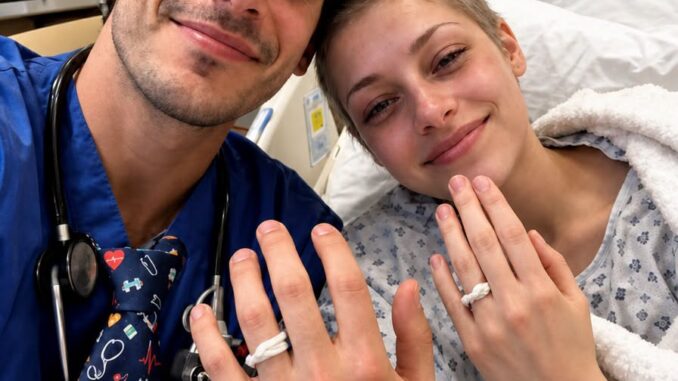
I thought marrying my dying patient was a kindness. After her funeral, her sister handed me a box with my name on it. Before I finished reading, I was forced to defend myself against an accusation that could end my career.
I was thirty years old, equipped with a medical degree, a crisp white coat, and student loans that consistently made my stomach knot. Healing people was all I had ever dreamed of doing. Since my folks couldn’t chip in much for tuition, I spent my weeks buried in books and my weekends clocking long shifts at work. By the time Alicia came into my life, I assumed the hardest hurdles were behind me.
She was eighteen and easily the most vibrant person on the oncology ward. Even completely drained from her treatments, she could coax a laugh out of a nurse while her bedding was being changed.
“Doctor Lucas, you know smiling doesn’t cost a dime, right?”
I attempted to maintain a stern expression. She simply waited until I cracked. I had known her for six weeks when she caught me peering at a digital billing reminder on my phone.
“Bad news?”
“Worked straight through my medical training. Still paying the price.”
She grimaced.
“They honestly ought to hand you a full refund just for your terrible handwriting alone.”
Then the pharmacology stopped working. On Tuesday, the attending physician informed her family that she likely had about three days left. Afterward, I lingered hesitatingly outside her door. I had no fresh therapies left to administer, and I dreaded the moment she would look to me for hope I couldn’t provide. Instead, she motioned for me to take a seat.
“I have one final request.”
“What is it?”
“I’d like to marry you.”
At first, I figured she was teasing. She offered a tired, faint smile.
“Come on. I refuse to show up at the pearly gates as a single woman.”
“Alicia, I’m your doctor.”
“You certainly wouldn’t be my top pick if I were tying the knot for romance, doc.” She glanced toward a passing nurse and blushed, then looked right back at me. “Though I do have my reasons.”
“Then why me?”
She grinned softly.
“Because you actually listen—even when my ideas sound a bit silly. I just want one major thing that I actually get to choose.”
“It isn’t nearly that simple.”
“Why should having less time left make my wishes any less worthy of consideration?”
I couldn’t come up with a way to decline without watching her face crumble. I should have stood my ground and kept trying to reason with her. Instead, I envisioned giving her one joyful afternoon following weeks of crushing news. I arranged for a colleague to take over her medical care. Yet, I neglected to consult Dr. Patel, my supervisor, regarding whether I should actually go through with it.
We got married the following day right there in her hospital room. I wore a necktie in place of my stethoscope. A nurse braided thin strips of sterile medical bandage into two makeshift bands. Alicia wore a pristine white scarf over her bald head like a traditional bridal veil. Her sister, Nora, brought fresh flowers. Alicia beamed throughout the entire ceremony. Nora adjusted the scarf twice, then gave my hand a firm squeeze.
“Thank you. You really gave her something wonderful. I mean that.”
I walked away believing I had done a good deed.
Two days later, Alicia was gone. At the service, I stood behind people who had cherished her for her entire life, feeling completely out of place. Afterward, I was standing right next to my car when Nora hurried over carrying a small, taped box.
“She asked me to hand this over to you only after she passed away.”
My name was scrawled across the lid in Alicia’s distinct handwriting. I broke the seal with Nora lingering right beside me. The very first item inside was an official letter from an attorney. Alicia had bequeathed me her portion of a substantial inheritance from her late grandmother. The sum was large enough to wipe out every single dollar of my remaining debt. I cross-referenced the figure with my name, certain there had been a clerical error.
A folded piece of paper rested right beneath the legal notice. Nora leaned over my shoulder before I could unfold it. Her expression instantly flushed crimson.
“What the hell!” she yelled out. “She left you Grandma’s money?”
Nora pointed accusingly at the lawyer’s paperwork, her tone turning razor-sharp.
“I had no clue. I swear to you, I didn’t know anything about this.”
“Then why on earth did you marry her?”
“It wasn’t a romantic arrangement. You knew that.”
“I thought I did.” Her voice fractured. “And now I can clearly see what you stood to gain from it.”
She pressed a trembling hand against her mouth.
“No, I promise you, it isn’t like that at all.”
Nora stepped backward and pointed a finger at me.
“I am reporting you straight to the hospital administration.”
She stormed off before I could offer a defense. I remained parked by my vehicle with the box wide open. If the administration suspected I had wed a terminal patient for financial gain, I could lose my license permanently. I wanted to chase after Nora and explain. At the same time, I wanted to stare at that incredible financial figure just one more time. I snapped the lid back into place before doing either.
That evening, I punched the total into my digital loan calculator. The balance instantly dropped to zero. I sat in silence staring at the digits, picturing taking my parents out for a nice dinner without constantly checking my bank balance beforehand. Then I shut the laptop lid. I needed to decline the funds while I still possessed the willpower to do so.
The next morning, I contacted the attorney and stated that I wished to reject the inheritance entirely.
“Are you absolutely certain?”
I glanced at the loan payment reminder glowing on my laptop screen. Turning it down meant enduring years more of those grueling monthly bills, but my dream career was hanging by a thread, and I needed to salvage it.
“Yes,” I replied. “Please email me the necessary paperwork to sign.”
I rang Nora before heading out for my shift.
“I’ve formally refused the money. You don’t need to file a formal complaint anymore.”
“Refusing it now changes nothing,” she retorted. “You only backed down because you got caught.”
“I honestly didn’t know about it beforehand.”
“Grandma always spoke of those funds as our entire future. I just buried my sister on Saturday, and now there’s a legal letter naming you as a beneficiary.”
I couldn’t make her believe my total innocence.
“I’m truly sorry,” I said.
She disconnected the call. I changed into my work clothes and drove straight to the hospital.
Dr. Patel was waiting right outside the ward when I stepped out of the elevator.
“Your caseload has been completely reassigned,” she said coldly. “I need your security badge.”
“Why?”
“You married an eighteen-year-old patient and now stand to inherit her estate.” She clenched her jaw tight. “What on earth were you thinking?”
“But I transferred her medical care…”
“Marrying someone under your direct care crosses a fundamental professional boundary. Transferring her file afterward didn’t erase that fact.”
“Am I losing my job?”
“That is for the formal review board to determine.”
She held out an open palm. I unclipped my ID badge and handed it over.
Once back home, I finally unfolded Alicia’s handwritten note.
Grandma left each sister funds for education and a fresh start. You mentioned working your way through school. Everyone calls you fortunate to be a physician, but I don’t think they understand the actual toll it took. Nora still has her half, and I couldn’t use mine for the life Grandma envisioned for me. Perhaps it can give you some of yours back instead. The wedding was something I genuinely wanted; this is simply something I wish to give you. You deserve a good life, doc.
There was a cheerful smiley face sketched right beside her signature. I felt deeply understood in a way I never had before.
My parents invited me over for supper that evening. Mom piled extra rice onto my plate, and for a few brief moments, I allowed myself to feel looked after.
“Any updates on the situation?” Dad inquired.
“Not yet,” I murmured.
Then Mom set her fork down gently.
“Who was this young woman, Lucas? Why risk everything you’ve worked for over her?”
I told them the whole story about Alicia, but the moment I mentioned her age, their expressions fell.
“Eighteen years old!?” Dad shouted. “Why would you ever marry an eighteen-year-old patient?”
Mom covered her mouth with both hands. I carefully explained her diagnosis, her dying wish, and the utter lack of romance. Dad waited until I finished speaking.
“Even so, why did you agree to it?”
“Don’t make it sound bizarre. It wasn’t like that.”
“That doesn’t really answer my question,” Mom noted. “I’m asking why you chose to marry her.”
I stared blankly down at my plate.
“Because there simply wasn’t anything else I could do to help her.”
“Oh, Lucas.” Mom’s tone softened significantly. “That doesn’t mean marrying her was the appropriate solution.”
I desperately wanted Dad to push back or disagree. Instead, he reached slowly for his glass of water. They knew my character well; neither genuinely believed I had chased after her money, but neither thought the wedding itself was right. Eventually, Dad broke the silence.
“Do you need financial assistance while this investigation plays out?”
“No.”
“Lucas.”
“Maybe. I’ll let you know.”
They hugged me tightly at the door. I clung to them, immensely relieved that their affection hadn’t wavered.
Back at my apartment, I began drafting the formal statement requested by the hospital committee. I typed that Alicia had insisted upon it, then stopped typing mid-sentence. She had asked, yes, but I had agreed. I modified the sentence entirely. Detailing my choices without hiding behind her dying wish took up most of the night. I submitted the document before my nerve could fail me again.
Later that week, Nora posted our wedding photograph online for the public to see.
This doctor exploited my dying sister to secure a massive inheritance, she captioned it.
I called her with my hands trembling uncontrollably.
“Why would you do this? The internal review isn’t even finished yet.”
“Because I suspect the hospital intends to protect you and quietly sweep this under the rug.”
“I have already legally refused the money.”
“Only after I lodged my official complaint.”
When she hung up on me, I opened the comments section. Strangers were rapidly sharing the image. I began frantically typing out every detail I could recall that might make them understand the context. Then I looked at Alicia’s note. I almost took a photograph of it to attach to my reply. She had trusted me to simply listen; now, I was rummaging through her most private words just to stop internet strangers from judging me. The note couldn’t prove what I had known before the ceremony took place. I set my phone down without posting a thing.
An aunt phoned my parents to gossip. A former professor who had once written me a glowing recommendation letter reached out to ask if the rumors were true. I drafted a lengthy response to him, deleted it entirely, and started over from scratch.
Then Dad called me up.
“The shop could really use an extra pair of hands,” he said casually. “If you’re interested in some honest work.”
“I’m a medical doctor, Dad.”
“I’m well aware of your profession. I’m simply offering you a straightforward way to pay your monthly bills. That is all.”
I looked across the room at the stack of bills sitting beside my laptop.
“What time should I report for work?”
“Eight sharp. I’ll show you what needs to be organized.”
On Monday morning, I unpacked inventory behind his shop counter. When a customer asked if I was his son, I mentally braced myself for an inquiry about the viral photograph. Instead, she merely asked where we kept the replacement lightbulbs. I was relieved enough that I nearly laughed out loud. During lunch, Dad handed me a simple sandwich and left me alone with my phone. I had already signed the refusal paperwork and submitted my account of the marriage to the hospital committee. Yet Nora’s public allegations continued to spread online. The people sharing it had no idea she had actively participated in the wedding preparations, nor that she couldn’t prove I had ever anticipated a payout.
I called Nora and requested an in-person meeting. She replied that she wanted Alicia’s handmade white scarf and bandage rings returned—she had tossed them into the keepsake box after the funeral.
“I will bring them to you. But I also need you to inform the hospital committee of what you actually witnessed firsthand.”
“I am not withdrawing my formal complaint.”
“I’m not asking you to do that.”
She finally agreed to meet on Saturday. I gathered the keepsakes along with copies of the attorney’s notification and my signed refusal documents.
She invited me into her kitchen. I placed the small box between us on the table and opened it so she could see the fabric and the ring. She brushed her fingers lightly across the white material before snapping the lid shut.
“I am not going to apologize,” she stated firmly. “I had every single right to file that complaint.”
“You did.”
Her hand remained resting on top of the box.
“I was her attending physician,” I said quietly. “I alone was responsible for my own choices. Her asking me didn’t absolve me of that.”
“So you finally admit it. You took advantage of her vulnerability.”
My face flushed hot. I still couldn’t adequately defend the marriage itself.
“I should have turned down the proposal. But I certainly didn’t marry her for financial gain.”
“You were inside her hospital room every single day.”
“Yes. You can tell the committee that exact fact. You can also tell them what you personally knew about the wedding when you helped put it together.”
She pulled her hand back sharply from the box.
“The inheritance changed everything.”
“It naturally raised red flags. I completely understand why.”
I slid the papers across the table toward her. She scanned the legal notice, then the refusal form, carefully verifying the dates on both.
“This doesn’t definitively prove you were completely in the dark beforehand.”
“No. It simply demonstrates when I was officially notified and the exact steps I took immediately afterward.”
“You want me to declare to them that you’re entirely innocent?”
“I want you to state precisely what you witnessed. You knew it wasn’t a romance; you actually assisted with the ceremony itself. You have no reason to believe I expected a payout.”
She pushed the documents right back across the table.
“People will assume I’m just taking your side.”
“You are free to include all your personal concerns within your official statement.”
“And now you can get out of my house.” Her voice cracked slightly. “I genuinely thought I was giving her something comforting. But you…”
I looked down at the small box beneath her hand. I remembered how meticulously she had arranged the scarf around her sister’s head. For a brief second, I wanted to tell her that we had both acted with good intentions—it would have made seeking her support much easier afterward. But I had spent too many sleepless nights trying to force that narrative to fit reality.
“I thought I was helping too,” I admitted. “Even so, I made a choice I never should have made.”
She wiped a tear from her cheek with her sleeve.
“And if the board actually lets you return to practice?” Nora asked. “What happens the next time another patient asks you for something you have no business giving?”
I started to promise that I would never repeat that mistake—just another hollow reassurance offered simply to make her feel better.
“I will ask for supervision and help before I ever answer again,” I said instead.
Nora picked up her smartphone, hovered over the screen for a moment, and set it down again.
“What you did was wrong. And I am refusing to delete my public complaint.”
“I understand.”
She opened an email addressed to the official handling the review board and began typing. She could easily send it and I could still lose my career entirely. She detailed helping orchestrate a ceremony she understood to be entirely nonromantic. She noted that she had zero direct knowledge of me expecting an estate. She maintained her lingering concerns regarding the propriety of the marriage. When she spun the screen around to show me, I read through it twice. It was far from a glowing endorsement. I thanked her sincerely, and she hit send. Afterward, she drafted a brief correction to her public social media post, her thumb hovering over the publish button for a moment before she let it go. I left the keepsakes with her. As I reached the door, she was already lifting the lid of the box once more.
The formal review concluded a few weeks later. Nora’s statement was evaluated alongside my written account and all the other collected evidence. The committee found no indication of calculated financial exploitation. However, they formally concluded that I had exercised poor professional judgment. I was permitted to return to medicine, but with an official reprimand permanently noted in my file, mandatory boundary retraining, and strictly supervised clinical duties.
I read through the final terms at my parents’ kitchen table. Dad asked if I intended to accept the conditions.
“Yes.”
Mom gave my shoulder a reassuring squeeze. The legal paperwork rejecting the inheritance was fully finalized as well. No windfall of money for me. Alicia may have gifted it with the purest intentions, but I simply couldn’t keep it. I still carried my student debt, and I would be spending my Saturdays working shifts at the shop until I finally caught up.
On my very first morning back, I waited outside the ward while Dr. Patel double-checked the administrative arrangements. A digital payment reminder suddenly popped up on my phone screen. I tucked the device away and pulled out my brand-new security badge. My hand shook slightly as I pressed it against the electronic scanner. It beeped. The heavy door clicked open.
“No more weddings, Lucas,” Patel warned with a stern frown.
I nodded in agreement.
Leave a Reply