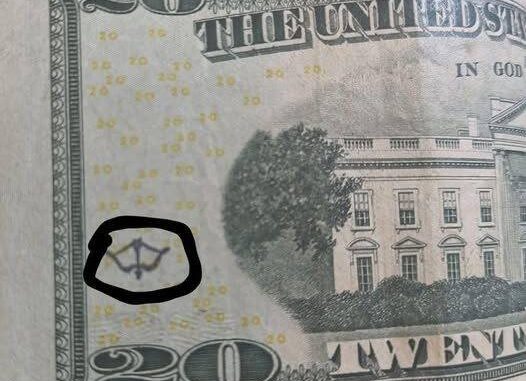
At first glance, a U.S. dollar bill seems simple. It’s a piece of currency we use every day without thinking much about it—handed over at stores, folded into wallets, or exchanged for goods and services. But if you look closely at certain bills, you might notice something unusual: small stamped symbols, initials, or even distinctive markings like a bow and arrow.
These markings are known as chop marks, and they carry a surprisingly rich history tied to global trade, trust in currency, and the movement of money across international borders.
While they may seem like random ink stamps at first, chop marks actually tell a deeper story about how U.S. dollars travel the world and how people in different countries verify their authenticity long before modern digital systems existed.
To understand why these marks exist—and why a symbol like a bow and arrow appears on some bills—we need to explore the global journey of currency itself.
What Are Chop Marks?
Chop marks are small stamps or symbols placed on paper currency, most commonly on U.S. dollar bills that have circulated outside the United States. These marks are typically applied by money changers, merchants, or currency dealers in regions where U.S. cash is widely used.
Their primary purpose is simple:
They indicate that a bill has been checked and verified as genuine.
In places where counterfeit currency is a concern, or where formal banking systems are not always easily accessible, trust becomes extremely important. Chop marks act as a visual signal that a bill has already been inspected and accepted by someone in the local financial network.
Once a bill carries a chop mark, it often becomes easier for others to accept it, because it has already “passed inspection” at least once.
The Origins of Chop Marks
The concept of marking currency is not new. The practice can be traced back to ancient trade systems, particularly in Asia.
The word “chop” itself is believed to originate from old Chinese trade terminology, where merchants used stamped seals to verify goods, contracts, and even silver coins. These stamps acted as proof of authenticity and trust.
In historical Chinese trade hubs, especially during periods when silver currency was widely used, merchants would stamp coins to confirm they were not counterfeit or diluted. Over time, this practice evolved and expanded beyond coins to paper money and foreign currency.
When U.S. dollars began circulating globally as a dominant trade currency, especially in the 19th and 20th centuries, the tradition of stamping money carried over into international markets.
Why U.S. Dollars Became a Global Target for Chop Marks
Today, the U.S. dollar is one of the most widely used currencies in the world. It is often accepted not just in the United States but also in international trade, tourism, and informal economies.
Because of this global circulation, U.S. bills often travel far beyond American banks and financial institutions.
In many regions:
- U.S. dollars are used alongside local currencies
- Cash-based transactions are common
- Access to advanced counterfeit detection tools may be limited
- Trust in physical bills becomes essential
In these environments, chop marks developed as a practical solution. Instead of relying solely on complex verification tools, money handlers used physical stamps to signal that a bill had already been checked.
This created a kind of informal trust network built directly onto the currency itself.
The Purpose of Chop Marks in Everyday Transactions
Chop marks serve several important functions in the real-world flow of money.
1. Verification of Authenticity
The most important purpose is confirmation that a bill is real. When a money changer or merchant receives a U.S. dollar bill, they examine it for signs of counterfeiting. If it passes inspection, they may stamp it to indicate approval.
This reduces the need for repeated checks by other handlers.
2. Building Local Trust
In some regions, trust in currency is built locally rather than centrally. A chop mark from a known money exchanger can reassure others in the same market that the bill is safe to accept.
In this way, trust becomes layered and shared across a community.
3. Tracking Currency Flow
While not an official tracking system, chop marks can indicate that a bill has moved through multiple hands or regions. Over time, a single bill may accumulate several different stamps, each representing a point in its journey.
4. Speeding Up Transactions
Checking every security feature on a bill takes time. Chop marks allow quicker decisions, especially in busy markets where speed matters.
If a bill already has a trusted mark, it may be accepted immediately without further inspection.
What Does the Bow and Arrow Symbol Mean?
Among the many chop marks found on U.S. bills, the bow and arrow symbol stands out due to its distinctive shape.
However, it is important to understand that:
There is no official meaning assigned by the U.S. government to this symbol.
Instead, it is believed to be a private or regional stamp used by specific money changers or exchange businesses.
In many cases, such symbols function like a signature or branding mark. Just as companies use logos today, money exchangers historically used unique stamps to identify themselves and signal trust.
A bow and arrow design may have been chosen because:
- It is visually recognizable
- It is easy to stamp quickly
- It stands out among other markings
- It may represent the identity of a specific exchanger or region
Over time, certain symbols became more widely recognized than others, especially if they were used consistently in active trade hubs.
Are Chop Marks Legal on U.S. Currency?
Chop marks exist in a legal gray area but are generally tolerated.
The U.S. government does not encourage defacing currency, but chop marks are not typically considered illegal unless they significantly damage or obscure the bill.
According to general currency guidelines:
- Writing or stamping small marks is usually acceptable
- Bills remain valid as long as they are not mutilated or destroyed
- Excessively damaged bills may be rejected by banks or machines
In practice, chop-marked bills are still widely accepted in circulation, especially in international markets.
However, heavily stamped bills may sometimes be refused if their condition interferes with machine processing or security feature visibility.
The Journey of a Chop-Marked Bill
To understand chop marks fully, it helps to imagine the life of a single U.S. dollar bill.
- It is printed by the U.S. Treasury
- It enters circulation through banks
- It is used in everyday domestic transactions
- It is deposited and redistributed
- It is sent overseas through banking systems
- It enters foreign markets and exchange centers
- It is checked by money changers
- It receives chop marks as proof of verification
- It continues circulating internationally
Each mark becomes part of a physical timeline—a record of where the bill has been and who has trusted it.
Why Chop Marks Still Exist Today
Even with modern banking technology, chop marks have not completely disappeared.
There are several reasons for this:
Cash is still widely used globally
In many parts of the world, physical currency remains the primary form of payment.
Not all regions rely on digital systems
Some markets still operate heavily on informal exchange systems where quick verification matters.
Tradition continues
In some places, chop marking is a long-standing practice passed down through generations of currency handlers.
Speed and convenience
A stamp is fast, simple, and effective in busy environments.
Do Chop Marks Affect Currency Value?
In most cases, chop marks do not affect the face value of a bill. A $20 bill with a chop mark is still worth $20.
However, there are practical considerations:
- Banks may refuse heavily marked bills if they are difficult to process
- Vending machines may reject damaged currency
- Clean bills are often preferred for resale or exchange
Despite this, chop-marked bills remain valid legal tender in most situations.
What Chop Marks Reveal About Global Trade
Chop marks offer a unique glimpse into how global trade actually works outside formal systems.
They show that:
- Currency travels far beyond national borders
- Trust is often built locally, not just institutionally
- People develop their own systems of verification
- Money carries physical evidence of its journey
In a way, chop marks turn currency into a storytelling object.
Each stamp represents a decision, a transaction, and a moment of trust between strangers.
The Hidden Story in Your Wallet
If you ever come across a U.S. bill with a chop mark, you are holding something more than just money.
You are holding a record of movement.
A bill like that may have passed through:
- Markets in different countries
- Hands of multiple currency dealers
- Small businesses and street vendors
- Exchange counters and trade hubs
Each mark is a silent reminder that money is not static—it moves, connects people, and crosses borders constantly.
Final Thoughts
Chop marks, including distinctive symbols like the bow and arrow, are not random decorations. They are part of a long-standing global system of trust and verification that developed alongside modern banking.
While digital payments and advanced security features have reduced their importance in many places, chop marks still exist as a reminder of how currency once—and still—flows through the world.
They show that money is not just numbers or paper. It is a living system shaped by human behavior, trust, and communication.
So the next time you see a small stamped symbol on a dollar bill, remember:
It is not just a mark.
It is a journey.
Leave a Reply