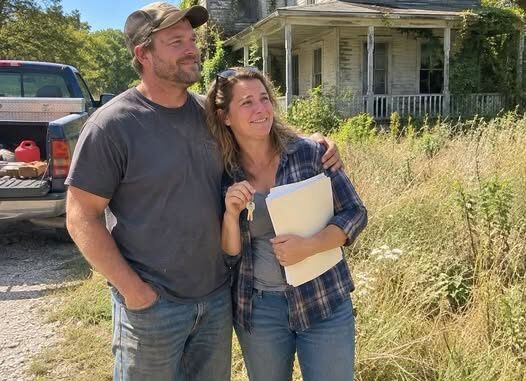
Part 1
The first thing my husband’s grandmother did when she stepped inside our rundown house was place her palm against the kitchen doorframe.
She didn’t pay attention to the peeling wallpaper. She didn’t glance at the hole in the ceiling where Nate had removed the old knob-and-tube wiring. She didn’t even notice the bucket sitting in the corner, catching water from the leaking roof.
Her attention was fixed on the doorframe.
Beneath several coats of paint, if you looked closely, you could make out tiny pencil marks. There were dozens of them, stretching upward along the wood. A few even had letters written beside them, although they were too faded to read clearly.
Opal gently ran her thumb across one of the lowest marks. Her hand trembled slightly.
“My mother used to measure my height right here,” she said. “Every birthday, until I turned fourteen.”
I stood motionless in the middle of the kitchen, still holding my car keys.
“Opal,” I said, “I had no idea you’d ever lived here.”
“I was born in the back bedroom, Callie. In 1938, during a terrible blizzard. The doctor couldn’t make it through the snow, so a neighbor helped deliver me.” She turned toward me, her sharp blue eyes fixed on my face. “My name was Opal Miller before I became Opal Brenner. This house belonged to my family.”
Then she reached into her purse and pulled out a folded piece of paper.
“But that’s not the only reason I wanted you to bring me here,” she continued. “There’s something I need your help with. And I need you to keep it between us, especially from Ronald.”
She placed the paper in my hand.
It was a collection notice from the hospital where I worked.
“I’ve never had a debt sent to collections in my entire life,” Opal said. “Not once in eighty-eight years. And I have money. Or at least, I thought I did.”
She slowly lowered herself into the only decent chair we owned.
“I believe my son has been taking money from me,” she said. “And I suspect the twenty thousand dollars he handed your brothers and sisters-in-law at Easter came from my savings.”
To explain how we ended up in that kitchen, I need to take you back two years, to another Easter Sunday.
To the envelopes.
My husband’s parents, Ron and Judy Brenner, had hosted Easter dinner every year for as long as anyone could remember. They lived just outside Corwin, Iowa, in a large white farmhouse with a wraparound porch and a basketball hoop that hadn’t been touched since 1998.
Judy usually spent two full days preparing the meal. There was brown sugar-glazed ham, scalloped potatoes, green bean casserole, and deviled eggs arranged neatly on a glass platter shaped like an egg. She also made three different pies. The long dining table was always covered with her finest china, white plates decorated with tiny blue flowers around the edges. She even folded napkins into fans and tucked them inside the water glasses.
But that Easter, something unusual had been placed on the table.
There was an envelope underneath every couple’s dinner plate.
At first, none of us noticed. We sat down, Ron said grace, and Judy began passing around the ham. It wasn’t until Kim lifted her plate to make room for the potatoes that she discovered the envelope.
“Mom? What’s this?” she asked.
Judy gave her a smile. It was the kind of smile someone wears when they’ve been eagerly waiting for a particular moment.
“Go ahead and open it, sweetheart.”
Kim was Ron and Judy’s oldest child. She was forty years old, worked as an elementary school principal, and was married to Doug, a quiet man who sold insurance. She carefully opened the envelope using the edge of her butter knife.
Inside was a greeting card. Then a check slipped into her lap.
She picked it up and read the amount. Her eyes widened before she covered her mouth with both hands.
“Mom! Dad! Oh my goodness!”
“We thought it was time you two stopped renting and bought yourselves a house,” Ron announced proudly from the head of the table.
Jeff opened his envelope next. He was thirty-seven, worked as a sales representative for a seed company, and had inherited his father’s booming laugh and love of big trucks. His wife, Brittany, leaned over to see what was inside.
He let out a surprised whistle.
“Twenty thousand dollars? Dad, are you kidding?”
“I’m as serious as I can be,” Ron replied.
Then it was Stacy’s turn. At thirty-four, she was the youngest of the three siblings and worked as a hairdresser in Ames. Her fingers trembled as she opened the envelope. When she saw the check, tears immediately filled her eyes. She grabbed the napkin from her water glass and pressed it against her face.
“Daddy,” she cried. “I honestly don’t know what to say.”
“You don’t need to say anything, sweetheart.”
Each of them had received twenty thousand dollars to help purchase a home.
I lowered my eyes toward my own plate.
There was an envelope underneath mine, too.
Nate is Ron’s oldest son, but he isn’t Judy’s.
His biological mother, Ellen, passed away from breast cancer when he was just five years old. Two years later, Ron married Judy. Kim arrived the following year, followed by Jeff and then Stacy.
Judy did raise Nate, and I won’t deny that. She provided him with food, clothing, and everything he needed growing up. She took him to Little League and looked after him. But Nate once told me that living in that house always made him feel like someone who wasn’t quite welcome.
“Nobody ever treated me terribly,” he explained one evening. “It was just that I always felt like a visitor who had stayed a little longer than I should have.”
I lifted my plate and took out the envelope.
It was cream-colored, just like the others. I opened it carefully.
Inside was a greeting card featuring a bluebird perched on a branch covered in white blossoms.
I opened the card.
There wasn’t a check inside.
Instead, I found a short message written in Judy’s familiar, elegant handwriting.
You’ve always been such a capable couple! We know you can handle anything. Love, Mom & Dad.
I searched the envelope again. I honestly don’t know what I expected to find. Perhaps the check had slipped somewhere inside. I even turned it upside down and gave it a little shake over my lap.
Nothing fell out.
Nate reached over and took the card from my hand. He read the message without saying a word. Then he carefully folded it along its original crease and slipped it into the front pocket of his flannel shirt.
His ears had turned bright red.
I’d been married to Nate Brenner for eleven years. He worked as a farm equipment mechanic and was the sort of man who could repair a broken combine in the middle of a field at two in the morning, holding a flashlight between his teeth.
He rarely raised his voice. He never slammed doors. He was one of the most even-tempered people I’d ever known.
But whenever something deeply upset him, his ears turned red.
There was no hiding it.
At the head of the table, Ron raised his coffee mug toward us.
“Every word on that card is true,” he said. “You two are the most independent children we have. You ought to consider that a compliment.”
Everyone was watching us.
Kim was holding her check. Jeff had his beside his plate. Stacy was still wiping away tears, with her check resting in front of her.
“Thank you,” I replied. “The card is beautiful.”
Judy smiled.
“I chose the bluebird myself. It’s supposed to represent happiness.”
“It’s lovely.”
I wanted to ask them why. I wanted to know what we’d done to deserve being treated differently.
But asking for an explanation about a gift isn’t easy. Not at Easter dinner, not at your mother-in-law’s table, and certainly not after she’d spent two entire days preparing the meal.
And Nate remained silent.
So I reached for the green beans and passed them along.
Grandma Opal was sitting at the table that evening, too.
She was seated at the far end, near the window, wearing her lavender church dress and pearl earrings. She was eighty-six at the time. Ron’s mother. After falling and breaking her hip the previous winter, she’d moved into a small apartment at Prairie View Senior Living in town.
She didn’t say anything when the envelopes were opened.
But I noticed her watching everyone.
Her eyes moved from Kim’s check to Jeff’s, then to Stacy’s. Finally, she looked at the bluebird card as Nate slipped it into his shirt pocket.
After that, she turned her attention toward her son, who was sitting proudly at the head of the table with his coffee mug raised.
Her lips tightened into a thin line.
Back then, I assumed she simply disapproved of people showing off.
I had no idea what she’d actually noticed.
We drove home without exchanging a single word.
Nate’s truck was a 2006 Ford F-150 with a cracked windshield and a heater that only worked on its highest setting. We traveled along the gravel roads, passing fields that were still brown from winter. The radio remained silent.
About halfway home, Nate finally broke the silence.
“How much money do we have saved?”
I didn’t need to check the account. I handled our finances, and keeping track of numbers was part of my everyday routine.
“Six thousand two hundred dollars in our savings account at First Farmers.”
He slowly nodded while keeping his eyes on the road.
“Then we’ll have to save more,” he said. “I’ll start accepting extra repair jobs during harvest. Nights, weekends, whatever work I can find.”
“I’ll pick up additional shifts at the diner,” I replied.
He reached across the seat and gently took my hand.
Neither of us mentioned the card again.
When we got home, Nate pulled it out of his shirt pocket. He unfolded it and stared at the message for quite some time while sitting at the kitchen table.
Eventually, he folded it again and placed it inside the drawer beside the stove, where we kept rubber bands and spare batteries.
He didn’t throw it away.
I noticed that.
Leave a Reply