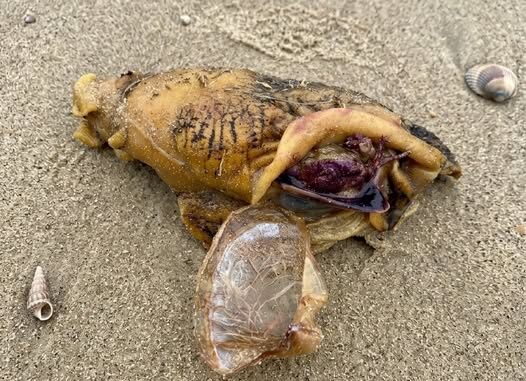
I was walking along the beach one late afternoon with my dog, a lively golden retriever named Bailey, when something unusual caught my eye near the shore. At first, I didn’t know what it was. It seemed out of place, something that didn’t belong in the soft expanse of sand and grass. My stomach gave a little flip, a mix of curiosity and unease, as I instinctively slowed my pace, letting Bailey sniff at the sand while I approached more carefully.
The object was partially buried in the dunes, its shape partially obscured by the tall, waving grasses that lined the beach. The light from the setting sun cast long shadows across the sand, making the area seem almost surreal, like a scene from a painting rather than reality. I crouched down to take a closer look. The closer I got, the more I could see that it wasn’t anything I recognized. It had a rounded, bulky shape, and a rigid surface that glinted faintly in the sunlight. Something about it seemed… off.
Bailey barked once, startling me, then nudged at my leg, as if to say, “Careful.” I took a deep breath, reminding myself to stay calm. Beaches often surprise you with what they bring ashore—driftwood, seaweed, shells, even occasional lost toys from kids playing nearby. But this was different. There was a quiet stillness around it, a subtle tension in the air, as if nature itself was holding its breath.
I circled the object slowly, careful not to disturb it more than necessary. As I got a better look, I realized what it was: a sea turtle that had washed ashore, no longer alive. Seeing it in person was sobering. I had read about this happening, of course, but reading about it in a book or seeing a photograph is entirely different from standing there, looking at it in the real world. It was a reminder that life in the ocean is beautiful, but also fragile, and that the shoreline carries more than shells and sand—it carries stories of the lives that depend on the sea.
Despite its stillness, there was something quietly majestic about the turtle. Its shell, though dull in the afternoon light, still had an elegant curve to it. The way its flippers rested naturally, as if it had been swimming moments before, was oddly peaceful. I knelt a little closer and ran my fingers along the sand near it, careful not to touch the turtle. I wanted to respect it, to give it space. Bailey sat down beside me, his tail wagging slowly, sensing that I was quietly absorbing the moment.
Walking along the beach later, I reflected on how connected all life is. Here was a creature that had traveled countless miles in the ocean, navigating currents, storms, and predators, and yet, like all of us, it eventually reached the end of its journey. Nature is beautiful, but it is also impartial. It doesn’t pick and choose who thrives and who doesn’t. The turtle’s presence on the sand was a gentle, if somber, reminder of this truth.
As I looked around the shoreline, I noticed other small signs of life. A crab scuttled sideways across the sand, disappearing into a burrow. Seagulls circled lazily overhead, occasionally diving to investigate the waves. A family of sandpipers dashed back and forth at the water’s edge, chasing tiny crustaceans with their quick, delicate movements. All of this life went on, seemingly unaware of the turtle that had come to rest on their shared beach. And yet, in some ways, the turtle’s journey had become part of this ecosystem too, contributing to the ongoing cycle of life and nature’s stories.
I stayed there for a while, watching the waves roll in and out. Each one seemed to bring something new to the shore, some small gift from the ocean—shells, bits of driftwood, seaweed, and the occasional stone polished smooth by the water. It reminded me of how the sea gives and takes in equal measure, how it shapes the lives of everyone and everything that lives along its edges.
Eventually, I realized that I should let the professionals handle the situation. Many local wildlife organizations monitor and respond to stranded or deceased sea animals, both to respect the animal and to maintain the safety and health of the environment. I marked the location mentally, took a few photos from a respectful distance for documentation, and planned to call the local marine wildlife hotline. It felt like the right thing to do, giving the turtle a final acknowledgment from those who could properly care for its remains and learn from its journey.
As I continued walking, I thought about how we often fail to notice these quiet lessons in nature. Life can be busy, with work, family responsibilities, and endless distractions, but moments like this force you to slow down, to pause, and to reflect on your place in the world. The beach, with its endless horizon and gentle waves, has a way of putting things into perspective, reminding us that life is fragile, beautiful, and interconnected.
Bailey trotted ahead, sniffing eagerly, pulling me out of my thoughts. The sun was lower now, casting golden hues over the sand. I felt a sense of calm wash over me. Despite the initial unease, the encounter had been a gift in its own way—a moment of clarity and connection to the natural world. Sometimes, lessons come from unexpected places, even from a quiet, still presence like that of a sea turtle resting on the shore.
By the time we reached the end of the beach, the sky was streaked with pinks and purples, the waves reflecting the fading light in soft, shimmering patterns. I felt a quiet gratitude—for the ocean, for the life it supports, and for the small, poignant reminders it offers about resilience, journey, and the impermanence of all things. That evening, I left the beach with a renewed sense of respect for the natural world, and a deeper understanding that even in loss, there is a story worth noticing, a lesson worth learning, and a quiet beauty worth appreciating.
Leave a Reply