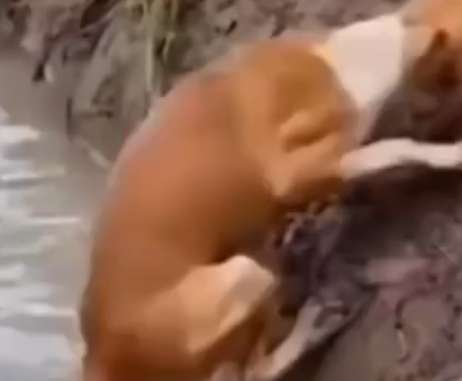
A peaceful moment near a riverbank suddenly turns into a terrifying struggle for survival when a massive snake emerges from the water and grabs a brown dog standing dangerously close to the river’s edge.
The dramatic encounter shows the enormous reptile attempting to overpower the frightened animal and pull it into the water. As the snake tightens its grip, the dog desperately struggles to escape, creating a tense confrontation between two animals fighting for completely different reasons.
What makes the scene particularly frightening is how quickly an ordinary moment beside the river transforms into a potentially life-threatening situation.
A Peaceful Riverbank Turns Into a Dangerous Scene
Rivers are often associated with peaceful surroundings, beautiful landscapes, and the calming sound of flowing water. However, beneath their seemingly quiet surfaces, unexpected dangers can sometimes be hiding.
In this dramatic scene, a brown dog finds itself near the muddy edge of a river, apparently unaware of the threat lurking beneath the water.
Without warning, a large snake emerges and grabs the animal, turning the peaceful environment into the setting of a desperate struggle.
The sudden attack leaves the dog fighting to regain control as the powerful reptile attempts to move backward toward the river.
The muddy ground and slippery riverbank make the situation even more challenging. With limited space to escape, the dog must struggle against both the snake’s strength and the dangerous surroundings.
The Snake Tightens Its Grip Around the Dog
One of the most frightening aspects of the encounter is the snake’s apparent determination to drag the dog into the water.
Large constrictor snakes possess powerful muscles that allow them to restrain prey. Depending on the species, some snakes are also capable of hunting in or near water.
As the struggle continues, the dog twists its body and attempts to pull away from the reptile.
The snake, meanwhile, appears to maintain its hold, using its body and position near the water to gain an advantage.
Every movement increases the tension as the dog struggles to avoid being dragged farther from the safety of the riverbank.
The encounter demonstrates how dangerous a confrontation with a large wild predator can become, particularly when it occurs in an environment where the predator may have a natural advantage.
A Desperate Fight for Survival
The brown dog’s resistance becomes the central focus of the scene.
Despite being caught by the much larger reptile, the animal continues struggling, attempting to free itself from the snake’s powerful grip.
Its movements suggest a desperate effort to remain on land and avoid being pulled into the river.
The water beside the animals adds another layer of danger. If the dog is dragged into deeper water, escaping could become significantly more difficult.
The scene is a reminder that survival in the natural world can depend on strength, instinct, positioning, and sometimes a matter of seconds.
For the dog, the immediate challenge is simple but critical: break free before the snake can pull it farther into the water.
Why Large Snakes Hunt Near Rivers
Many snake species live in environments that provide access to water, shelter, and potential prey.
Rivers, lakes, wetlands, and marshes can offer suitable habitats for reptiles, including several species of large snakes.
Some snakes are excellent swimmers and spend considerable time in aquatic environments.
Large constrictors such as anacondas are especially associated with waterways and wetlands, although the species involved in this particular scene cannot be identified from the description alone.
These predators rely on stealth, strength, and carefully timed movements to capture prey.
Unlike venomous snakes that rely primarily on venom to immobilize their victims, constrictors use muscular pressure to restrain animals and interfere with circulation.
Although attacks on dogs are not everyday occurrences, encounters between domestic animals and large snakes can happen in regions where their habitats overlap.
Why Riverbanks Can Be Dangerous for Pets
Dogs naturally enjoy exploring outdoor environments. Many are attracted to rivers because of the water, unfamiliar smells, and opportunities to investigate their surroundings.
However, riverbanks can present hazards that are not immediately visible.
Thick vegetation, muddy ground, hidden wildlife, and deep water can all create dangerous conditions.
In areas where large snakes are present, pets wandering close to the water may encounter wildlife without warning.
The risk becomes greater when dogs are allowed to explore unfamiliar riverbanks without supervision.
Pet owners visiting these environments should remain aware of their surroundings and keep animals at a safe distance from areas where dangerous wildlife may be hiding.
The Unpredictable Power of Nature
Encounters between predators and other animals can be difficult to witness, particularly when a domestic animal is involved.
The scene of a snake grabbing a dog illustrates the harsh reality of natural survival instincts.
Wild predators do not act out of cruelty in the human sense. Their behavior is generally driven by feeding, defense, and survival.
For the snake, capturing another animal may represent an opportunity for food. For the dog, escaping the encounter is a matter of survival.
These opposing instincts create a dramatic situation in which both animals respond according to their natural behavior.
Such encounters also remind us that wild environments can be unpredictable, even when they appear calm and harmless.
What Should Someone Do If They Witness a Similar Attack?
Witnessing a large snake attacking a pet can be frightening, and the natural reaction may be to rush toward the animals.
However, approaching or attempting to pull an animal away from a large snake without appropriate training can put people at serious risk.
A frightened or defensive snake may bite, and an injured dog may also react unpredictably.
The safest response is generally to keep other people and animals away from the danger and contact trained wildlife rescuers or emergency animal services.
If the dog is rescued, it should receive prompt veterinary attention, even if its injuries are not immediately visible.
Bite wounds, tissue damage, and internal injuries may require urgent treatment.
A Moment That Raises One Important Question
As the confrontation unfolds near the river’s edge, the dog continues fighting against the snake’s grip.
The reptile appears determined to pull its captive toward the water, while the frightened animal struggles to remain on the riverbank.
The outcome of the encounter is not established by the available description, leaving one important question unanswered.
Will the brown dog manage to escape the giant snake, or will the powerful predator succeed in dragging it into the river?
Whatever the outcome, the scene serves as a striking reminder of the dangers that can exist near natural waterways and the importance of protecting domestic animals in wildlife habitats.
What would you do if you witnessed a situation like this? Share your thoughts in the comments.
Leave a Reply