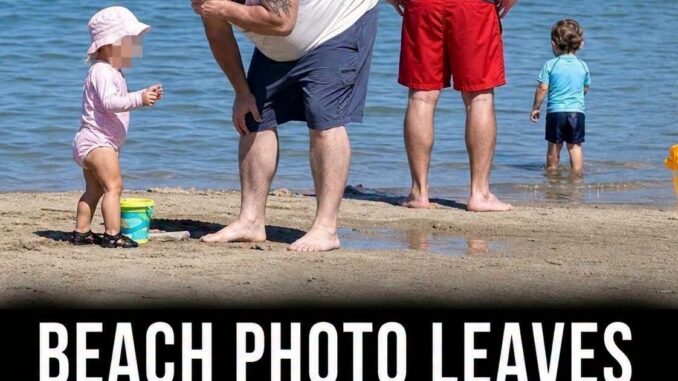
A family photograph taken during a relaxing day at the beach has left thousands of people questioning what might have been lurking in the water.
At first glance, the picture seems completely ordinary.
A father and his young daughter are enjoying themselves near the shoreline at Carrum Beach, with a dog nearby and the ocean stretching out behind them.
Nothing about the scene immediately suggests danger.
But when people began examining the background, they noticed something that changed how they viewed the entire photograph.
A large, dark shape appeared to be moving beneath the water’s surface.
Some viewers believed it was a shark.
Others suggested a much less alarming explanation.
And as the image spread online, one question became impossible to ignore: Had the family unknowingly been standing near a potentially dangerous marine animal?
A Happy Family Moment That Took an Unexpected Turn
Family trips to the beach are usually filled with simple pleasures.
Children play near the shoreline, parents enjoy the fresh air, and photographs capture memories that families can revisit for years.
That appeared to be the case during this particular outing at Carrum Beach in Australia.
A father stood beside his young daughter near the water.
The little girl seemed to be enjoying the experience, surrounded by sand, gentle waves, and the excitement of spending time outdoors.
A dog was also visible nearby.
Someone captured the moment in a photograph.
It was the kind of picture that might normally be saved on a phone, shared with relatives, or added to a family photo album.
But this image contained something unusual.
And it wasn’t immediately obvious.
The Strange Detail Hidden Behind the Family
The most unsettling part of the photograph wasn’t the father or his daughter.
It was the water behind them.
At a distance, a dark silhouette appeared beneath or near the surface.
The shape was partially obscured, making it difficult to identify.
Its outline wasn’t particularly clear.
But to some people examining the image, it resembled a large marine animal.
More specifically, they thought it looked like a shark.
That possibility immediately changed the atmosphere of the photograph.
What had initially appeared to be a peaceful family outing suddenly seemed potentially dangerous.
The father and daughter appeared completely unaware of the shape behind them.
And that apparent lack of awareness made the image even more disturbing to viewers who believed a shark was nearby.
Why People Immediately Suspected a Shark
Sharks are among the most recognizable animals associated with ocean danger.
Although most shark species pose little threat to humans, the possibility of encountering one near a swimming area can understandably cause concern.
In this photograph, the unidentified shape appeared dark against the surrounding water.
Its outline was difficult to distinguish, but certain features seemed consistent with what some viewers expected a shark to look like.
The concern reportedly intensified because a shark warning had been associated with the area.
That additional context influenced how people interpreted the image.
A mysterious underwater shape is one thing.
A mysterious underwater shape photographed in an area reportedly linked to a shark warning is another.
For some viewers, the combination seemed convincing.
But there was an important problem.
The photograph itself did not clearly establish that the animal was a shark.
The Image Quickly Became an Online Mystery
As the photograph circulated online, people began examining it in detail.
Some zoomed in on the dark silhouette.
Others studied the water surrounding it.
Many tried to estimate how large the animal might have been.
The discussions became increasingly divided.
One group believed the outline was unmistakably shark-like.
Another argued that the image was too blurry to support such a conclusion.
Some viewers focused on the apparent shape of the animal.
Others questioned whether perspective was making it seem larger or closer than it actually was.
The debate transformed an ordinary family photograph into a visual mystery.
And the more closely people examined it, the more questions emerged.
A Different Explanation Began to Gain Attention
Not everyone believed the animal was a shark.
Some observers suggested that the mysterious shape could have belonged to a southern eagle ray.
Southern eagle rays are marine animals found in Australian waters.
Their flattened bodies and broad, wing-like fins can create distinctive silhouettes when viewed from above or through shallow water.
Depending on the angle, lighting, and water conditions, a ray’s outline may be difficult to distinguish from other marine animals.
This alternative explanation offered a less frightening possibility.
Perhaps the dark shape wasn’t a shark approaching the family.
Perhaps it was simply a ray swimming through the area.
But the photograph wasn’t detailed enough to confirm that identification either.
The mystery remained unresolved.
What Is a Southern Eagle Ray?
The southern eagle ray is a type of cartilaginous fish related to sharks.
It has a broad, flattened body and wing-like pectoral fins that help it move through the water.
Unlike the familiar streamlined silhouette of many sharks, rays have a more flattened appearance.
They often swim by moving their fins in a graceful, wing-like motion.
When viewed from certain angles, however, their shape can appear unusual.
Water reflections and shadows may make identification even more difficult.
Southern eagle rays are generally not aggressive toward people, although rays should never be handled or deliberately disturbed.
The possibility that the photographed animal was a ray helped explain why some viewers interpreted the image differently.
But without clearer evidence, the suggestion remained only a theory.
Could the Water Have Distorted the Animal’s Appearance?
Water can significantly change how objects appear in photographs.
Light bends as it passes between air and water.
Ripples distort outlines.
Reflections interfere with visibility.
And shadows can make underwater objects seem larger, darker, or differently shaped.
These effects become especially noticeable when the subject is photographed from a distance.
In this case, the mysterious silhouette was not captured with enough clarity to identify its defining features.
Its exact size was uncertain.
Its distance from the family was difficult to judge.
And its shape may have been altered by the surrounding water.
This made the photograph especially challenging to interpret.
What appeared to be a large animal close to shore might have been farther away than viewers assumed.
Alternatively, the shape might have belonged to an animal whose outline was distorted by the camera angle.
The image simply didn’t provide enough information to settle the question.
Was the Animal Actually Close to the Father and Daughter?
One of the most important unanswered questions concerned distance.
In the photograph, the dark shape appeared behind the family.
But that didn’t necessarily mean it was immediately beside them.
Photographs compress three-dimensional scenes into two-dimensional images.
Objects located at different distances can appear much closer together than they really are.
Without reliable measurements or additional images, it is difficult to determine the exact position of the unidentified animal.
The depth of the water also matters.
An animal swimming in deeper water may appear different from one moving through shallow water near the shoreline.
The photograph didn’t provide enough detail to establish these conditions.
As a result, claims that the family was only moments away from danger would go beyond what the image could prove.
The Dog Added Another Interesting Detail
A dog visible near the family became another point of discussion.
Some viewers wondered whether the animal would have reacted if a shark had been swimming nearby.
Would it have barked?
Would it have moved away from the water?
Would the father have noticed the dog’s behavior?
These questions added another layer to the online debate.
However, an animal’s apparent lack of reaction doesn’t prove that a nearby marine creature was harmless or absent.
Dogs respond differently depending on their attention, surroundings, and what they can detect.
A still photograph also cannot reveal how the dog behaved before or after the image was taken.
It captures only a single moment.
The dog may have been calm throughout the outing.
Or it may have reacted to something outside the frame.
There is no way to determine that from the photograph alone.
Why the Family’s Relaxed Expressions Made the Image More Unsettling
Perhaps the most emotionally powerful aspect of the photograph was the contrast between the family’s apparent happiness and the possibility of danger behind them.
The father seemed focused on his daughter.
The little girl appeared carefree.
Neither seemed concerned about the water.
For viewers convinced that the dark shape was a shark, this created a frightening scenario.
They imagined the family standing near a dangerous animal without realizing it.
The photograph seemed to capture a moment of innocence surrounded by uncertainty.
But that interpretation depended on an assumption that hadn’t been verified.
If the animal was a harmless ray, the same photograph would represent an entirely different situation.
The father and daughter might simply have been enjoying a beach outing while marine life passed in the distance.
Nothing dangerous may have happened at all.
How Fear Can Influence What We Think We See
The human brain is remarkably good at recognizing patterns.
This ability helps us identify familiar objects, interpret our surroundings, and respond quickly to possible threats.
But it can also influence how we understand unclear images.
When people expect to see something dangerous, they may interpret ambiguous details in ways that support that expectation.
For example, a dark underwater shape may initially appear meaningless.
But once someone suggests it could be a shark, viewers may begin searching for shark-like features.
A curved outline might resemble a fin.
A shadow might appear to be part of a large body.
A ripple could seem connected to movement.
The mind attempts to organize incomplete information into a recognizable picture.
This doesn’t mean viewers are deliberately imagining things.
It means expectations can influence perception, particularly when visual evidence is limited.
Why Photographs Can Be Misleading
Photographs often feel more trustworthy than written descriptions.
After all, they appear to show exactly what happened.
But a photograph captures only a fraction of a second.
It doesn’t preserve the full sequence of events.
It doesn’t record every sound or movement.
And it doesn’t necessarily reveal the true distance between objects.
A single image may show an animal-shaped shadow without providing enough information to identify it.
The viewer must interpret what remains.
Sometimes those interpretations are accurate.
Other times, they are influenced by assumptions or missing context.
This is why visual mysteries can become so compelling online.
People believe they are examining direct evidence, yet the evidence may be too incomplete to support a definite conclusion.
The Shark Warning Made the Story Even More Dramatic
The reported connection to a shark warning was particularly important.
Warnings can provide useful safety information, but they also influence how people interpret nearby events.
When viewers learned that sharks had reportedly been a concern in the area, the dark shape seemed more threatening.
The possibility of a shark became easier to imagine.
However, a warning associated with a beach doesn’t establish that every unidentified animal photographed there is a shark.
Nor does it confirm that a particular animal was present at the exact moment a photograph was taken.
The timing, location, and details of any warning would need to be verified independently.
Without that confirmation, the warning remains part of the reported context rather than proof of the animal’s identity.
Why Some Viewers Remained Skeptical
While many people were alarmed, others approached the photograph more cautiously.
They pointed out that the shape lacked clear identifying features.
There was no unmistakable view of a shark’s body.
The image didn’t provide reliable information about the animal’s size.
And the water made its outline difficult to interpret.
Skeptical viewers also noted that rays and other marine animals can create unusual silhouettes.
Some suggested that the apparent danger was being exaggerated by the way the photograph was discussed online.
Their central argument was straightforward.
An unidentified dark shape isn’t enough to establish that a shark was present.
The image could support several possibilities.
And without additional evidence, none could be confirmed.
The Strange Experience of Discovering Something After the Moment Has Passed
One reason the story resonates with so many people is the idea of noticing something unsettling only after an event is over.
Imagine returning home from a wonderful family outing.
You scroll through photographs, smiling at the memories.
Then you notice something unusual in the background.
At first, you assume it’s a shadow.
But when you look closer, it appears to resemble an animal.
You enlarge the image.
You study the outline.
And suddenly, a memory that once felt completely ordinary begins to seem different.
You wonder whether you missed something important.
Was there danger nearby?
Were you completely unaware?
Or are you interpreting the photograph differently because you now have time to examine it?
That uncertainty can be difficult to dismiss.
Even when nothing harmful occurred, the possibility of an unseen threat can change how someone remembers an experience.
Why This Beach Photograph Captured So Much Attention
The image combined several elements that naturally attract curiosity.
There was an ordinary family scene.
An unexpected dark shape.
A possible connection to a shark warning.
And a disagreement over what the camera had captured.
The photograph also invited viewers to participate.
Anyone could look at the image and form an opinion.
Some saw a shark.
Others saw a ray.
Still others believed the photograph was too unclear to identify anything.
That uncertainty encouraged repeated examination and discussion.
Unlike a mystery with an obvious solution, this one left room for competing interpretations.
And because the possible consequences seemed frightening, the debate became emotionally engaging.
What Beachgoers Can Learn From the Incident
Regardless of what the photograph captured, the discussion offers an opportunity to think about ocean safety.
Marine environments are home to many different animals.
Most encounters are uneventful.
But beachgoers should still remain aware of local conditions and official safety information.
Before entering the water, it’s sensible to check for warnings, follow lifeguard instructions, and avoid swimming in areas where hazards have been reported.
People should also avoid approaching or disturbing unfamiliar marine animals.
If a potentially dangerous animal is spotted, the safest response is to leave the water calmly and notify the appropriate beach authorities.
These precautions are useful whether or not the dark shape in the photograph was actually a shark.
The Difference Between a Possible Threat and a Confirmed Danger
One of the most important lessons from the image is the distinction between possibility and certainty.
The photograph appears to show a dark object or animal in the water.
That observation is different from concluding that the object was a shark.
And identifying a shark would still be different from proving that the family faced an immediate threat.
Each conclusion requires additional evidence.
The image doesn’t clearly establish the animal’s species.
It doesn’t reliably show how far the animal was from the family.
And it doesn’t demonstrate that an attack or dangerous encounter was imminent.
Recognizing these limitations doesn’t make the photograph less interesting.
It simply allows viewers to separate what can be observed from what is being imagined.
Could the Mystery Ever Be Solved?
A clearer photograph or video might help identify the animal.
Additional images taken moments before or after could reveal its movement and shape.
Reliable information about the location, water depth, and surrounding conditions might also narrow the possibilities.
Marine wildlife specialists could potentially offer an informed assessment if sufficient visual evidence were available.
But the original image, as described, leaves too many questions unanswered.
Without better evidence, the competing explanations remain speculative.
The dark silhouette might belong to a shark.
It might be a southern eagle ray.
Or it could be another marine animal or underwater feature entirely.
The photograph alone cannot settle the debate.
The Real Reason the Image Is So Unsettling
The most memorable part of the photograph isn’t necessarily the mysterious shape.
It’s the possibility that something important was happening in the background while the people in the foreground remained unaware.
The father and daughter were enjoying a normal moment.
They had no apparent reason to believe anything unusual was happening.
But viewers examining the image later began imagining a completely different scene.
A possible predator.
An unnoticed danger.
A frightening encounter that might have happened.
That contrast between an ordinary memory and an imagined threat gives the photograph its emotional power.
It reminds us how easily new information can change the way we interpret the past.
Even when the facts themselves remain uncertain.
Final Thoughts: One Unidentified Shadow Changed How People Saw an Ordinary Family Photo
What began as a simple photograph of a father and daughter at Carrum Beach became the subject of widespread curiosity.
A dark silhouette in the water led some viewers to suspect a shark.
Others suggested a southern eagle ray.
The presence of a dog, the apparent distance from shore, and the reported shark warning all became part of the discussion.
But none of those details conclusively identified the mysterious shape.
The image remained open to interpretation.
And perhaps that’s why it continued to attract attention.
It offered just enough visual information to raise an unsettling question, but not enough to provide a definitive answer.
Sometimes, the most frightening part of a photograph isn’t what it clearly shows. It’s what we think might be hiding in the background.
The father and daughter remain frozen in a peaceful moment.
The dog is nearby.
The water stretches behind them.
And somewhere within that scene is a dark shape that viewers still cannot confidently identify.
Maybe it was a shark.
Maybe it was a ray.
Maybe it was something else.
Whatever the truth, the photograph demonstrates how a single unexplained detail can transform an ordinary memory into an enduring mystery.
And sometimes, what we imagine might have happened is more unsettling than anything the photograph can actually prove.
Leave a Reply