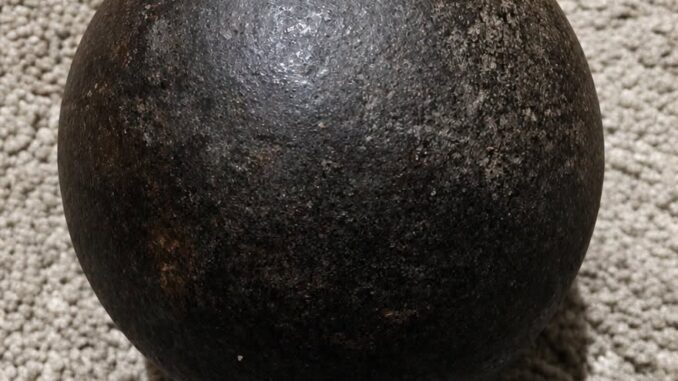
Imagine visiting an old battlefield or walking through a history museum when you notice a heavy, rust-covered iron ball displayed behind glass.
At first glance, it might not seem particularly remarkable.
It has no elaborate decorations, intricate carvings, or complicated machinery. It is simply a solid-looking sphere of metal, often darkened by centuries of exposure to the elements.
Yet this ordinary-looking object may have played a role in some of history’s most significant conflicts.
It is a cannonball, a powerful reminder of an era when artillery transformed warfare, challenged traditional defenses, and changed the course of battles.
Today, cannonballs are preserved in museums, archaeological collections, and historical exhibitions. They offer valuable insights into the technology, military strategies, and human experiences of earlier generations.
But their significance extends far beyond the battles in which they were used.
These artifacts also tell a story about human ingenuity, the development of engineering, and the importance of preserving our shared history.
When History Becomes Something You Can Touch
For many people, their first meaningful encounter with history happens outside a textbook.
Perhaps it takes place during a school trip to a museum.
A teacher points toward an old piece of military equipment and explains how it was used centuries ago.
Or a museum guide shows visitors a historical artifact and describes the people who once handled it.
Suddenly, the past feels more real.
Instead of memorizing dates and names, visitors begin imagining the lives of people who experienced those events firsthand.
An old cannonball can create this kind of connection.
Its weight, texture, and weathered appearance make it different from an illustration in a history book.
It is physical evidence that the events we study actually happened.
Someone manufactured that object.
Someone transported it.
And at some point, it may have been used during a conflict that affected countless lives.
That is what makes historical artifacts so compelling.
They transform distant events into something tangible.
What Exactly Is a Cannonball?
A cannonball is a projectile designed to be fired from a cannon.
Although the term often brings to mind a large iron sphere, historical artillery ammunition existed in several forms.
Early cannonballs were frequently made from stone.
As metalworking techniques developed, iron became increasingly important because it offered greater durability and more consistent performance.
Iron projectiles could withstand the forces involved in firing and cause significant damage when striking their targets.
The familiar spherical shape was practical.
Round projectiles were relatively straightforward to manufacture and load into early cannons.
Once fired, they could travel considerable distances and strike defensive walls, buildings, ships, or formations of soldiers.
However, not every historical artillery projectile was identical.
Different designs were developed for different military purposes.
Why Were Cannonballs Round?
The spherical shape of traditional cannonballs was closely connected to the technology available at the time.
Early artillery relied on relatively simple loading and firing mechanisms.
A round projectile could fit inside a cylindrical cannon barrel and be propelled forward by expanding gases produced when gunpowder burned.
Manufacturing spherical ammunition also allowed metalworkers to produce projectiles in relatively consistent sizes.
This was important because cannons were designed for specific ammunition dimensions.
A projectile that did not fit properly could create serious problems.
Military forces therefore needed dependable manufacturing methods and standardized supplies.
Although a cannonball appears simple today, producing reliable ammunition required knowledge of materials, measurements, and manufacturing.
Its shape reflected the practical engineering needs of the period.
The Different Types of Historical Artillery Ammunition
Not all cannon ammunition was designed to function in the same way.
One of the most familiar forms was solid shot.
These projectiles relied on their mass and momentum to damage targets.
A solid iron cannonball did not need to explode to be destructive.
Other artillery ammunition was developed to produce different effects.
Some historical projectiles contained explosive charges, while other types were designed to disperse smaller pieces of metal.
These variations reflected the changing demands of warfare.
Armies needed weapons capable of attacking fortified positions, damaging ships, and disrupting enemy formations.
As artillery technology improved, ammunition became more specialized.
This development helped transform cannons from relatively basic weapons into increasingly sophisticated military systems.
How Cannons Changed the History of Warfare
The development of artillery marked a major turning point in military history.
Before powerful cannons became widespread, many defensive structures were designed primarily to resist traditional siege weapons and direct attacks.
Thick walls, towers, and elevated positions could provide substantial protection.
However, increasingly effective artillery challenged these defenses.
Cannons allowed attacking forces to strike targets from a distance with tremendous force.
Repeated bombardment could weaken defensive structures and create openings in fortifications.
This forced military engineers to reconsider how castles and forts should be constructed.
Over time, the growing power of artillery influenced battlefield strategies, defensive architecture, and military organization.
The cannonball was one of the essential components of this transformation.
The Evolution of Early Artillery
The earliest cannons were far less reliable than modern weapons.
They could be difficult to transport, slow to reload, and dangerous to operate.
Manufacturing limitations also affected their performance.
Military engineers gradually worked to improve cannon construction.
They experimented with stronger materials, more dependable manufacturing techniques, and improved ammunition.
Greater consistency in cannonball production helped artillery crews use weapons more effectively.
Standardized ammunition became increasingly important as armies expanded their artillery capabilities.
The development of cannons was therefore not simply about creating larger weapons.
It involved progress in metallurgy, engineering, transportation, and military planning.
Each improvement contributed to the broader evolution of warfare.
The Devastating Power of a Solid Iron Cannonball
Modern audiences often associate artillery with explosions.
However, traditional solid cannonballs could cause tremendous damage without containing explosives.
Their destructive power came from their speed, weight, and momentum.
When fired from a cannon, a heavy iron sphere could strike a target with considerable force.
Against buildings and defensive structures, repeated impacts could damage walls and weaken fortifications.
On battlefields, solid shot could inflict severe injuries and disrupt troop formations.
The effectiveness of these projectiles depended on factors such as the weapon, ammunition, distance, and target.
Even so, their role in historical warfare was significant.
The simple iron sphere became one of the most recognizable symbols of early artillery.
What Battlefields Were Like During the Age of Cannons
Imagine standing on a battlefield several centuries ago.
Soldiers are moving into position.
Officers are shouting commands.
Horses are carrying equipment and personnel across the terrain.
Smoke from gunpowder hangs in the air.
Then comes the sound of artillery fire.
Cannons produce tremendous noise, and their projectiles can cause destruction far beyond the immediate firing position.
For soldiers, the presence of artillery added another layer of danger and uncertainty.
They had to contend not only with opposing troops but also with powerful weapons capable of striking from a distance.
Artillery could influence where soldiers moved, how formations were arranged, and which positions could be defended.
Its psychological impact was also important.
The sound and destructive potential of cannon fire could create fear and confusion.
These conditions help explain why artillery became such an influential part of military strategy.
Cannonballs and the Transformation of Naval Warfare
Cannons also played a major role in battles at sea.
For centuries, wooden warships carried artillery intended to damage enemy vessels.
During naval engagements, ships could exchange cannon fire while maneuvering across the water.
Solid iron cannonballs could strike wooden hulls, damage equipment, and injure crew members.
The resulting destruction could be severe.
Wooden structures might splinter under repeated impacts.
Masts, rigging, and other essential components could be damaged.
Crew members faced dangerous conditions as ships exchanged fire.
The development of naval artillery influenced ship construction and maritime military tactics.
Cannonballs became closely associated with an era of wooden warships and large naval engagements.
Today, recovered naval projectiles can help researchers understand the weapons and technologies used during these conflicts.
How Artillery Changed Castles and Fortresses
One of the most important consequences of artillery development was its effect on defensive architecture.
For centuries, castles and fortified walls had provided protection against invading forces.
Their height and thickness made them difficult to attack using many traditional methods.
But increasingly powerful cannons changed the situation.
Stone walls could become vulnerable to sustained bombardment.
Military engineers responded by designing fortifications better suited to withstand artillery fire.
Defensive structures gradually evolved to address new threats.
This created an ongoing competition between offensive and defensive technology.
As artillery became more effective, fortifications had to adapt.
As defenses improved, attackers developed new approaches.
The cannonball was central to this changing relationship between weapons and military architecture.
Why Old Cannonballs Matter to Archaeologists
Today, an old cannonball may appear to be nothing more than a rusted piece of metal.
For archaeologists, however, it can provide valuable historical evidence.
Artifacts recovered from battlefields and other historical sites may help researchers reconstruct past events.
The location of a projectile can be especially important.
When several cannonballs are discovered in a particular area, their distribution may offer clues about military activity.
Researchers may examine where artillery was positioned, which locations were targeted, and where fighting was concentrated.
The size and material of a projectile can also provide information.
These characteristics may help identify the type of weapon associated with it or the general period in which it was manufactured.
However, interpreting archaeological evidence requires care.
A single object rarely tells the entire story.
Its significance becomes clearer when examined alongside other discoveries and historical records.
Why the Location of an Artifact Matters
Archaeologists place considerable importance on the context in which objects are discovered.
A cannonball found near a former fortification may have a different historical significance from one recovered from a shipwreck.
Its exact position, surrounding materials, and relationship to nearby artifacts can provide useful clues.
Researchers document these details because they help reconstruct how an object came to be in a particular location.
Removing an artifact without recording its context can destroy valuable information.
This is why archaeological work involves more than simply collecting interesting objects.
It requires careful observation, documentation, and interpretation.
A cannonball’s location may be just as informative as the object itself.
Preserving that information allows future researchers to study the evidence more effectively.
The Stories Hidden Beneath Layers of Rust
Old iron objects often develop corrosion after years of exposure to moisture and oxygen.
A cannonball that once had a relatively smooth surface may become rough, discolored, and heavily rusted.
To an ordinary observer, this deterioration might make the object appear less interesting.
But its weathered condition can also reflect its long history.
Perhaps the projectile remained buried beneath a battlefield for generations.
Maybe it spent centuries underwater before being recovered.
Or perhaps it was stored in a building and passed through several owners before reaching a museum.
Every artifact has a history of its own.
Sometimes that history can be documented.
In other cases, researchers must rely on physical evidence and historical records to understand its origins.
The marks left by time can become part of the object’s story.
How Historians Reconstruct the Past
Historical artifacts rarely provide complete explanations by themselves.
Instead, historians combine different kinds of evidence.
Written records may describe military campaigns or battles.
Old maps can reveal the locations of fortifications and troop movements.
Archaeological discoveries provide physical evidence of activity.
Museum collections may contain similar objects with documented histories.
By comparing these sources, researchers can develop a more detailed understanding of historical events.
A cannonball may help support an interpretation of a battle, but it usually cannot establish every detail on its own.
This process is similar to assembling a puzzle.
Each discovery contributes another piece.
Over time, the evidence can reveal patterns that were previously unclear.
Why People Collect Historical Cannonballs
Historical military artifacts attract interest from collectors, researchers, and enthusiasts.
For some people, the appeal lies in the connection to a particular period of history.
Others are interested in military technology or the craftsmanship involved in producing old weapons.
A cannonball may be associated with a specific battlefield, fortification, or historical conflict.
Its age, condition, and documented origin can influence its historical interest.
Collectors often value provenance, meaning the known history of an object’s ownership and discovery.
Reliable documentation can help establish authenticity and historical significance.
However, collecting military artifacts also involves important legal, ethical, and safety considerations.
Not every old projectile is suitable for private handling or display.
An Important Warning About Old Cannonballs
One of the most important facts about historical artillery ammunition is that some old projectiles can still be dangerous.
Not every cannonball contains explosives.
Many traditional cannonballs were solid iron spheres.
However, some historical artillery projectiles were designed to explode.
Unexploded ammunition can remain hazardous long after the conflict in which it was used.
Age and corrosion do not necessarily make such objects safe.
An unfamiliar projectile discovered underground, underwater, or near a former military site should never be assumed harmless.
Its appearance alone may not reveal whether it contains explosive material.
For that reason, potentially dangerous military artifacts should be left to trained professionals.
What to Do If You Discover a Suspected Cannonball
Finding an unusual iron sphere while exploring an old battlefield or digging on private land may seem exciting.
However, safety must come before curiosity.
If the object could be historical ammunition, do not attempt to inspect it yourself.
Do not pick it up, move it, strike it, or attempt to open it.
Avoid transporting it in a vehicle.
Instead, leave the object undisturbed, move away, keep other people clear, and contact the appropriate local authorities.
Qualified specialists can determine whether the object is dangerous and arrange for safe handling if necessary.
Even if the projectile appears old, rusted, or damaged, it should not be treated as harmless without professional assessment.
Historical discoveries can be fascinating, but personal safety is always more important than recovering an artifact.
What Cannonballs Reveal About Early Engineering
A cannonball may seem like a basic object, but it represents considerable technological knowledge.
Manufacturing reliable artillery ammunition required understanding materials and dimensions.
Metalworkers needed techniques for producing projectiles that were sufficiently consistent for military use.
Engineers also had to design cannons capable of firing them.
Artillery crews needed ways to transport heavy equipment and operate weapons under difficult conditions.
Military planners had to consider the practical limitations of their technology.
These challenges encouraged innovation across several fields.
The development of artillery demonstrates that technological progress existed long before computers and modern electronics.
Even an ordinary-looking iron sphere can reveal the complexity of earlier engineering.
The Connection Between Artillery and Industrial Development
The production of cannons and cannonballs required access to materials, skilled labor, and manufacturing facilities.
As military demands increased, producing consistent equipment became increasingly important.
Foundries and metalworking workshops played a significant role in supplying artillery.
Workers needed to understand casting, shaping, and quality control.
Transportation systems were also essential because cannons and ammunition could be extremely heavy.
These requirements connected military technology to broader developments in manufacturing and logistics.
The history of artillery therefore overlaps with the history of industry.
Studying cannonballs can provide insight into how societies organized production and applied technical knowledge.
The Human Cost Behind These Historical Objects
Although cannonballs can be fascinating from an engineering perspective, their original purpose should never be forgotten.
They were weapons.
They were designed to damage structures, destroy equipment, and injure or kill people.
The conflicts in which they were used often caused enormous suffering.
Soldiers faced injury and death on battlefields.
Civilians could lose homes and livelihoods.
Communities could experience destruction and displacement.
Families were affected by events far beyond their control.
When examining historical weapons, it is important to recognize both their technological significance and their human consequences.
Understanding the past requires acknowledging the suffering associated with warfare.
Why Museums Preserve Weapons of War
Museums preserve military artifacts for reasons that extend beyond displaying old equipment.
These objects help explain how warfare developed and how societies responded to conflict.
A cannonball can illustrate the technology available during a particular period.
It can also help visitors understand the conditions faced by soldiers and civilians.
When displayed alongside historical documents, maps, and other artifacts, it becomes part of a broader educational story.
Museums can use these objects to encourage questions about military strategy, political decisions, and the consequences of war.
Preserving historical weapons does not require celebrating their destructive purpose.
Instead, it allows people to study the past and reflect on its lessons.
The Challenges of Preserving Old Iron Artifacts
Even objects made from iron can deteriorate over time.
Moisture, oxygen, and changing environmental conditions can contribute to corrosion.
For historical artifacts, this creates significant conservation challenges.
Museum specialists must consider how to protect objects without unnecessarily altering them.
Cleaning an artifact too aggressively can remove important surface details.
Restoration may improve its appearance, but it can also affect historical evidence.
Conservators therefore evaluate the condition of each object before deciding how it should be treated.
In some cases, preserving the existing surface is more important than making the artifact look new.
The goal is to protect both the physical object and the information it contains.
Should Historical Artifacts Be Restored?
Restoration is an important topic in museum conservation.
Some visitors may prefer seeing historical objects in a condition that resembles their original appearance.
Others appreciate the visible signs of age.
Both perspectives raise questions about how artifacts should be presented.
Removing corrosion may reveal details that were previously hidden.
However, excessive treatment can damage original surfaces or erase evidence.
Conservation specialists must balance accessibility, preservation, and historical accuracy.
The appropriate approach depends on the object’s condition, materials, and significance.
For many artifacts, careful stabilization is more valuable than extensive restoration.
Preserving their authenticity helps future generations study them.
Why Historical Artifacts Make Learning More Meaningful
History can sometimes feel distant when it is presented only through written information.
Students may memorize dates, battles, and names without fully imagining the people involved.
Physical artifacts can help bridge that gap.
Seeing an old cannonball in a museum makes the technology of earlier warfare more tangible.
Its size and appearance encourage questions.
How was it made?
How heavy was it?
What kind of cannon fired it?
Where was it discovered?
Who might have handled it?
These questions can lead to deeper exploration of historical events.
Objects encourage curiosity because they provide something concrete to examine.
They remind visitors that history was experienced by real people.
The Importance of Remembering Ordinary People
Historical accounts often focus on famous leaders, generals, and major battles.
But countless ordinary people contributed to the events that shaped the past.
Metalworkers manufactured weapons.
Laborers transported materials.
Engineers designed equipment.
Soldiers operated artillery.
Civilians experienced the consequences of conflict.
Many of these individuals are absent from traditional historical narratives.
Yet their work and experiences were essential parts of history.
Artifacts can help draw attention to these less visible stories.
A cannonball may have been produced by a craftsman whose name was never recorded.
It may have been transported by workers who received little recognition.
It may have affected the lives of people whose experiences were never documented.
Remembering these individuals creates a more complete understanding of the past.
How One Small Object Can Represent an Entire Era
A historical artifact does not need to be elaborate to be meaningful.
Sometimes, a simple object can represent a much larger period of technological and social change.
A cannonball reflects the development of metallurgy.
It represents advances in artillery.
It connects to changes in battlefield strategy.
It reveals how fortifications evolved.
It can provide archaeological evidence.
And it reminds us of the human consequences of warfare.
All of these stories can be connected to a single iron sphere.
That is what makes historical artifacts so valuable.
Their physical simplicity often hides a much more complicated history.
Learning From the Past Without Glorifying War
Studying military history involves understanding both innovation and destruction.
Cannons and artillery projectiles demonstrate the technical abilities of earlier societies.
But they also reveal how those abilities were used during conflict.
The same knowledge that allowed people to manufacture stronger metals and more effective machinery could be applied to increasingly destructive weapons.
This relationship between invention and consequence remains relevant today.
Technological progress can create new possibilities, but it can also introduce new risks.
Historical artifacts encourage us to examine not only what people invented but also how those inventions affected others.
That perspective helps make the study of history more thoughtful and meaningful.
Why Preserving Historical Evidence Matters
Once an artifact is destroyed or removed from its original context without documentation, important information may be lost.
Preservation helps protect evidence for future research.
Museums, archaeological organizations, and conservation specialists work to maintain objects that can deepen our understanding of earlier generations.
Their efforts allow researchers to revisit historical questions as new techniques become available.
An artifact studied today may reveal additional information in the future.
Preservation also supports education.
Future generations can examine physical objects rather than relying entirely on written descriptions.
This creates opportunities for new discoveries and interpretations.
Protecting historical evidence helps ensure that the past remains accessible.
A Rusty Cannonball Can Inspire Bigger Questions
Imagine a child standing in front of a museum display.
Inside the case is an old cannonball.
At first, the child sees only a rusty sphere.
Then curiosity begins.
Why was it made?
How did people use it?
What happened during the battle where it was found?
How did soldiers survive in those conditions?
Why did countries go to war?
A single artifact can lead to questions about engineering, politics, society, and human behavior.
This is one of the greatest strengths of historical objects.
They encourage people to look beyond appearances.
They invite us to explore the circumstances that gave them meaning.
Final Thoughts: More Than Just an Old Piece of Iron
An old cannonball may appear ordinary compared with the advanced technology of the modern world.
But its historical importance can be remarkable.
These projectiles were part of a technological transformation that changed warfare, influenced defensive architecture, and affected countless lives.
Today, surviving cannonballs provide valuable evidence for historians and archaeologists.
They help researchers understand the weapons, manufacturing methods, and conflicts of earlier centuries.
They also remind us of the human cost associated with military innovation.
Whether displayed in a museum, studied at an archaeological site, or preserved in a historical collection, a cannonball represents far more than its physical materials.
It is a connection to the people, decisions, technologies, and events that shaped the world we inherited.
The next time you encounter an old military artifact, consider the history behind it.
Think about the people who created it, the circumstances in which it was used, and the generations that lived with its consequences.
Because sometimes, an object as simple as a rusted iron sphere can reveal an extraordinary story about humanity’s past.
And by preserving and studying these reminders, we give future generations the opportunity to understand not only what happened before them, but also what those events can teach us about the future.
Leave a Reply