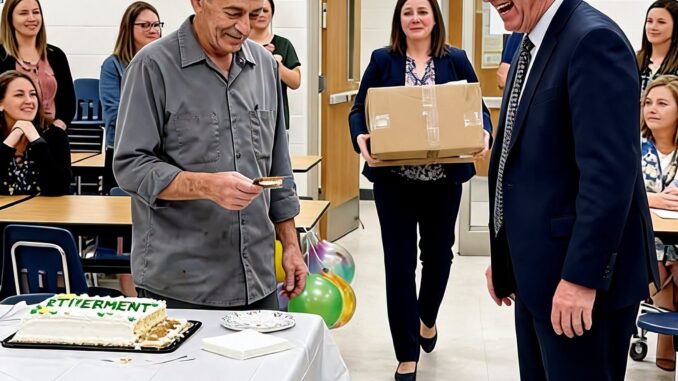
After 38 years of working as the janitor at our elementary school, Mr. Earl was handed a $25 gift card by the principal in front of the entire staff. The principal even made a joke about it, saying, “Now you can finally go home and clean your OWN house for a change!”
A few teachers laughed.
Mr. Earl simply smiled, thanked him politely, and slipped the envelope into his shirt pocket. His hand trembled slightly as he did so.
Then I walked into the cafeteria carrying a large cardboard box. Nobody knew what was inside it. But the moment I pulled out the first item, the cafeteria manager covered her mouth, and tears began rolling down her cheeks.
Thirty years earlier, I had been the little girl at Lincoln Elementary who wore sneakers with holes in them.
My mother worked two jobs just to keep food on the table, and even with all her effort, there were months when we couldn’t afford to keep the electricity running. Sometimes, I ate the free lunch provided at school and went home pretending I wasn’t hungry because I knew there wasn’t always enough food for dinner.
I had learned how to hide those things from other children. I didn’t want anyone to feel sorry for me, and I certainly didn’t want to become the subject of whispers in the classroom.
But there was one person who seemed to notice everything.
He wasn’t a teacher, a counselor, or even a school administrator.
He was the janitor.
His name was Earl Haskins.
He wore the same gray uniform almost every day, had a thick mustache, and carried a large ring of keys that jingled whenever he walked through the hallways. He knew all 400 students by name, and somehow, he remembered the smallest details about each of us.
He noticed when someone was having a difficult day. He noticed when a child came to school without a proper coat during the winter. He even noticed when someone was sitting alone during lunch.
When I was in third grade, my winter coat had a broken zipper. I wore it anyway because my mother couldn’t afford to replace it. Every morning, I struggled to pull the zipper together, and every afternoon, I walked home holding the two sides closed with my hands.
One Monday morning, I arrived at school and discovered something unusual.
There was a brand-new purple coat hanging on my hook.
I looked around, wondering whether someone had made a mistake. There was a small tag attached to it that read:
“Lost and Found — Maya.”
I knew immediately that something wasn’t right. The coat looked new, and there was still a store sticker inside.
I never found out who had placed it there.
But I suspected Mr. Earl.
He never mentioned it, and I never asked. Somehow, I understood that he didn’t want me to feel embarrassed or indebted to anyone.
That small act of kindness stayed with me long after I left Lincoln Elementary.
Today, I’m a pediatric surgeon. I spend my days helping children who are frightened, sick, and sometimes too young to understand why they’re in a hospital. Whenever I meet a child who feels alone, I remember the little girl I used to be and the man who quietly made her feel seen.
Last June, I heard that Mr. Earl was finally retiring after 38 years of service.
I couldn’t let that moment pass without seeing him again.
I drove two hours to Lincoln Elementary, hoping to surprise him and thank him personally for something he probably hadn’t thought about in decades.
When I arrived, I discovered that the school was holding a small retirement celebration in the cafeteria.
Calling it a celebration would have been generous.
There was a grocery-store sheet cake sitting on a folding table, a handful of balloons tied to the chairs, and about twelve people scattered around the room. Most of them seemed more interested in checking their phones than paying attention to the occasion.
The principal, who had only been working at the school for three years, stood near the front and began delivering a short speech.
He talked about how Mr. Earl had spent nearly four decades cleaning up after generations of students.
“Thirty-eight years of mopping up after these kids, Earl!” he announced with a grin.
A few people chuckled.
Then he handed Mr. Earl a small envelope.
“Here’s a $25 gift card to the hardware store. Now you can finally go home and clean your OWN house for a change!”
He laughed loudly at his own joke.
Some of the teachers joined him.
Mr. Earl didn’t react negatively. He simply gave his familiar smile and answered politely.
“Thank you, sir. That’s very kind.”
But I noticed something that apparently nobody else did.
His hand was shaking as he slipped the envelope into his shirt pocket.
I stood there for a moment, looking at the man who had spent 38 years caring for children who weren’t even his own.
Thirty-eight years of opening doors, cleaning classrooms, fixing broken things, picking up forgotten belongings, and quietly helping children who needed someone.
And all they had given him was a $25 gift card and a joke.
I couldn’t stand there any longer.
I walked toward the front of the cafeteria, carrying the heavy cardboard box I’d brought with me. I placed it on the table beside the cake.
Mr. Earl turned toward me.
“Can I help you, ma’am?” he asked.
I smiled.
“It’s Maya Ortiz,” I said. “The little girl with the purple coat. Third grade.”
For a few seconds, he simply stared at me.
Then his eyes filled with tears.
“Maya?” he whispered.
I nodded.
He stepped closer, looking at me as though he were trying to recognize the little girl he’d known so many years ago.
Before he could say anything else, the principal interrupted.
“I’m sorry, we’re in the middle of something.”
I turned toward him.
“So am I,” I replied.
Then I opened the cardboard box.
The first thing I removed was a thin, worn green ledger book. Its corners were damaged, its cover was faded, and several pages had yellowed with age.
It looked like something that should have been sitting in an old storage cabinet.
But to the woman standing at the back of the cafeteria, it meant something much more.
The cafeteria manager, Mrs. Bennett, recognized it immediately.
She put one hand over her mouth, and tears began streaming down her face.
“Where did you get that?” she whispered.
I looked at her, then at Mr. Earl.
“That’s exactly what I came here to talk about.”
I carefully placed the ledger on the table and opened it.
Inside were dozens of handwritten entries, each with a date, a child’s name, and a brief description of something that child needed.
Some entries mentioned winter coats. Others listed shoes, school supplies, lunch money, and groceries.
There were notes about children who needed breakfast before class, children whose families had lost their homes, and children who came to school wearing the same clothes every day.
I turned a few pages.
Mr. Earl leaned forward.
His expression changed as he recognized the handwriting.
“Where did you find this?” he asked again, his voice barely audible.
“Mrs. Bennett helped me locate it,” I explained. “But before I tell you the whole story, I want everyone here to understand what this book represents.”
The cafeteria became completely quiet.
I explained that I had started looking into Mr. Earl’s retirement a few weeks earlier. I wanted to do something meaningful for him, but I knew that simply buying him a present wouldn’t be enough.
I wanted to understand how much he had given to the school over the years.
During my search, I contacted a few former teachers and employees. One of them mentioned that Mr. Earl had once kept a small notebook where he recorded the needs of students whose families were struggling.
That was how I learned about the green ledger.
Mrs. Bennett, who had worked in the cafeteria for many years, remembered seeing him carrying it around. She told me that he used to visit her before the school day began, asking whether there were extra sandwiches, fruit, or milk available.
At first, she thought he was simply trying to help the children who forgot their lunches.
Eventually, she discovered that he was keeping track of students who regularly went without food.
“He never wanted anyone to know,” she said, wiping her eyes. “He would ask me to put something aside and tell the children it was extra food from the kitchen. He didn’t want them to feel ashamed.”
I looked at Mr. Earl.
He lowered his head.
I continued turning the pages.
There was my name.
Maya Ortiz.
Beside it was a short note written in faded blue ink:
“Third grade. Purple coat needed. Zipper broken. Mother working two jobs. Make sure she gets breakfast when possible.”
I couldn’t hold back my tears.
For thirty years, I had remembered the purple coat as one of the kindest things anyone had ever done for me.
But now I was discovering that it wasn’t an isolated act.
It was part of something much bigger.
I looked around the cafeteria.
“How many children do you think he helped?” I asked.
Nobody answered.
So I turned another page.
Then another.
There were hundreds of entries.
Some students had received coats, others had been given backpacks, shoes, or school supplies. There were notes about families who needed groceries and children who had been quietly given breakfast before anyone else arrived.
And the most surprising part was that Mr. Earl had never recorded these things to receive recognition.
He had simply written them down so he wouldn’t forget who needed help.
The principal was no longer smiling.
He stared at the ledger, then glanced toward Mr. Earl.
“Is all of this true?” he finally asked.
Mr. Earl took a deep breath.
“I just did what I could,” he replied.
Mrs. Bennett stepped forward.
“That’s not all he did,” she said.
She explained that many years earlier, when the cafeteria budget was tight, Mr. Earl had sometimes used his own money to buy groceries and basic supplies for families who were struggling.
He had never asked to be reimbursed.
He had never told anyone.
And whenever someone thanked him, he always gave the same answer.
“Those children are our responsibility.”
I reached into the box again.
This time, I removed a large envelope.
Inside was a letter from a group of former Lincoln Elementary students, including several who had grown up to become doctors, teachers, business owners, nurses, and parents.
I had spent the previous month contacting people who remembered Mr. Earl.
I asked them one simple question:
“Did Mr. Earl ever do something for you that you never forgot?”
The responses were overwhelming.
One former student wrote about receiving his first winter boots.
Another remembered being given a lunch every Friday because his family couldn’t afford groceries.
A woman who now taught second grade said that Mr. Earl had once stayed late to help her find a lost school project because he knew her father would be angry if she came home without it.
There were dozens of stories.
And every single one ended with gratitude.
I placed the letters on the table.
“Mr. Earl, you may think you spent 38 years cleaning this school,” I said, looking directly at him. “But you did much more than that. You made children feel safe. You made them feel important. And for some of us, you were the first person who made us believe that someone cared.”
He covered his face with both hands.
I reached into the box one final time and pulled out a framed document.
It was a photograph of the original Lincoln Elementary building, surrounded by the signatures of former students and staff members.
Below it was a message:
“To Earl Haskins, who taught generations of children that kindness is something you do, not something you talk about.”
But that wasn’t the only surprise.
I had also arranged something else.
For the past several weeks, a group of former students and community members had been raising money to establish a permanent student assistance fund in Mr. Earl’s honor.
The fund would provide winter clothing, shoes, school supplies, groceries, and emergency assistance to children whose families needed support.
We had raised enough money to get it started, and several local businesses had agreed to contribute every year.
I handed him another envelope.
“This isn’t a retirement gift card,” I said. “It’s the beginning of something that will keep helping children long after your last day here.”
He opened the envelope with trembling fingers.
When he saw the document inside, he began crying.
Mrs. Bennett hugged him.
One of the teachers who had laughed at the principal’s joke quietly stepped forward and apologized.
The principal stood frozen for a moment before finally approaching Mr. Earl.
“I didn’t know,” he said.
Mr. Earl wiped his eyes and gave him that same gentle smile.
“That’s all right,” he replied.
But I knew something had changed in that cafeteria.
People were no longer looking at Mr. Earl as the man who emptied trash cans and cleaned floors.
They were finally seeing the person he had been all along.
Before I left, I asked him whether he still remembered the little girl who had received the purple coat.
He smiled.
“Of course I remember you, Maya,” he said. “You used to sit near the window at lunch. You always tried to save half your sandwich.”
I laughed through my tears.
“I thought nobody noticed.”
He shook his head.
“Somebody always notices, sweetheart. Sometimes they just don’t say anything.”
Those words stayed with me long after I drove away.
A few months later, the student assistance fund was officially established. The school began using it to help families who were facing difficult circumstances, and former students continued sending donations.
Mr. Earl came back for the opening ceremony.
He wore a clean gray suit instead of his old janitor uniform, but he still carried the same ring of keys.
When I asked why, he smiled and told me he hadn’t found a reason to stop carrying them.
I think he simply wasn’t ready to let go of the place where he had spent so much of his life.
That day, I realized something I wish every school administrator understood.
Some of the most important people in a school aren’t standing in front of a classroom. Some aren’t giving speeches, receiving awards, or having their names printed on certificates.
Sometimes, they’re walking quietly through the hallways with a mop in one hand and a ring of keys in the other.
And sometimes, they’re the reason a child makes it through another difficult day.
Mr. Earl had spent 38 years taking care of a building.
But more importantly, he had spent 38 years taking care of the people inside it.
And while the school had given him a $25 gift card, the children whose lives he had touched had given him something far more meaningful.
They had remembered.
And that was something no retirement envelope could ever replace.
Leave a Reply