I never expected that leaving a job after six years would end with thousands of pennies scattered across my driveway.
It was a Friday afternoon in late September when my former employer arrived at my home in his pickup truck.
Instead of handing me a check or depositing my final wages into my bank account, he began emptying buckets of coins onto the gravel.
I stood on the porch, unable to understand what was happening.
My two children watched from behind me.
When the last bucket was empty, my former boss attached my pay stub to one of the containers.
“Paid in full,” he announced.
Then he climbed into his truck and drove away.
The coins added up to $915, the amount of my final paycheck.
There were 91,500 pennies.
Every one of them was covered in dark motor oil.
At first, I felt frustrated and embarrassed.
I had worked hard for those wages, and I couldn’t understand why my decision to accept another job had led to this.
But over the following days, my children and I found a way to turn the situation into something meaningful.
What began as an unpleasant employment experience eventually inspired a community project that helped local students and brought neighbors together.
Six Years at the Auto Repair Shop
My name is Becky Lindahl, and I was thirty-four years old when these events took place.
I lived with my husband, Jake, and our two children in a small yellow house outside Merrill, Wisconsin.
Our son, Noah, was eight years old, and our daughter, Lily, was five.
For six years, I had worked at Heckert Auto & Diesel, a repair shop located along Highway 64.
The business had been established by my employer’s father in 1968.
By the time I started working there, Dale Heckert had taken over its daily operations.
The shop served local farmers, truck drivers, and residents who needed repairs or replacement parts.
My responsibilities included answering calls, managing inventory, ordering parts, and helping mechanics locate the equipment they needed.
When I first applied, I had little experience with automotive parts.
But I was willing to learn.
Over time, I became familiar with the shop’s suppliers, ordering systems, and equipment specifications.
The mechanics often came directly to me when they needed help finding a particular part.
I enjoyed the work and took pride in doing it well.
Although Dale wasn’t especially expressive or generous with compliments, I believed we had a professional working relationship.
I never imagined that my departure would create such tension.
Why I Decided to Accept Another Job
In August, I learned about an opening at the Lincoln County Farmers Co-op.
The position involved managing parts and inventory, which closely matched my experience.
The salary was similar to what I already earned.
However, the new job offered something important that my previous position did not.
Family health insurance.
My husband worked as a truck driver, and our children had previously been covered through his employer’s insurance plan.
But his company had recently changed providers.
The new plan was more expensive, and the deductible had increased.
Our son Noah had asthma and required regular medical care.
Lily had also needed treatment following a playground accident.
Reliable health coverage had become a priority for our family.
When the co-op offered me the position, I accepted.
I prepared a two-week resignation letter and placed it on Dale’s desk.
He read it quietly.
“The co-op?” he asked.
“Yes,” I replied.
“For the insurance?”
“For my children,” I explained.
He didn’t ask any more questions.
He simply returned to his paperwork.
My Final Two Weeks at Work
After I submitted my resignation, the atmosphere at the repair shop changed.
Dale rarely spoke to me.
When he needed information from the parts counter, he sometimes asked another employee to deliver the message.
I continued doing my job as professionally as possible.
I wanted to leave on good terms.
During my final two weeks, I organized inventory records and prepared a binder for whoever would replace me.
It contained supplier contacts, commonly ordered parts, and instructions for handling routine tasks.
On the cover, I wrote a short note wishing the next employee well.
On my final Friday, I cleaned out my desk and said goodbye to my coworkers.
One of the longtime mechanics, Carl, gave me a hug and wished me luck.
Dale remained in his office.
I left expecting my final wages to arrive through the usual payment process.
The amount owed was $915.
When I checked my bank account that afternoon, nothing had arrived.
A short time later, I heard a truck pulling into my driveway.
An Unexpected Delivery at My Home
It was almost four o’clock when Dale arrived.
I heard a loud rattling sound outside.
When I opened the front door, I saw him emptying buckets of pennies onto the gravel.
The coins scattered across the driveway in every direction.
There were so many that they formed a large pile near the mailbox.
At first, I thought there must be some misunderstanding.
Then I noticed the dark coating on the coins.
They were covered in greasy motor oil.
The smell reached the porch.
Noah and Lily stepped outside behind me.
Neither seemed to understand what was happening.
Dale finished emptying the buckets, attached the pay stub, and announced that my wages had been paid.
He told me to count the money.
Then he left.
I remained standing there for several minutes.
I felt upset, but I didn’t want to react in front of the children.
Instead, I brought them inside and began thinking about what to do next.
Figuring Out What to Do With 91,500 Pennies
That evening, I called Jake.
He was away for work and staying overnight near Tomahawk.
When I explained what had happened, he was understandably frustrated.
His first suggestion was to borrow a trailer and return the coins to Dale’s business.
I understood why he felt that way.
But I didn’t want the situation to become a prolonged argument.
I wanted to find a practical solution.
I considered taking the coins to a bank.
However, the amount was unusually large, and I knew I would need to ask about its procedures for accepting bulk coins.
The oil coating created another problem.
The coins couldn’t simply be placed into a counting machine.
They would need to be handled carefully, and the contamination would have to be addressed.
I decided to begin by organizing the money.
It would take time, but I hoped we could find a way forward.
Turning the Problem Into a Family Project
The next morning, I brought out several containers and began sorting the coins.
Because they were covered in motor oil, I kept the children away from the contaminated pennies.
I handled the dirty coins myself while considering appropriate cleaning and disposal precautions.
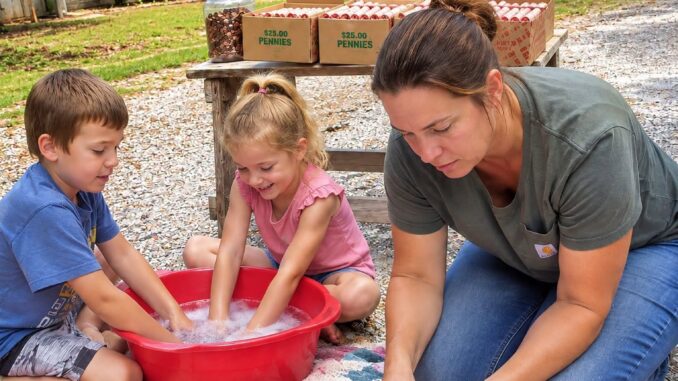
Once the coins were clean and safe to handle, Noah and Lily helped with counting and organizing them.
Noah quickly became interested in the process.
“How many pennies are there?” he asked.
“Ninety-one thousand five hundred,” I replied.
He looked amazed.
“That’s a lot.”
“It certainly is.”
Lily joined us a little later, wearing her favorite pink rain boots.
She wanted to help too.
I gave her a small group of clean pennies to count.
Soon, the children were arranging coins into rows and small stacks.
What had started as a frustrating task gradually became something we could work on together.
Learning to Count and Organize the Coins
We developed a system.
Noah counted the clean pennies into groups of fifty.
Lily helped arrange smaller stacks.
I checked the totals and placed the coins into paper wrappers.
Each roll contained fifty pennies, worth fifty cents.
To organize the entire payment, we would need 1,830 rolls.
It was an enormous amount of work.
I visited a local bank to ask about coin wrappers and counting arrangements.
The teller seemed surprised when I explained how many I needed.
Back at home, we continued working.
The children began treating the task like a counting challenge.
Noah enjoyed checking the totals.
Lily took pride in preparing her own little stacks.
By the end of the first day, we had made progress.
But there was still a great deal left to do.
That evening, Noah asked me a question that changed the direction of the project.
A Question About School Lunches
We were sitting on the porch when Noah began talking about a boy in his class named Mason.
He explained that Mason sometimes received a different lunch from the other children.
According to Noah, the boy’s school meal account had an outstanding balance.
Some students had noticed, and one had made an unkind comment about it.
Noah seemed bothered by the situation.
“Mom, why does he get a different lunch?” he asked.
I explained that families sometimes experience financial difficulties.
Parents may be dealing with unexpected bills, reduced working hours, or other challenges.
None of those circumstances should make a child feel embarrassed.
Noah thought about that for a moment.
Then he looked toward the boxes of pennies.
“Could we use some of this money to help kids who need lunch?”
I didn’t answer immediately.
The $915 was part of our family budget.
We had groceries, transportation costs, and medical expenses to consider.
But his question stayed with me.
I told him we could contact the school and find out whether there was a way to help.
Speaking With the School Cafeteria Manager
On Monday morning, I called Washington Elementary.
The school secretary connected me with Mrs. Edna Fogle, who managed the cafeteria.
I explained that I was interested in contributing toward outstanding student meal balances.
Mrs. Fogle thanked me for asking.
She also explained that individual students’ financial information was private.
I understood.
I wasn’t interested in identifying particular children.
I simply wanted to know whether a general contribution could help.
After reviewing the available information, she told me that twenty-three second-grade students had outstanding balances.
Together, those balances totaled $908.40.
I was surprised.
The amount was almost exactly the same as my final paycheck.
I looked at the boxes of pennies sitting in the corner of our kitchen.
Then I made a decision.
“I’d like to cover the entire amount,” I told her.
Mrs. Fogle paused.
“Are you sure?”
“Yes,” I replied.
I explained that my family had discussed it and that we wanted to help.
Finding Meaning in an Unpleasant Experience
After speaking with Mrs. Fogle, I told Jake about the plan.
He listened carefully.
We discussed our household budget and how we would manage until my first paycheck from the co-op arrived.
It would require some adjustments.
But Jake agreed that helping the students was something we could do.
That evening, I told Noah and Lily the news.
“We’re going to use the pennies to help children at your school,” I said.
Noah smiled.
“Even Mason?”
“The school will handle the money privately,” I explained. “But it will help students who have outstanding lunch balances.”
Lily looked excited.
“Can I make a special roll?”
I laughed.
“Of course.”
She carefully counted fifty clean pennies and placed them inside a wrapper.
The paper was a little uneven, but she was proud of her work.
Noah asked whether he could deliver that particular roll to Mrs. Fogle.
I agreed.
A Week of Counting Pennies
The project continued throughout the week.
I worked at my new job during the day.
After returning home, I helped prepare dinner and spent time with the children.
Then we continued organizing the coins.
Jake joined us when he returned from his trucking route.
At first, he struggled with the paper wrappers.
His large hands weren’t particularly suited to folding the small ends.
He tore a few before learning the technique.
The children found that amusing.
Soon, all four of us had developed a routine.
Noah counted.
Lily arranged the stacks.
Jake helped with the wrappers.
I checked the totals.
It was repetitive work, but we enjoyed spending the time together.
We talked about school, work, and the importance of treating other people with consideration.
The coins gradually filled dozens of boxes.
By the time we finished, we had organized all 91,500 pennies into 1,830 rolls.
Delivering the Donation to Washington Elementary
When the coins were ready, Jake borrowed a pickup truck and a hand truck to help transport them.
The boxes were heavy.
We loaded them carefully and drove to Washington Elementary.
Mrs. Fogle was waiting with the school principal, Mr. Okonkwo, and the secretary, Mrs. Jaeger.
They looked surprised when they saw how many boxes we had brought.
Jake helped move them into the office.
It took several trips.
Eventually, the boxes were stacked along the wall.
Noah stood beside me, holding the special roll Lily had prepared.
When everything was unloaded, he walked toward Mrs. Fogle.
“This one is from my sister,” he said. “It’s for the children who need lunch.”
Mrs. Fogle accepted it with a warm smile.
She thanked both children.
Then she turned to me.
“I’ve worked here for thirty-one years,” she said. “I’ve seen how difficult things can be for some families.”
She looked at the boxes.
“This is going to make a real difference.”
A Small Gesture With a Meaningful Impact
The school arranged for the coins to be counted and processed through the bank.
Once the donation was confirmed, the outstanding second-grade meal balances could be cleared.
The total was $908.40.
The remaining $6.60 was placed toward future meal assistance.
For the families receiving help, the contribution meant one less financial concern.
For the children, it meant their school meal accounts could begin again without the previous balances.
Noah was especially pleased.
He understood that the donation wasn’t about receiving attention.
It was about helping classmates feel more comfortable.
On the way home, he asked whether other schools had students who needed assistance.
“I imagine some do,” I told him.
He looked thoughtful.
“Maybe other people could help too.”
I smiled.
“That’s a good idea.”
I didn’t realize how quickly that suggestion would become important.
The School Shared a Thank-You Message
Later that day, Washington Elementary prepared a public thank-you message.
The school described how a local family had organized thousands of pennies and donated the money toward student meal balances.
The message focused on the generosity of the contribution and the children’s involvement.
It did not identify the students receiving assistance.
The school also respected our family’s privacy.
But in a small town, news travels quickly.
People began talking about the donation.
Some had already heard about the unusual way my former employer had delivered my final wages.
Others were simply interested in the school project.
The story spread through local conversations and social media.
Several people offered to contribute additional money.
I appreciated their kindness, but I didn’t want the attention to become focused on my disagreement with Dale.
The important part was that children were receiving support.
Then I received an unexpected phone call.
A Call From the School
The following morning, I was preparing breakfast when my phone rang.
The caller was Mrs. Fogle.
“Becky, could you come to the school?” she asked.
I was concerned.
“Is everything all right?”
“Yes,” she reassured me. “There’s someone here who would like to speak with you.”
“Who?”
She paused.
“Dale Heckert.”
I was surprised.
I hadn’t spoken with Dale since he had left the pennies in my driveway.
I wasn’t sure why he would be at the school.
Mrs. Fogle explained that he had arrived earlier that morning and asked about the meal assistance program.
After dropping off the children, I went to the office.
Dale was sitting near the counter.
Beside him was an old red coffee can.
An Unexpected Contribution
When Dale saw me, he stood.
“Becky,” he said quietly.
I remained near the doorway.
He looked uncomfortable.
“I’m not here to argue,” he said. “I wanted to talk.”
He placed the coffee can on the counter and removed the lid.
Inside were stacks of banknotes.
“There’s $4,300 here,” he explained.
I looked at him, confused.
He said he had contacted the school after learning about our donation.
He wanted to know how much money was needed to help students with outstanding meal balances in other grades.
Then he decided to contribute.
Mrs. Fogle confirmed that the school had discussed the donation with him.
I didn’t know what to say.
Finally, I asked the question that seemed most important.
“Why did you decide to do this?”
Dale looked down.
Then he began telling us about his childhood.
A Memory From His School Years
Dale explained that his family had experienced financial difficulties when he was young.
Although his father owned a repair business, money wasn’t always managed carefully.
Some weeks, the family struggled to cover ordinary expenses.
School lunches were occasionally a problem.
Dale remembered receiving a basic alternative meal when his lunch account had an outstanding balance.
Other students noticed.
Some made unkind comments.
He said the experience had stayed with him long after he finished school.
Mrs. Fogle listened quietly.
Then she explained that her mother, Irene Bauer, had worked in the school cafeteria years earlier.
Irene had known Dale when he was a child.
At one point, she had quietly helped cover his outstanding lunch balance.
Dale hadn’t known about it at the time.
He learned what she had done years later.
“She helped me without making me feel embarrassed,” he said.
He paused.
“I never forgot that.”
Understanding What Had Changed His Mind
Dale explained that seeing the school’s thank-you message had brought back those childhood memories.
He had thought about the students who were struggling with lunch balances.
Then he thought about the way he had treated me.
He admitted that he had been upset when I resigned.
He had relied on my work for years and hadn’t handled my decision to leave professionally.
Instead of expressing his concerns, he had allowed his frustration to influence his behavior.
“I wanted you to be annoyed by those pennies,” he admitted.
He looked toward the boxes.
“But you and your children turned the situation into something good.”
Then he apologized.
He said he was sorry for the way he had delivered my final wages, for the oil on the coins, and for how he had treated me during my last two weeks at work.
He also thanked me for the six years I had spent helping run the parts department.
I listened.
I appreciated his apology, although I still felt that what he had done was wrong.
An apology couldn’t undo the experience.
But it was a beginning.
Noah Offered a Simple Gesture of Kindness
While we were speaking, Noah entered the office.
He had come from his classroom with permission from a staff member.
When he saw Dale, he stopped.
“Mr. Heckert?”
Dale turned toward him.
“Hello, Noah.”
Noah noticed the coffee can on the counter.
“Is that money for the lunch kids?”
Dale nodded.
“Yes. It’s to help students who need it.”
Noah smiled.
Then he asked whether Dale had also experienced difficulty paying for school lunches when he was young.
Dale said that he had.
Noah thought about that for a moment.
Then he reached into his pocket.
He pulled out a clean penny he had kept from our family project.
He held it toward Dale.
“This is one of the pennies,” he said.
Dale looked surprised.
“Why are you giving it to me?”
Noah shrugged.
“Because you said sorry to my mom. And because I’m sorry people were mean to you when you were little.”
Dale accepted the coin.
For a moment, he didn’t speak.
Then he thanked Noah.
It was a small exchange, but I could see how much it meant to him.
A Community Idea Begins to Take Shape
After the school’s donations were processed, the outstanding second-grade meal balances were cleared.
Dale’s contribution helped address additional balances across the school.
The project had already accomplished more than I expected.
But a week later, Dale called with another idea.
He explained that the repair shop had a large container of spare change collected over the years.
Customers occasionally left small amounts behind, and employees sometimes added coins of their own.
Dale wondered whether the money could be used to support school meal programs.
He suggested organizing a community coin collection.
Residents could donate spare change, help count and sort coins, and contribute toward student meal assistance.
I liked the idea.
But I reminded him that the project needed to be organized carefully and transparently.
Donations should be counted properly, and the school should manage the funds through appropriate procedures.
He agreed.
We began discussing how to make it happen.
The First Penny Saturday
Two weeks later, we organized a community gathering at the Merrill Fire Hall.
We called it Penny Saturday.
The concept was simple.
People could bring spare coins and other small donations to support local school meal assistance.
Volunteers would help organize the contributions before they were processed through the bank.
We expected a modest turnout.
Instead, 240 people attended.
Families arrived carrying jars, coffee cans, and containers of loose change.
Some brought coins they had saved for years.
Others brought their children because they wanted them to participate.
Carl came with several employees from the repair shop.
Local residents offered tables, supplies, and refreshments.
Mrs. Fogle brought an old cafeteria apron that had belonged to her mother.
She displayed it as a reminder of Irene Bauer’s kindness.
Throughout the afternoon, volunteers counted and organized donations.
By the end of the event, more than $4,000 had been collected.
Children Became Part of the Project
One of my favorite parts of Penny Saturday was watching the children participate.
Noah helped younger volunteers learn how to count coins into groups.
Lily demonstrated how to place pennies into paper wrappers.
Dale sat at a table nearby.
He was still learning how to fold the wrappers neatly.
At one point, Lily leaned over and corrected him.
“Mr. Dale, you’re squishing the paper.”
He laughed.
“I’m trying my best.”
“Do it like this,” she instructed.
He followed her example.
For a moment, I thought about the afternoon he had emptied the pennies in my driveway.
The atmosphere couldn’t have been more different.
Instead of frustration and embarrassment, there was conversation and cooperation.
People were working together toward a shared goal.
And the children were learning that even small contributions could matter.
Taking Responsibility for the Driveway
A few days after Penny Saturday, I returned home from work and noticed a truck parked outside.
Workers were replacing part of the gravel on my driveway.
Dale was standing nearby.
I walked toward him.
“What’s happening?”
He pointed to the area where the pennies had been dumped.
“The oil left a stain,” he explained. “I wanted to take care of it.”
The damaged gravel was being removed and replaced.
I was surprised by the gesture.
Dale explained that he wanted to take responsibility for the mess he had created.
Then he reached into his pocket.
He showed me the penny Noah had given him.
He had attached it to his key ring.
“I keep this with me,” he said.
“Why?”
“It reminds me that I can make better choices.”
I looked at the little coin.
For Dale, it had become a reminder of the apology he had made and the kindness Noah had shown him.
One Year Later
A year after the afternoon when Dale delivered my final wages in pennies, life had settled into a new routine.
I was still working at the farmers co-op.
The family health insurance had made a meaningful difference.
Noah continued receiving regular care for his asthma.
Lily was growing quickly and remained as energetic as ever.
Jake was still driving trucks.
He occasionally joked that he hoped never to see another box of coin wrappers.
Dale continued operating Heckert Auto & Diesel.
Over time, he made changes to the way he managed the business.
He began offering health insurance to employees.
When I asked him about the decision, he simply said he wished he had done it sooner.
Our relationship was different from what it had been when I worked for him.
But we had found a way to communicate respectfully.
And Penny Saturday had become something the community looked forward to.
A Tradition That Continued to Grow
Every September, volunteers gathered at the fire hall to collect donations for local school meal assistance.
The event became an annual tradition.
Families brought spare change.
Local businesses contributed.
Volunteers helped organize the funds.
Dale took responsibility for much of the event planning.
He purchased folding tables and equipment to make the process easier.
A large banner hung near the entrance.
It read:
EVERY PENNY COUNTS.
The donations helped support meal assistance programs throughout the school district.
Organizers also worked toward maintaining a small reserve for future needs.
The project had grown beyond the original boxes of pennies.
It had become a way for neighbors to support families experiencing financial difficulties.
Honoring the Woman Who Had Helped Dale
As the community program developed, Dale suggested naming the assistance fund after Irene Bauer.
She had been the cafeteria worker who quietly helped him when he was a child.
Mrs. Fogle was deeply moved by the idea.
The fund became known as the Irene Bauer Fund.
A small plaque was later placed near the cafeteria entrance.
It honored Irene’s years of service and her commitment to helping students.
For Dale, the tribute carried personal meaning.
He had spent years remembering the embarrassment of not having enough money for lunch.
But he had also remembered the woman who helped him without asking for recognition.
Now, through the fund, that kindness could continue reaching other children.
A Change in the Schoolyard
Noah occasionally told me about Mason, the boy whose lunch situation had first inspired our donation.
He said Mason was doing well.
The teasing had also stopped.
One afternoon, Noah explained that another student had tried to use the old nickname again.
This time, Noah spoke up.
He told the student that families sometimes face difficult circumstances and that no one should be made to feel ashamed about needing help.
I was proud of him.
Not because he had been part of a fundraising project.
But because he had learned to recognize when someone needed support.
He understood that kindness wasn’t limited to giving money.
Sometimes it meant saying something when another person was being treated unfairly.
That lesson mattered just as much as the donation itself.
Returning to the Repair Shop
Several months later, I stopped by Heckert Auto & Diesel to purchase a replacement fuel filter for Jake’s truck.
The building looked almost exactly as I remembered.
The same gray exterior.
The same repair bays.
The familiar smell of coffee near the counter.
But something new stood beside the register.
It was a large glass jar filled with clean pennies.
A handwritten sign was attached to the front.
FOR THE SCHOOL LUNCH FUND — EVERY PENNY COUNTS.
Beneath it was a smaller note.
It thanked me, Noah, and Lily for helping start the project.
At the bottom, Dale had signed it with the childhood nickname he had once disliked.
I stood there reading the message.
It reminded me how much had changed since my final day at the shop.
What the Experience Taught Our Family
When Dale first emptied those buckets onto my driveway, I felt that my years of work had been dismissed.
I was angry about the way my wages had been delivered.
I worried about the time and effort required to handle the coins.
And I didn’t want my children to remember the experience as an example of how adults should treat one another.
But Noah’s question about school lunches changed our focus.
Instead of allowing the incident to remain only a source of frustration, we found a way to use the money for something positive.
That decision led us to Mrs. Fogle.
It introduced us to the needs of local students.
It encouraged neighbors to contribute.
And it eventually helped Dale reflect on his own experiences and behavior.
None of those developments made his original decision acceptable.
But they showed us that a difficult experience doesn’t have to determine what happens next.
Why Community Support Matters
One of the most important things I learned was that meaningful change doesn’t always begin with a large organization or a complicated plan.
Sometimes it begins with a conversation.
Noah noticed that a classmate was having a difficult time.
He asked whether we could help.
We contacted the school.
The school explained how donations could be used.
Then other people became involved.
Each person contributed something different.
Some gave money.
Others volunteered their time.
Local businesses provided supplies.
School staff helped coordinate the assistance.
Together, those contributions created something more sustainable than a single donation.
The project also helped reduce the embarrassment that some students experienced when their families faced financial challenges.
And that was worth more than any headline about the unusual payment I had received.
Final Thoughts: Every Penny Counts
I still remember the sound of those pennies falling onto my driveway.
I remember the dark oil on the coins and the look of confusion on my children’s faces.
At the time, I couldn’t imagine anything positive coming from the situation.
But the days that followed changed my perspective.
My children helped turn an unpleasant experience into an opportunity to support others.
A school received assistance for students who needed it.
Neighbors came together.
A former employer acknowledged his mistake and began making different choices.
And a community tradition grew from a simple question asked by an eight-year-old boy.
Sometimes, the value of a small act isn’t measured by the money involved, but by the people it inspires to help.
The 91,500 pennies that once covered my driveway eventually became part of a much larger story.
One about empathy, responsibility, forgiveness, and the importance of looking out for one another.
And whenever I see a jar of spare change, I remember what my children taught me.
Every penny counts.
But so does every act of kindness.
Leave a Reply