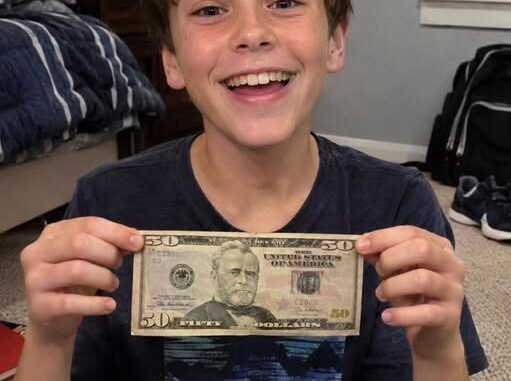
When I handed my eleven-year-old son fifty dollars for his school fair, I expected him to spend the afternoon enjoying games, eating pizza, and buying the biggest cookie he could find.
I never imagined that a few hours later, his teacher would call me in tears.
“Ms. Khloe, please don’t panic.”
Those were the first words I heard when I answered the phone.
Naturally, I panicked.
“Is Morgan okay?” I asked immediately.
“He’s fine,” Mrs. Coleman assured me.
But her voice was trembling.
“Then why are you crying?”
She paused.
“Because I’ve never seen anything like this. You need to come to the school and see what your son has done.”
Twenty minutes later, I hurried into the school gymnasium.
What I saw stopped me in my tracks.
My son was standing behind a folding table, wearing a crooked paper crown.
Several shelves that had previously held prizes were almost empty.
A handwritten sign above his head read:
FREE PRIZES
And approximately thirty children were gathered around him.
I turned to his teacher.
“What exactly did Morgan do with that money?”
She smiled through her tears.
“Something I don’t think you’ll ever forget.”
Life With My Eleven-Year-Old Son
Morgan and I had been a team for years.
It was just the two of us, and although raising him alone wasn’t always easy, he made even the most exhausting days feel worthwhile.
He was funny, curious, and full of energy.
He still hugged me goodbye every morning before school.
Of course, he always checked afterward to make sure none of his friends had noticed.
At home, we had our own little traditions.
Every evening, we ate dinner together and shared the best and worst parts of our day.
Morgan loved that game.
Mostly because he loved finding ways to break the rules.
“Best part of your day?” I’d ask.
“Playing on the swings. Oh, and passing my science quiz!”
“That’s two best parts.”
“You’re the mom. You can change the rules.”
I’d laugh and shake my head.
“Nice try.”
He always had a comeback.
And somehow, he always managed to make me smile.
The School Fair He Couldn’t Stop Talking About
For two weeks, Morgan talked about almost nothing except the upcoming school fair.
He described the games, food stalls, prizes, and activities in extraordinary detail.
But one attraction seemed especially important.
“Mom, they’re going to have giant cookies!”
“Giant cookies?”
“Actual giant cookies. Bigger than my hand!”
“Sounds like a very educational event.”
“Extremely educational,” he replied seriously.
Every afternoon, he came home with another update.
There would be pizza.
There would be games with tickets.
There would be stuffed animals and toys.
He had already decided which activities he wanted to try.
But the night before the fair, I discovered something that made me smile.
Morgan was sitting on his bedroom floor, carefully counting money.
His Twelve-Dollar Budget
I leaned against the doorway.
“What are you doing?”
“Working on my budget.”
I raised an eyebrow.
“Very professional.”
He arranged several bills and coins in front of him.
“I have twelve dollars.”
“That sounds like a decent amount.”
He shook his head.
“Not really. I can afford pizza and two games.”
“What about those famous giant cookies?”
He sighed dramatically.
“Budget cuts.”
I laughed.
He looked genuinely disappointed.
I knew how much he’d been looking forward to the fair.
So I opened my wallet and took out a fifty-dollar bill.
“Here.”
Morgan stared at it.
“What’s that?”
“Your fair money.”
His eyes widened.
“Fifty dollars?”
I nodded.
“All fifty?”
“All fifty.”
He looked at the bill as though I’d handed him a treasure.
“Buy Whatever Makes You Happy”
Morgan turned the money over in his hands.
“Are you serious?”
“Completely.”
“What if I spend it on something stupid?”
I smiled.
“Then you’ll learn a fifty-dollar lesson.”
He laughed and threw his arms around me.
“You’re my favorite mom!”
“I’m your only mom.”
“Still counts.”
I hugged him back.
Then I told him something simple.
“Buy whatever makes you happy.”
I meant it.
I wanted him to enjoy the day without worrying about whether he could afford a snack or an extra game.
I imagined him coming home with a bag full of toys and an enormous cookie.
I had no idea he’d interpret my words in a completely different way.
The Morning of the Fair
The next morning, Morgan was ready earlier than usual.
He checked his backpack twice.
He made sure the fifty-dollar bill was tucked safely inside.
And he spent the entire drive to school talking about what he planned to buy.
When we arrived, he jumped out of the car.
“Have fun!” I called.
He turned around.
“And don’t spend everything on cookies!”
He grinned.
“No promises!”
Then he ran toward the school entrance.
I watched him disappear into the building before heading to work.
By lunchtime, I’d almost forgotten about the money.
Until my phone rang.
The Call That Made My Heart Race
It was 2:18 in the afternoon.
I glanced at my phone and saw Morgan’s teacher calling.
I answered immediately.
“Hello?”
“Ms. Khloe?”
Something about Mrs. Coleman’s voice made me sit up straighter.
“Yes. Is everything okay?”
“Your son is fine.”
I exhaled.
Then I heard her voice break.
She was crying.
“Mrs. Coleman, what’s wrong?”
“I’m sorry,” she said. “I’m just overwhelmed.”
My heart started pounding.
“What happened?”
She hesitated.
“Your son brought fifty dollars to the fair today, correct?”
“Yes.”
Another pause.
“Could you please come to the school? I think you need to see what he did with it.”
I grabbed my things.
I didn’t know whether to be worried, confused, or angry.
But I knew I needed to get there.
The Strange Scene Inside the Gymnasium
Twenty minutes later, I arrived at the school.
Mrs. Coleman was waiting outside the gym.
Her eyes were red.
“Where’s Morgan?”
“Inside.”
“Please tell me he’s okay.”
“He is. I promise.”
She opened the door.
I stepped inside.
And immediately stopped walking.
Children were gathered around a folding table.
A long, uneven line stretched across part of the gymnasium.
Behind the table stood Morgan.
He was wearing a paper crown.
Above him hung a sign that said:
FREE PRIZES
The shelves behind him were nearly empty.
And my son was waving his arms.
“Everybody calm down! I’m only one person!”
I turned toward his teacher.
“Please tell me he hasn’t started a business.”
She laughed.
“No.”
“Then why are thirty children surrounding him?”
“He’s been organizing something.”
I stared at her.
“What kind of something?”
Before she could answer, Morgan spotted me.
“Mom? Why Are You Here?”
Morgan’s eyes widened.
“Mom?”
He looked at Mrs. Coleman.
“You called her?”
She nodded.
He groaned.
“I was going to explain everything at dinner.”
I folded my arms.
“Explain why you’re running a toy store?”
“It’s not a store!”
“Then why does it have merchandise?”
He sighed.
“Can you give me five minutes?”
“Five minutes?”
“Please. Hannah’s been waiting.”
I followed his gaze.
A little girl stood near the table.
She was wearing a yellow sweater and holding her hands tightly together.
She looked nervous.
Mrs. Coleman gently touched my arm.
“Just watch him,” she whispered.
“You’ll understand.”
So I stepped aside.
The Little Girl in the Yellow Sweater
Morgan turned toward the girl.
“Okay, Hannah. It’s your turn.”
She looked around at the other children.
“I don’t know if I can.”
Morgan leaned forward.
“Remember what we practiced?”
She nodded.
“You’ve got this.”
Someone farther back in the line sighed impatiently.
Morgan immediately raised his hand.
“Nobody rushes anybody! That’s the rule!”
The children quieted.
Hannah took a deep breath.
Then she spoke.
“Why did the cookie go to the doctor?”
Morgan smiled.
“Why?”
“Because it felt crummy.”
For a second, nobody reacted.
Then Morgan slapped the table.
“That was amazing!”
The children burst into laughter.
Hannah covered her mouth.
She was smiling.
My son reached behind him and picked up a stuffed rabbit.
“Congratulations! You won!”
The Prize That Made Hannah Smile
Hannah stared at the rabbit.
“Really?”
“Really.”
“Can I keep it?”
Morgan grinned.
“That’s usually how prizes work.”
She hugged the stuffed animal tightly.
Then, without warning, she wrapped her arms around Morgan.
My son froze.
“Okay. That’s enough hugging.”
I nearly laughed.
But when I looked at Mrs. Coleman, she was wiping tears from her cheeks again.
“That’s the first joke Hannah has told in front of a group,” she whispered.
I looked at her.
“What do you mean?”
“Hannah transferred here recently. She’s had a difficult time feeling comfortable around the other children.”
I glanced across the gym.
Hannah was showing her rabbit to two girls.
They admired it.
Then they invited her to play.
Mrs. Coleman smiled.
“She’s been trying so hard to make friends.”
My throat tightened.
I looked back at Morgan.
What had he done?
And where had my fifty dollars gone?
What Happened Earlier That Afternoon
Mrs. Coleman guided me toward the bleachers.
“The fair opened after lunch,” she explained.
“Some children brought spending money. Others didn’t.”
I nodded.
“The school said money was optional.”
“It was. We had free activities too. But the prize stalls were very popular.”
She looked toward Hannah.
“She wanted that stuffed rabbit.”
“Couldn’t she afford it?”
“She had three dollars, but she’d already spent them on games.”
Apparently, a volunteer had allowed Hannah to hold the rabbit for a moment.
But when she learned she couldn’t take it home, she became disappointed.
Morgan noticed.
At first, he decided to buy the rabbit for her.
That seemed simple enough.
But then he looked around.
And he noticed other children standing near the prize stalls.
Some had run out of tickets.
Others hadn’t brought money.
They were watching their classmates win toys they couldn’t afford.
That’s when Morgan changed his plan.
He Decided One Gift Wasn’t Enough
“So he bought Hannah the rabbit?” I asked.
Mrs. Coleman smiled.
“That was his original idea.”
“Original?”
“Your son started thinking about the other children.”
Before she could explain further, Principal Harris approached.
“Khloe! I’m glad you could come.”
I turned toward him.
“Could someone please tell me what my son has done?”
He laughed.
“Morgan has made quite an impression today.”
“Apparently.”
The principal looked toward the table.
“I think he should explain it himself.”
I sighed.
“Does this school teach advanced secrecy?”
Mrs. Coleman laughed.
“Give him a little time.”
So I waited.
And I watched my son continue handing out prizes, encouraging children, and making sure everyone got a turn.
Morgan Finally Explained the Missing Money
By three o’clock, the fair was winding down.
Morgan finally left his table.
He approached me carrying a paper bag.
“Hi, Mom.”
“Hello, Your Majesty.”
He touched his paper crown.
“It’s an official position.”
“Who appointed you?”
“Me. Nobody else applied.”
I tried not to smile.
“Morgan, where’s your fifty dollars?”
His expression changed.
“Well…”
“Well?”
“I spent it.”
“All of it?”
He nodded.
I held out my hand.
“Show me what you bought.”
He opened the paper bag.
Inside were two toy cars and a plastic dinosaur.
I stared.
“Fifty dollars for three toys?”
“No! Those are leftovers!”
“Leftovers from what?”
He pulled out a receipt.
It listed stuffed animals and several smaller prizes.
The total was exactly fifty dollars.
“Remember What You Told Me Yesterday?”
I looked at him.
“Morgan!”
“I know how it looks!”
“Then explain.”
He glanced at Mrs. Coleman.
“Can we sit down?”
Something about his tone made me stop.
For once, he wasn’t joking.
We sat on the bleachers.
Morgan removed his crown and held it in his lap.
“Remember what you told me yesterday?”
“That you shouldn’t spend fifty dollars on cookies?”
He smiled.
“No. The other thing.”
I thought for a moment.
“Buy whatever makes you happy?”
He nodded.
“Yeah.”
Then he looked toward the gym.
“I was going to buy pizza, cookies, and a giant pencil.”
“A giant pencil?”
“An essential purchase.”
I laughed.
But his expression became serious again.
“Then I saw Hannah.”
The Reason He Changed His Plans
Morgan explained how he’d noticed Hannah holding the stuffed rabbit.
He could tell she wanted it.
And when she couldn’t afford it, he saw how disappointed she was.
“I was going to buy it for her,” he said.
“That was kind of you.”
“But then I saw Oliver.”
“Who’s Oliver?”
“He wanted a toy car.”
Morgan paused.
“And Ben wanted a dinosaur.”
He looked down at his shoes.
“Then I noticed other kids just standing around watching.”
Some children didn’t have enough money for the prizes.
Others had already spent their tickets.
Morgan didn’t like seeing them excluded.
“I didn’t want anybody to feel left out,” he said quietly.
I felt something shift inside me.
“So what did you do?”
“I asked Mrs. Coleman for help.”
How Fifty Dollars Became a Free Prize Table
Morgan had approached his teacher and explained his idea.
He wanted to use his money to buy as many prizes as possible.
But instead of keeping them, he wanted to give them away.
Mrs. Coleman helped him speak with the fair volunteers.
They agreed to let him distribute the toys.
The only problem was figuring out how to do it fairly.
Morgan came up with a solution.
A game.
“A joke competition,” he announced proudly.
I looked at him.
“A joke competition?”
“Everybody gets a turn.”
“And what happens if their joke isn’t funny?”
“They still get a prize.”
I smiled.
“Then why do they have to tell jokes?”
Morgan looked genuinely confused by my question.
“Because laughing is fun.”
He said it as though the answer should have been obvious.
The Rules Were Designed So Nobody Could Lose
The activity was simple.
Children could tell jokes.
They could make funny faces.
They could answer silly questions.
Or they could simply participate in whatever way felt comfortable.
Nobody had to perform if they didn’t want to.
And nobody was judged on whether they were funny enough.
Everyone had a chance to receive a prize while supplies lasted.
When the toys were gone, the children could continue playing.
“Some kids stayed even after the prizes ran out,” Mrs. Coleman explained.
Morgan nodded.
“The prizes weren’t the best part.”
I looked at him.
“What was?”
He shrugged.
“Everybody was laughing.”
For a moment, I couldn’t think of anything to say.
My eleven-year-old had used his entire fair budget to create something that made other children feel included.
But his teacher still had another story to tell me.
What He Did When Hannah Became Frightened
Mrs. Coleman looked toward Hannah.
“There’s something else you should know.”
Morgan groaned.
“Mrs. Coleman, please.”
She smiled.
“Your mother deserves to hear it.”
I turned toward him.
“What happened?”
His teacher explained that Hannah had been nervous about speaking in front of the group.
When she approached the table earlier, she struggled to get the words out.
Some children laughed.
One boy told her to hurry.
Hannah became upset and wanted to leave.
Morgan noticed.
And instead of ignoring the situation, he stopped the game.
“He told everyone they had to wait,” Mrs. Coleman said.
I looked at my son.
He shrugged.
“She was trying.”
Those three words nearly broke my heart.
He Helped Her Practice Until She Felt Ready
Morgan explained that he’d asked Hannah whether she wanted to practice her joke privately.
She agreed.
They whispered it together.
Then they practiced again.
And again.
“She got it on the third try,” he said.
He made sure the other children waited.
When Hannah finally felt ready, he invited her to tell the joke.
That was the moment I’d witnessed when I arrived.
The cookie joke.
The stuffed rabbit.
The applause.
The smile.
And the hug.
Mrs. Coleman’s voice trembled.
“Afterward, three children invited Hannah to play.”
She wiped her eyes.
“She’s been working toward moments like that all semester.”
I looked across the gym.
Hannah was laughing with her new friends.
And I finally understood why Morgan’s teacher had called me.
I Couldn’t Hold Back My Tears
I turned toward my son.
My eyes were filling.
Morgan immediately looked alarmed.
“Mom, please don’t start crying too.”
“I’m not crying.”
He stared at me.
“Your eyes are leaking.”
I laughed.
“It’s a medical condition called motherhood.”
He shook his head.
“Sounds exhausting.”
“Very.”
Then I pulled him into a hug.
Usually, Morgan became embarrassed when I hugged him in public.
He’d look around to see whether his friends were watching.
But this time, he hugged me back.
He didn’t pull away.
He didn’t make a joke.
For a few seconds, he simply let me hold him.
And I realized that the fifty dollars had become something far more meaningful than I’d expected.
The Principal Had an Unexpected Request
Before we left, Principal Harris approached us.
“Khloe, may I ask you something?”
“Of course.”
“We’re considering making this activity a permanent part of our school fair.”
I looked at him.
“The joke table?”
He nodded.
“Something similar. A free prize table where children can participate without needing spending money.”
Morgan’s eyes widened.
“Really?”
The principal smiled.
“Really.”
Then he turned toward me.
“Would you consider helping our parent committee organize it?”
I hesitated.
“I work during most school events.”
“We usually meet after school or online.”
I thought about Hannah.
I thought about the children who had gathered around Morgan’s table.
And I thought about how much joy one afternoon had created.
“I’d be happy to help plan it,” I said.
Morgan Wanted an Official Position
Morgan immediately raised his hand.
“Can I join the committee?”
I looked at him.
“You’re eleven.”
“This is age discrimination.”
Principal Harris burst out laughing.
“How about student adviser?”
Morgan straightened.
“Do I get an office?”
“No,” I said.
“A badge?”
“Maybe.”
“A parking space?”
“You don’t have a car!”
“Not yet.”
I shook my head.
My son was impossible.
But in that moment, I couldn’t have loved him more.
The Question He Asked on the Drive Home
On our way home, Morgan was unusually quiet.
I glanced at him in the rearview mirror.
“Everything okay?”
“Yeah.”
“Then why are you so quiet?”
He hesitated.
“Mom?”
“Yes?”
“Are you mad about the money?”
I felt my heart soften.
“Why would I be mad?”
“Because I didn’t buy anything for myself.”
I smiled.
“Did you enjoy your day?”
He nodded enthusiastically.
“A lot!”
“Then you followed my instructions.”
He looked relieved.
“But next time, remember to eat lunch.”
“I ate the sandwich you packed.”
“Good.”
“And Oliver shared his pizza.”
“That’s nice.”
“And Hannah’s mom bought me a cookie.”
I laughed.
“Of course she did.”
Morgan grinned.
“It was enormous!”
I shook my head.
“That’s my boy.”
Our Dinner Conversation That Evening
That night, we had spaghetti for dinner.
Morgan insisted on wearing his paper crown.
Apparently, being royalty was a full-time responsibility.
I placed our plates on the table.
“Best part of your day?”
He thought for a moment.
“When Hannah made everybody laugh.”
I smiled.
“And the worst?”
He sighed.
“When I realized fifty dollars wasn’t enough.”
I reached across the table and patted his hand.
“I’m sorry.”
“Thanks, Mom.”
Then I put down my fork.
“Want to know the best part of my day?”
“What?”
“Seeing how kind you’re becoming.”
Morgan groaned.
“Mom, that’s embarrassing.”
“I’m putting it on a T-shirt.”
“Please don’t.”
“With your picture.”
“Mom!”
I laughed.
Then he looked thoughtful.
“Can I have two best parts today?”
The Giant Cookie Still Mattered
I pretended to consider his request.
“That’s against the rules.”
Morgan smiled.
“You’re the mom. Change the rules.”
I shook my head.
“Fine. What’s your second best part?”
His face lit up.
“The giant cookie!”
I burst out laughing.
Some things never changed.
He might have spent his fifty dollars making other children happy.
He might have organized an entire activity at the fair.
He might even have impressed the principal.
But he was still my eleven-year-old boy.
And giant cookies were still very important.
The Photograph That Went Straight on Our Refrigerator
The following Monday, Mrs. Coleman sent me an email.
She had attached a photograph from the school fair.
Morgan stood behind his table.
His paper crown was tilted sideways.
Beside him stood Hannah, smiling while holding her stuffed rabbit.
Underneath the photograph, Mrs. Coleman had written a message.
“Thank you for raising a child who notices when others feel left out.”
I stared at those words for a long time.
Then I printed the picture.
I placed it on our refrigerator.
When Morgan came home from school, he spotted it immediately.
“Mom. Seriously?”
“What?”
“That’s embarrassing!”
I smiled.
“Would you prefer I frame it, Your Highness?”
He stared at me.
“You wouldn’t.”
“Try me.”
He shook his head and walked away.
But just before leaving the kitchen, he looked back at the photograph.
And smiled.
His Idea Became Something Bigger
Over the following weeks, I attended several parent committee meetings.
We discussed how to make the next school fair more inclusive.
One parent offered to collect donated toys.
Another suggested organizing free games.
Several volunteers agreed to help.
Principal Harris approved the plan.
We decided to call the activity the Second Chance Table.
The idea was simple.
Every child should have an opportunity to participate.
Nobody should feel excluded because they didn’t bring spending money.
And the activities should be fun without making children feel pressured to perform.
When I told Morgan about the plan, he nearly dropped his cereal.
“Wait. My idea is becoming a real thing?”
“Apparently.”
He stared at me.
“Do I get royalties?”
I laughed.
“You’re eleven.”
“That’s not an answer.”
“No royalties.”
He thought about it.
“Fine. Can I help run it?”
“Absolutely.”
Then he raised one finger.
“But I have one condition.”
The Rule He Refused to Change
I looked at him.
“What’s your condition?”
“Nobody has to tell a joke.”
I smiled.
“That’s fair.”
He nodded seriously.
“But terrible jokes should still be encouraged.”
“Naturally.”
That was Morgan.
He loved making people laugh.
But he also understood that not everyone felt comfortable being the center of attention.
He wanted children to enjoy themselves without feeling judged.
And he wanted the table to be a place where everyone could belong.
It was such a simple idea.
Yet it was something adults sometimes struggled to remember.
The Second Chance Table Returned
At the following school fair, the Second Chance Table became an official activity.
This time, it didn’t depend on one child’s spending money.
Families had donated toys and games.
The school provided additional supplies.
Volunteers helped organize everything.
And Morgan was there to welcome the children.
But he wasn’t working alone.
Hannah had joined him.
She helped arrange the prizes.
She greeted children.
And she’d even prepared joke cards for anyone who wanted to participate.
Mrs. Coleman sent me another photograph.
Morgan and Hannah stood behind the table, laughing together.
Looking at the picture, I remembered the nervous little girl in the yellow sweater.
The one who’d been afraid to tell a joke.
Now she was helping other children feel comfortable.
I couldn’t have been prouder of them both.
The Cookie He Brought Home for Me
That evening, Morgan returned home carrying something.
A giant cookie.
He placed it on the table between us.
“For you,” he announced.
I stared at him.
“For me?”
“Yep.”
“Did you buy it with your own money?”
“Yep.”
“What’s the occasion?”
He shrugged.
“You’re my favorite mom.”
I smiled.
“I’m your only mom.”
He broke the cookie in half.
“Still counts.”
Then he handed me a piece.
We sat together and ate.
And I thought about everything that had happened since the first fair.
What Fifty Dollars Taught Me About Kindness
When I gave Morgan that money, I thought I was giving him a chance to enjoy himself.
I wanted him to play games.
Buy toys.
Eat pizza.
And finally get the enormous cookie he’d been talking about for weeks.
But Morgan saw something I hadn’t expected.
He noticed children who couldn’t afford prizes.
He noticed a little girl who was struggling to make friends.
And instead of focusing only on what he wanted, he found a way to include them.
He didn’t give away his money because someone told him to.
He didn’t expect recognition.
He simply wanted everyone to have fun.
And when I asked why he’d done it, his answer was wonderfully simple.
He didn’t want anybody to feel left out.
The Most Important Thing He Bought Wasn’t a Toy
Morgan spent every dollar I’d given him.
But he didn’t come home with a collection of expensive prizes.
Instead, he created a moment that changed someone’s day.
Hannah gained the confidence to speak in front of other children.
She made new friends.
Other students enjoyed an activity where they didn’t need money to participate.
And the school discovered an idea that could help future students feel included.
The toys were only part of the story.
The real gift was the sense of belonging Morgan helped create.
He had turned fifty dollars into laughter, friendship, and kindness.
And somehow, that generosity continued long after the fair ended.
Final Thoughts: My Son Spent His Entire $50 — And I Couldn’t Have Been Prouder
When Morgan’s teacher called me crying, I was terrified.
I thought something terrible had happened.
Instead, I arrived at school to find my eleven-year-old son wearing a paper crown and running a table full of free prizes.
He had spent the fifty dollars I’d given him on toys for other children.
But the most meaningful part wasn’t the money.
It was the way he’d treated Hannah.
He noticed that she was nervous.
He stopped other children from rushing her.
He helped her practice a joke until she felt confident enough to share it.
And when she finally made everyone laugh, he celebrated her as though she’d accomplished something extraordinary.
For Hannah, perhaps she had.
That one afternoon inspired the school to create a permanent free prize activity.
Hannah eventually helped run it.
And Morgan continued finding ways to make others smile.
I had told my son to spend the money on whatever made him happy.
He decided that making other people happy was what he wanted most.
Months later, when he brought home a giant cookie and broke it in half to share with me, I realized that kindness had come full circle.
I’d given him fifty dollars for one afternoon.
He’d used it to make others feel included.
And in the end, he’d brought that happiness right back home.
Leave a Reply