For nearly a century, the old red barn had stood at the center of the Jensen family farm.
Its wooden walls had weathered countless winters, summer storms, and changing seasons. Generations of family members had worked inside it, repaired its doors, and gathered beneath its familiar roof.
To most people, it was simply an aging farm building.
But to Carol Jensen and her husband, Arlo, it represented something far more meaningful.
It was part of their family’s history.
So when Carol returned home after spending eleven exhausting days at the hospital with her husband, she was completely unprepared for what she saw.
The barn was no longer red.
Every wall, door, and wooden panel had been painted gray.
And the person responsible was someone she never expected.
Her own son.
Eleven Difficult Days Away From Home
Carol was fifty-eight years old when her husband experienced a serious stroke.
Arlo had always been an active man.
He spent much of his life working around the farm, maintaining equipment, and taking care of the property his family had owned for generations.
But after the stroke, even ordinary activities became challenging.
He had difficulty speaking clearly and moving his right hand.
Doctors explained that his recovery would require medical care, rehabilitation, and patience.
Carol spent nearly every day at his bedside.
She listened to updates from the medical team, helped coordinate his care, and encouraged him through difficult moments.
The experience was physically and emotionally demanding.
During those eleven days, the farm received very little of her attention.
She trusted that everything would remain as she had left it.
After all, the property had been in their family for decades.
She never imagined that one of its most recognizable features would be changed while she was away.
A Surprising Sight in the Driveway
One September evening, Carol finally returned home to collect a few belongings and take care of household responsibilities.
As she turned onto the familiar driveway, she looked toward the barn.
At first, she thought the fading evening light was playing tricks on her eyes.
The building looked different.
She slowed her car.
Then she realized what had happened.
The bright red exterior was gone.
In its place was a uniform shade of gray.
Carol parked and stepped outside.
She walked toward the barn, trying to understand what she was seeing.
The doors had been repainted.
The wooden siding was gray.
Even the small window where the barn cats often rested had been surrounded by the unfamiliar color.
She stood quietly for several moments.
The change was more than cosmetic.
To Carol, it felt as though a piece of the family’s history had disappeared.
A Barn With Nearly a Century of Memories
The barn had been part of the property since 1925.
Over the years, it had become one of the most recognizable features of the Jensen farm.
Arlo’s relatives had maintained it through changing generations.
They repaired damaged boards, replaced worn hinges, and repainted the exterior whenever the color began to fade.
But one detail had always remained the same.
The barn was red.
That color was part of its identity.
Carol remembered family gatherings near the building.
She remembered Arlo telling stories about working there with his father.
She remembered the familiar smell of hay and old wood.
For the Jensen family, the barn was connected to ordinary moments that had become treasured memories.
Its appearance wasn’t something Carol had ever considered changing.
And she certainly hadn’t agreed to have it repainted.
Discovering Who Made the Decision
Carol soon learned that her son, Brad, had arranged the work.
Brad was a real estate agent.
He understood property values, market trends, and the importance of presenting buildings attractively to potential buyers.
While his father was hospitalized, Brad had become increasingly concerned about the family’s future.
He worried that Arlo might not be able to return to the same level of physical activity.
He also worried that Carol could eventually find it difficult to maintain the farm alone.
Rather than discussing those concerns with his parents, Brad began making plans.
He contacted a painting company and arranged for the barn to receive what he considered a modern update.
He believed a neutral gray exterior would make the property more appealing in photographs.
Brad was already thinking about the possibility of selling the farm.
But there was one major problem.
Neither Carol nor Arlo had agreed to sell it.
A Decision Made Without Permission
When Carol learned why the barn had been repainted, she felt deeply disappointed.
She understood that Brad was worried about his father’s health.
She knew he wanted to help.
But she couldn’t understand why he had made such an important decision without speaking to them.
The farm belonged to Carol and Arlo.
They had spent years maintaining it.
They had raised their family there.
And although Arlo was recovering from a stroke, that didn’t mean he had lost the right to participate in decisions about his home.
Carol believed that any discussion about selling the property should involve both of them.
Brad had acted before giving them that opportunity.
The more Carol considered the situation, the more determined she became to restore the barn.
But first, she wanted to see exactly what had changed.
A Small Detail That Meant Everything
That evening, Carol took a flashlight and walked around the building.
She examined the freshly painted boards.
The work itself had been completed neatly.
The gray coating was even, and the doors looked newly finished.
But Carol wasn’t interested in whether the painting crew had done a good job.
She was searching for something specific.
Above the haymow door, Arlo’s father had painted a set of initials in 1958.
The letters were slightly uneven.
They had never been professionally designed or carefully measured.
But they had remained there for decades.
Arlo had always been proud of them.
Whenever he spoke about his father, he sometimes pointed toward those initials and recalled stories from his childhood.
Carol raised her flashlight toward the familiar spot.
The letters were gone.
They had been covered by the new paint.
For a moment, she simply stood there.
Then she made a decision.
The barn would be red again.
Choosing Restoration Over an Argument
Carol could have called Brad immediately.
She could have demanded an explanation and expressed her disappointment.
Instead, she decided to focus on what she could do.
She wanted the barn restored before Arlo returned home.
She knew how much the building meant to him.
After everything he had experienced in the hospital, she wanted him to see something familiar when he came back.
Carol began planning the work.
The barn was large, and she knew she couldn’t repaint it alone.
There were tall walls, difficult corners, and sections that required specialized equipment.
She would need help.
The following morning, she visited a local supplier and purchased approximately forty gallons of traditional barn-red paint.
Then she contacted someone she believed might be able to organize a few volunteers.
The youth pastor at her church.
Asking the Community for Help
Carol explained the situation to the youth pastor.
She told him about Arlo’s stroke, the barn’s history, and her hope of restoring it before her husband returned.
She didn’t ask for an elaborate project.
She simply wondered whether a few people might be willing to help paint.
The response surprised her.
The youth pastor shared the request with members of the congregation.
Several teenagers volunteered.
Then more people offered to participate.
Parents joined.
Neighbors asked whether they could help.
Before long, twenty-two teenagers and several adults had agreed to spend part of their weekend working on the barn.
One neighbor offered access to a mechanical lift so the higher sections could be reached safely by qualified adults.
Others brought brushes, rollers, supplies, and refreshments.
What Carol had imagined as a difficult project was becoming a community effort.
The Barn Begins to Change Again
On Saturday morning, volunteers arrived at the Jensen farm.
Some helped prepare the work area.
Others organized supplies and protected nearby surfaces.
Adults familiar with painting and equipment use coordinated the more demanding tasks.
The younger volunteers worked on appropriate, safely accessible sections under supervision.
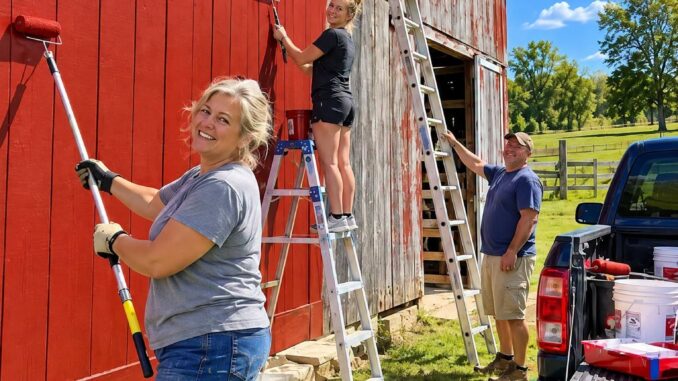
Soon, the first coats of red paint began covering the gray walls.
Carol watched as the familiar color slowly returned.
The sight brought her a sense of relief.
People chatted as they worked.
Some shared memories of visiting the farm years earlier.
Others asked Carol about the barn’s history.
She told them how long it had stood on the property and why the original color mattered to the family.
The volunteers listened with interest.
By midday, much of the exterior had been restored.
The building was beginning to look like the barn Carol remembered.
Restoring the Family Initials
One of the volunteers asked Carol whether there was anything special she wanted to preserve.
Carol explained the story behind the initials that Arlo’s father had painted above the haymow door.
She described their location and appearance.
She also mentioned how much they meant to her husband.
A young volunteer with an interest in art offered to help recreate them.
Using Carol’s description and available family photographs, the volunteer carefully worked on the lettering.
The goal wasn’t to make the initials look perfectly modern.
It was to preserve their familiar appearance.
When the work was finished, Carol stepped back to look.
The white letters stood out against the red wood.
They weren’t an exact replacement for the original paint beneath the gray coating.
But they represented the same family memory.
Carol smiled.
She knew Arlo would recognize them.
An Unexpected Visitor Arrives
By Saturday afternoon, the project was nearly complete.
Volunteers were cleaning brushes and putting away supplies.
A few people were finishing smaller sections near the doors.
Then a vehicle turned into the driveway.
It was Brad.
He stepped out and looked toward the barn.
The gray paint he had arranged only days earlier was almost completely gone.
In its place stood the familiar red building.
He noticed the volunteers.
He saw his mother speaking with neighbors.
And he realized that the repainting had meant much more to Carol than he had understood.
For a moment, Brad remained quiet.
Then he walked toward her.
“Mom,” he said, “can we talk?”
Brad Explains His Decision
Carol agreed.
They moved a short distance away from the volunteers.
Brad looked toward the barn.
He admitted that he hadn’t expected his mother to organize such a large restoration effort.
Then he began explaining why he had arranged the gray paint in the first place.
Seeing his father in the hospital had frightened him.
Arlo had always seemed strong and capable.
He was the person Brad remembered repairing fences, maintaining machinery, and solving problems around the farm.
Watching him struggle with basic movements had been difficult.
Brad worried about what would happen if his father couldn’t return to his previous responsibilities.
He imagined Carol managing the property alone.
He thought about maintenance costs and the physical demands of farm life.
As a real estate agent, his mind had immediately turned toward selling the property.
He believed that preparing the farm for a potential listing would give the family more options.
But he now understood that he had acted too quickly.
Fear Can Lead to Poor Decisions
Brad admitted that he had been overwhelmed.
He wanted to solve a problem before it became more complicated.
In his mind, updating the barn was a practical first step.
He hadn’t fully considered what the building represented to his parents.
Nor had he asked whether they wanted to sell.
Carol listened.
She understood that Brad’s intentions had come from concern.
But she also needed him to recognize why his actions had been hurtful.
She explained that Arlo was still recovering.
His future needs would become clearer with time and professional medical guidance.
There might eventually be important decisions about the farm.
But those decisions belonged to the people who owned it.
They needed to be discussed together.
Brad nodded.
He realized that his desire to help had led him to overlook his parents’ wishes.
A Conversation About Respect
Carol told Brad that she appreciated his concern for their future.
She knew he wanted them to be safe and financially secure.
But she reminded him that support should begin with listening.
Arlo’s stroke had changed many things.
It had not erased his history, preferences, or right to participate in decisions about his life.
Carol also explained that the farm was more than a financial asset.
It was their home.
It held memories that couldn’t be measured through property values alone.
Brad apologized.
He admitted that he should have spoken with both parents before arranging any changes.
Carol accepted his apology.
She didn’t want the situation to create lasting distance between them.
Instead, she wanted the family to learn from it.
Then she pointed toward the remaining work.
“If you want to help,” she suggested, “there’s still painting to finish.”
Working Together Again
Brad didn’t hesitate.
He changed into work clothes and joined the volunteers.
There were still a few small sections that needed attention.
He helped move supplies, clean equipment, and complete the remaining painting.
The work gave him time to reflect.
He had approached the situation as a real estate professional.
Now he was beginning to see it from his parents’ perspective.
The barn wasn’t simply a structure that could be improved for a future sale.
It represented the family’s connection to the property.
As the afternoon continued, Brad spoke with several volunteers.
He thanked them for helping his mother.
By the time the work was finished, the barn looked much as it had before.
Red walls.
Familiar doors.
And the white initials above the haymow.
Carol stood beside Brad and looked at the completed project.
Neither said much.
They didn’t need to.
Preparing for Arlo’s Return
Over the following days, Carol continued visiting Arlo at the hospital.
His medical team monitored his progress and helped plan his recovery.
He was gradually regaining some abilities, although everyday tasks still required effort.
Carol knew that recovery after a stroke could be unpredictable.
She wanted to support him without creating unrealistic expectations.
At home, she prepared the house for his return.
She organized necessary supplies and reviewed the instructions provided by his healthcare team.
Brad also became more involved.
This time, he asked what would be helpful rather than making decisions independently.
He offered assistance with chores and maintenance.
Carol appreciated the change.
Their conversations became easier.
The disagreement about the barn had been difficult, but it had opened the door to a more honest discussion about the family’s needs.
Arlo Finally Comes Home
Nine days after the barn was restored, Arlo was discharged from the hospital.
Carol drove him home.
The journey was quiet.
Arlo was tired, and speaking still required effort.
As they approached the farm, Carol slowed the car.
The red barn came into view.
Arlo looked toward it.
He studied the fresh paint and the familiar white initials above the door.
Then he turned to Carol.
With some difficulty, he asked who had painted it.
Carol smiled.
She explained that the community had helped restore the barn while he was away.
She told him about the teenagers, neighbors, and volunteers who had spent their Saturday working on the building.
Then she explained why the restoration had been necessary.
Brad had arranged for the barn to be painted gray.
And after realizing how important the original appearance was, he had helped put things right.
Arlo listened carefully.
A Father and Son Share an Important Moment
Later, Brad came to visit.
He wanted to speak directly with his father.
He explained that he had been worried about the future of the farm.
He admitted that he had made decisions without asking.
Then he apologized.
Arlo listened.
Communication was still challenging, but he understood what Brad was saying.
Brad told him that he wanted to help with the property in whatever way his parents preferred.
He promised to involve them in future decisions.
Before leaving, Brad noticed a small section near one corner that still needed a final touch-up.
He picked up a brush and finished the work himself.
Arlo watched from nearby.
When Brad returned, his father reached toward him and rested a hand gently against the back of his neck.
Then Arlo managed to say one word.
“Home.”
For Carol, that moment meant more than any explanation could.
The Meaning Behind One Simple Word
Arlo’s recovery was still ongoing.
He had challenges ahead and would continue needing support.
But standing near the barn, surrounded by his family, he seemed comforted by the familiar surroundings.
Carol understood that his single word carried many possible meanings.
It might have been a response to seeing the farm again.
It might have expressed relief at returning after a difficult hospital stay.
Or it might simply have reflected the comfort of being with his family.
Whatever he intended, the moment stayed with them.
Brad looked toward the red barn.
He finally understood why his mother had worked so hard to restore it.
The building wasn’t important because it was old.
It mattered because of the people and memories connected to it.
Three Years Later
Three years passed.
The barn remained red.
Its white initials were carefully maintained.
The family continued caring for the property, making repairs and improvements when needed.
Brad visited regularly.
His relationship with his parents became more collaborative.
Rather than assuming what they needed, he learned to ask.
He helped with practical tasks and discussed major decisions openly.
His young son, Earl, also became a familiar visitor.
The little boy enjoyed spending time with his grandparents.
On some afternoons, he played near the barn while the adults watched.
Occasionally, Arlo lifted Earl onto his shoulders beneath the haymow door.
Above them were the initials that connected the family to an earlier generation.
The same building now held new memories.
What the Experience Taught Brad
Looking back, Brad recognized that his biggest mistake hadn’t been choosing the wrong paint color.
It had been making a major decision without involving his parents.
He had been frightened by his father’s medical emergency.
He wanted to protect his mother from possible difficulties.
But he had confused helping with taking control.
Over time, he learned that supporting family members often means respecting their choices, even when the future feels uncertain.
Sometimes practical help is needed.
Other times, listening is more valuable.
Brad also learned that a family property can have emotional significance that isn’t reflected in its market value.
The barn was a reminder of generations who had lived and worked on the farm.
Changing it without permission had overlooked that history.
Why Family Communication Matters During Difficult Times
A serious medical event can affect an entire family.
Loved ones may feel uncertain about future care needs, finances, and household responsibilities.
It is natural to want to prepare for possible changes.
However, major decisions should be made with appropriate communication and respect for the people involved.
When possible, individuals recovering from medical conditions should remain involved in decisions about their own lives and property.
Family members can help by asking questions, listening to preferences, and seeking professional guidance when necessary.
Support doesn’t always require taking immediate action.
Sometimes the most useful first step is simply having a conversation.
Carol and Brad’s experience illustrates how misunderstandings can arise when fear replaces communication.
It also shows how families can work toward resolving those misunderstandings.
Preserving Family Memories While Embracing Change
Old buildings often carry stories that aren’t immediately visible.
A faded doorway might remind someone of childhood.
A painted sign may represent a family tradition.
An ordinary wooden wall might have witnessed generations of celebrations and everyday life.
Preserving these details doesn’t mean refusing all change.
Homes and farms require maintenance.
Families grow.
Needs evolve.
But thoughtful changes can respect both practical requirements and personal history.
For Carol and Arlo, keeping the barn red was an important way of maintaining that connection.
For Brad, helping restore it became an opportunity to understand his parents more deeply.
And for Earl, the barn would become part of his own childhood memories.
Final Thoughts: More Than Just a Red Barn
When Carol returned home from the hospital and discovered that her family’s barn had been painted gray, she felt that an important piece of their history had been overlooked.
Rather than allowing the disagreement to grow, she organized a restoration project.
Neighbors, teenagers, and friends came together to help.
Brad eventually recognized his mistake, apologized, and joined the effort.
When Arlo returned home, he found the barn looking familiar again.
The experience helped the family understand one another more clearly.
The most meaningful lesson wasn’t about the color of a building. It was about listening, respecting family decisions, and recognizing that some places carry memories far beyond their practical value.
Three years later, the red barn still stood on the Jensen farm.
Its doors opened to new days.
Its walls continued to shelter family traditions.
And the white initials above the haymow remained a reminder that a home is shaped not only by the people who live there today, but also by the generations who came before them.
Leave a Reply