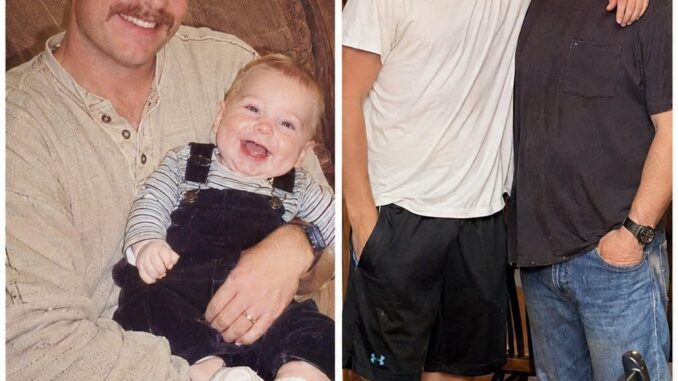
For five years, Jamie Collins paid his father $250 every month to continue living in their family home.
He believed the arrangement was one more sign of the distance that had grown between them.
His father, Ray, rarely spoke about his feelings, showed little interest in Jamie’s musical ambitions, and seemed determined to teach him that life was about responsibility rather than personal dreams.
When Ray passed away after a long illness, Jamie expected to feel relief from years of tension.
Instead, he found himself struggling with grief, unanswered questions, and memories of the relationship they had never managed to repair.
Then Ray’s closest friend arrived with a cardboard box.
What Jamie discovered inside would change his understanding of his father’s life and the sacrifices he’d made.
The House After the Funeral
The evening of Ray’s funeral, Jamie returned to the home where he’d spent his entire life.
His father’s worn work boots were still beside the front door.
The leather was cracked, the laces were tied, and dried mud covered the heels.
Jamie stood looking at them.
For years, he’d imagined how different the house might feel without his father’s constant presence.
Now that the moment had arrived, the silence was difficult to bear.
He walked into the kitchen and sat at the table.
It was the same place where he’d left $250 in cash on the first day of every month.
Their last meaningful conversation had been about a leaking faucet.
Ray had promised to repair it when he felt better.
He never had the opportunity.
The faucet was still dripping when someone knocked on the door.
It was Frank Russo, Ray’s longtime friend.
Frank owned an auto body shop and had known Ray for more than thirty years.
He was carrying a carefully sealed cardboard box.
“Your father wanted you to have this,” Frank explained. “But he asked me to wait until after he was gone.”
Jamie looked at the package.
He couldn’t imagine what it contained.
Frank encouraged him to open it before drawing any conclusions.
To understand why the box mattered, Jamie first had to remember the father he’d known as a child.
When Their Home Was Filled With Music
Before Jamie’s mother became ill, the Collins household had been lively.
Ray played guitar almost every evening.
He enjoyed rock and country music, sometimes performing familiar songs and sometimes creating melodies of his own.
Jamie’s mother, Annie, often sang along while preparing dinner.
She wasn’t a professional singer, but she loved music.
Sometimes she would hold a wooden spoon like a microphone and dance into the living room.
Ray would play louder, and Jamie would laugh.
As a little boy, Jamie had a red plastic guitar with yellow strings.
He would stand on the couch pretending to perform for a large audience.
His parents always encouraged him.
Those evenings became some of his happiest childhood memories.
Then everything changed.
Losing His Mother
When Jamie was eight, Annie began experiencing persistent headaches and difficulty finding words.
Doctors eventually diagnosed her with glioblastoma, a serious form of brain cancer.
She died eleven months later.
Jamie was nine.
After her death, Ray became a different person.
At first, his guitar remained in the living room.
One night, Jamie heard him playing a song Annie had loved.
Ray stopped before reaching the end.
A few days later, the guitar disappeared into its case.
It remained in his bedroom closet for years.
Ray began working additional shifts at a factory that manufactured automotive parts.
He left home early and returned late.
He provided food, paid the bills, and made sure Jamie attended school.
But their conversations became brief.
The playful father Jamie remembered seemed to have disappeared.
Growing Up With Emotional Distance
As Jamie grew older, he struggled to connect with Ray.
His father rarely asked about school or friendships.
When Jamie needed new shoes because his old sneakers were damaged, Ray suggested wearing additional socks rather than replacing them immediately.
Jamie remembered the experience for years.
He understood that money was limited, but he wished his father had shown more concern.
At twelve, Jamie discovered something surprising while searching through a drawer.
He found photographs of Ray performing onstage with a band called the Low Lanterns.
In the pictures, Ray had long hair and wore a leather vest covered in patches.
He looked confident and happy.
Jamie was fascinated.
He asked whether the band had recorded music or performed professionally.
Ray gave him only a brief answer.
It had been a long time ago.
Then he put the photographs away.
Jamie continued wondering about the person his father had been before Annie’s death.
One evening, he asked whether Ray had ever dreamed of becoming famous.
Ray admitted that music had once been an important ambition.
But he offered little explanation about why he’d stopped pursuing it.
Jamie Discovers His Own Musical Talent
By sixteen, Jamie had become interested in playing guitar.
He saved money from mowing lawns and purchased a secondhand acoustic guitar for $80.
The instrument was worn, with a crack near the bridge and a small silver star sticker.
It wasn’t expensive, but Jamie loved it.
He taught himself through online lessons.
He practiced for hours in his bedroom and eventually began writing songs.
One composition was especially meaningful.
He called it “Kitchen Light.”
The song was inspired by memories of his mother singing while Ray played guitar.
It described their family evenings, the wooden spoon she used as a microphone, and the warmth Jamie remembered from childhood.
Jamie hoped to pursue music seriously.
At school, he discovered a two-year music production program at a community college in Columbus.
The course offered training in recording, mixing, and other studio techniques.
He brought the brochure home and showed it to Ray.
His father’s response disappointed him.
Ray believed Jamie should concentrate on finding stable employment.
He warned that earning a living through music could be difficult.
Jamie pointed out that Ray had once been a musician himself.
But the conversation ended without encouragement.
A Birthday Jamie Never Forgot
On his eighteenth birthday, Jamie came downstairs hoping his father might acknowledge the occasion.
Instead, Ray handed him a small piece of paper.
It stated that Jamie would need to pay $250 in rent on the first of every month.
Ray explained that Jamie was now an adult and should begin contributing financially.
Jamie was surprised and hurt.
He already worked part-time at a grocery store.
After the new arrangement began, he accepted additional shifts to cover rent, transportation, groceries, and other expenses.
Saving money became difficult.
Whenever he managed to put something aside, an unexpected cost seemed to appear.
His car needed repairs.
His work shoes wore out.
A dental appointment used up money he’d planned to spend on recording equipment.
Jamie grew increasingly frustrated.
He wanted to invest in his future, but he felt unable to make progress.
Meanwhile, Ray continued enjoying occasional fishing trips with Frank.
Jamie assumed his father had money for hobbies but little interest in helping him pursue music.
Their relationship became more strained.
A Bedroom Recording Studio
At nineteen, Jamie finally saved enough to purchase a used microphone and an inexpensive audio interface.
He transformed his bedroom into a basic recording space.
Blankets covered parts of the walls to reduce echoes.
He recorded late at night after finishing his shifts at the grocery store.
One evening, while working on “Kitchen Light,” Ray entered his room.
He asked Jamie to lower the volume because he needed to wake up early for work.
Jamie was exhausted and frustrated.
He accused his father of discouraging the one activity that made him happy.
Ray responded that he didn’t want Jamie to make the same mistakes he believed he’d made.
Neither knew how to continue the conversation.
Afterward, Jamie recorded less frequently.
His guitar spent more time in its case.
Eventually, while clearing out his room, he realized the instrument was missing.
He searched the house but couldn’t find it.
He assumed he’d accidentally discarded it or left it somewhere.
He never asked Ray about it.
By then, their communication had become so limited that even simple questions felt difficult.
Ray’s Illness
When Jamie was twenty-one, Ray told him he’d been diagnosed with pancreatic cancer.
Doctors planned to begin chemotherapy.
Jamie didn’t know how to respond.
He offered to drive his father to appointments, but Ray preferred to manage them independently.
Over the next two years, Ray’s health declined.
He lost weight and eventually became unable to continue working.
Despite everything, the monthly rent arrangement remained unchanged.
Jamie continued leaving $250 on the kitchen table.
Ray continued collecting it.
Jamie couldn’t understand why his father insisted on maintaining the arrangement while they were facing such a difficult situation.
He felt angry, but he also worried about Ray.
Neither expressed those feelings openly.
In March, five years after Jamie’s eighteenth birthday, Ray died at the hospital.
Frank was with him.
Jamie was at home when he received the call.
He’d imagined that losing his father might bring an end to years of frustration.
Instead, he felt grief.
There were too many things they’d never discussed.
What Was Inside the Box?
On the evening of the funeral, Jamie finally opened the box Frank had delivered.
The first item was an old leather vest.
It was covered in patches, including one bearing the name Low Lanterns.
Underneath were guitar picks, backstage passes, concert photographs, and memorabilia from Ray’s musical career.
Jamie examined the pictures.
His father appeared onstage, performing in front of enthusiastic audiences.
Then Jamie found a photograph of Annie.
She was standing beside the stage in a summer dress, smiling at Ray as he played.
Ray was smiling back.
Jamie remembered the father who’d once filled their home with music.
He became emotional.
Frank stayed with him until he felt ready to be alone.
Later, while returning the photographs to the box, Jamie noticed something else.
A brass key had slipped from beneath the vest.
Attached to it was a paper tag.
In Ray’s handwriting was an address:
1144 Kessler Industrial Road, Unit C.
There was no explanation.
Curious, Jamie decided to visit the location.
A Building Jamie Had Never Seen
Kessler Industrial Road was on the outskirts of town.
Jamie drove past old warehouses and unused commercial buildings until he reached the address.
Unit C was part of a low gray building.
There were no signs identifying a business.
The windows were covered from inside.
Jamie hesitated.
He wondered why his father had kept a key to a place he’d never mentioned.
Eventually, he unlocked the door.
When he switched on the lights, he was astonished.
The room contained professional recording equipment.
Acoustic panels covered the walls.
There was a mixing console, microphones, studio speakers, amplifiers, a keyboard, and a separate recording booth.
It was a fully equipped music studio.
Everything appeared carefully maintained.
Cables were organized.
The instruments were arranged neatly.
Photographs and newspaper clippings covered one wall.
Jamie walked closer to examine them.
They documented Ray’s years with the Low Lanterns.
The Career Ray Had Left Behind
One newspaper article described the Low Lanterns selling out a 900-seat theater for three consecutive weekends.
Another mentioned interest from record labels.
A third reported that the band had declined a touring opportunity for family reasons.
Jamie checked the date.
It was the year he’d been born.
He realized that his father’s musical career had been more successful than he’d understood.
Ray had performed for large audiences.
He’d written songs.
He’d received opportunities to take his career beyond their hometown.
Yet he’d never explained any of it to Jamie.
As Jamie continued exploring the studio, he noticed several guitars.
One was Ray’s old Gibson.
Another was immediately familiar.
It was a black acoustic guitar with a silver star sticker.
Jamie’s guitar.
The instrument he’d believed was lost.
He picked it up.
The strings had been replaced, and the crack near the bridge had been professionally repaired.
Jamie remembered seeing Frank carry a long object wrapped in a blanket from their house years earlier.
For the first time, he wondered whether his father had been working on something for him.
A Recording Left Behind
Near the mixing console, Jamie found a flash drive.
A piece of tape attached to it read “Our Band.”
He connected it to the studio computer.
There was a video file.
Jamie pressed play.
The recording began with old footage of the Low Lanterns rehearsing and performing.
He saw a younger Ray playing guitar, laughing with his bandmates, and enjoying life onstage.
Frank appeared behind the drums.
Jamie recognized him immediately.
Other clips showed the band traveling, rehearsing, and joking backstage.
There were moments featuring Annie in the audience.
Watching them brought back memories Jamie hadn’t thought about in years.
Then the video changed.
The next scene showed Ray sitting in the very studio Jamie had just discovered.
He looked older and noticeably weaker.
The recording had clearly been made during his illness.
Ray looked directly at the camera.
He began speaking to his son.
The Apology Jamie Had Waited Years to Hear
Ray admitted that he’d struggled to express his feelings.
He apologized for the distance between them.
After Annie died, he’d become overwhelmed by grief and responsibility.
He believed that working hard and providing financial stability were the most important things he could do for Jamie.
But he now understood that his son had needed emotional support too.
Ray explained that he’d spent so much time worrying about Jamie’s future that he’d overlooked the importance of encouraging his happiness.
Then he began talking about the Low Lanterns.
He revealed that the band had received offers from record labels.
One opportunity involved a lengthy national tour.
Around the same time, Annie learned she was pregnant.
Although she encouraged Ray to pursue the opportunity, he decided to remain close to home.
His own father had spent long periods away for work, and Ray didn’t want to repeat that experience.
Without Ray, who wrote much of the band’s music, the group eventually separated.
Ray took a factory job.
He planned to return to music someday.
But life moved forward.
He married Annie, became a father, and discovered that playing guitar at home with his family brought him more happiness than performing for large crowds.
Then Annie became ill.
Why Ray Stopped Playing
In the recording, Ray explained how difficult music had become after Annie’s death.
One of their final musical memories together had taken place during her hospitalization.
Ray played a song she loved, and Annie sang along as much as she could.
After losing her, he found it painful to play the same music.
He put his guitar away.
Eventually, he began associating music with the possibility of losing something deeply important.
When Jamie developed a passion for guitar, Ray became afraid.
He worried that his son might experience the same disappointment and grief.
Rather than encouraging him, Ray tried to steer him toward a more predictable career.
In the recording, he acknowledged that this had been a mistake.
His fears had prevented him from supporting Jamie.
He told his son that he had listened to him practicing from the back porch.
He’d heard the songs.
He’d recognized Jamie’s talent.
And he’d been proud.
But he hadn’t known how to say it.
The Studio’s Real Purpose
Ray explained that after receiving his cancer diagnosis, he’d started watching old recordings of his band.
The memories reminded him of how much music had meant to him.
He also remembered Jamie playing his toy guitar as a child and practicing upstairs as a teenager.
He realized how much encouragement he’d failed to provide.
With Frank’s help, he began developing a plan.
He wanted to create a professional recording space where Jamie could pursue his interests.
Frank, along with former bandmates Marty and Leon, helped find and renovate the building.
They spent weekends installing equipment, arranging the recording rooms, and preparing the space.
Those weekends were the fishing trips Jamie had heard about.
The group had been working on the studio.
Ray explained that he’d chosen not to reveal the project while he was alive.
He didn’t want Jamie to feel obligated to forgive him because of an expensive gift.
Instead, he wanted Jamie to have the freedom to decide what to do with the studio.
He could make music.
He could sell the equipment.
He could use the space for another purpose.
Ray wanted the decision to belong entirely to him.
A Special Project on the Computer
Near the end of the video, Ray mentioned a recording project saved on the computer.
It was called “Kitchen Light.”
Jamie was stunned.
He’d never played the complete song for his father.
But Ray explained that he’d learned it by listening through the floor while Jamie practiced.
He’d recorded a guitar part and left the vocal track empty.
That part was for Jamie.
Ray also directed him to open a drawer beneath the mixing console.
Before the recording ended, Ray apologized again.
He mentioned specific memories he regretted, including the time he’d failed to replace Jamie’s damaged shoes.
He wished he’d been more encouraging and emotionally available.
Most importantly, he wanted Jamie to know how proud he’d always been.
Then the video ended.
Jamie remained seated for a long time.
He was grateful to hear his father’s words.
But he also wished they’d had the conversation face-to-face.
Sixty Envelopes in a Wooden Box
Eventually, Jamie remembered the drawer.
He opened it.
Inside was a wooden box filled with white envelopes.
Each envelope had a month and year written on the front.
Jamie opened the first one.
It contained $250.
Two hundred-dollar bills and a fifty-dollar bill, folded together.
He opened another.
The same amount was inside.
Then another.
Jamie counted the envelopes.
There were sixty.
One for every month he’d paid rent since turning eighteen.
The total was $15,000.
Ray had saved the money rather than spending it.
On top of the envelopes was a handwritten note.
His father explained that the money belonged to Jamie and that he hoped his son would use it to pursue something meaningful.
The monthly payments, Ray wrote, had been intended as a lesson in financial responsibility.
Jamie sat quietly, trying to understand what he’d discovered.
His father had been saving the rent for him all along.
But the discovery also raised a painful question.
Why hadn’t Ray explained his intentions earlier?
The money was generous.
The secrecy had still caused years of misunderstanding.
Both things could be true.
Hearing “Kitchen Light” Again
Jamie returned to the computer and opened the music project.
Two tracks appeared on the screen.
One contained Ray’s guitar recording.
The other was an empty vocal track labeled for Jamie.
He pressed play.
His father’s guitar filled the room.
Ray had learned the song almost exactly as Jamie had written it.
Every chord and transition sounded familiar.
Even an unusual chord Jamie had originally played by accident was included.
Then, near the end, Ray had added a short instrumental passage.
It was a melody Annie used to sing during their family evenings.
For years, Ray had struggled to finish playing that song because of the memories associated with it.
But on this recording, he played the entire passage.
Jamie listened until the music ended.
He stayed in the studio for hours, reflecting on his parents and the years that had passed.
Frank Explains the Rest
The following afternoon, Frank visited the house.
Jamie was sitting outside when he arrived.
He asked why Frank had kept the studio secret.
Frank explained that Ray had requested his silence.
Although Frank disagreed with the decision, he’d respected his friend’s wishes during his illness.
He told Jamie more about the project.
Ray had contacted him shortly after his diagnosis.
He was deeply concerned about the relationship with his son and wanted to do something meaningful before his health declined further.
Frank helped locate the building through a relative.
Marty worked on the electrical installation.
Leon helped construct the recording booth.
Ray installed acoustic panels and organized equipment whenever he felt well enough.
The project took nearly two years.
Frank also confirmed that Ray had arranged for Jamie’s missing guitar to be repaired.
A specialist in Columbus had restored the damaged instrument.
When Jamie asked why his father continued collecting rent even after becoming ill, Frank admitted that he hadn’t fully agreed with the decision.
Ray believed changing the arrangement would reveal the surprise.
He also viewed the monthly exchange as one of the few remaining routines between them.
Jamie found the explanation difficult to accept.
He appreciated the intention, but he wished his father had chosen a more open approach.
Frank understood.
An Invitation to Play Music Again
Before leaving, Frank mentioned something Jamie hadn’t known.
He, Marty, and Leon still met at the studio every Thursday evening.
Ray had played with them whenever his health allowed.
The three friends intended to continue gathering.
Frank told Jamie he would be welcome whenever he felt ready.
There was no pressure.
Jamie didn’t answer immediately.
He wasn’t sure whether he could return to the studio.
But he kept thinking about the empty vocal track.
That evening, he finally moved Ray’s work boots from the front door into the closet.
He placed them beside the old guitar case.
Then he repaired the kitchen faucet.
It took twenty minutes and an online tutorial.
When he finished, the house was quiet.
For the first time since the funeral, the silence felt a little more peaceful.
Returning to the Studio
On Thursday evening, Jamie drove to Kessler Industrial Road.
Frank’s truck was already parked outside.
Two other vehicles stood nearby.
Jamie could hear instruments being tuned inside.
He sat in his car for several minutes.
Then he entered.
Frank was behind the drums.
Marty held a bass guitar.
Leon sat near the keyboard.
They greeted Jamie warmly.
He walked toward the instrument stand and picked up his repaired acoustic guitar.
It was in tune.
When the musicians asked what he wanted to play, Jamie looked toward the computer.
The “Kitchen Light” project was still there.
He explained that Ray had recorded the guitar part.
But the song was unfinished.
It needed vocals.
Jamie stepped into the recording booth.
He put on the headphones.
Frank counted them in.
Ray’s guitar began playing.
And Jamie started to sing.
Finishing the Song Together
The first attempt wasn’t perfect.
Jamie struggled with emotion.
His voice wavered, and he had to stop.
The musicians waited patiently.
They started again.
On the fourth attempt, Jamie completed the song.
When the final instrumental passage began, he stopped singing.
He listened as Ray’s guitar played the melody Annie had once loved.
The recording ended.
For a while, nobody spoke.
Then Frank made a lighthearted comment about Jamie inheriting his mother’s difficulty with high notes.
Jamie laughed.
It was the first time in years that music had felt uncomplicated.
He wasn’t performing to prove anything.
He was simply doing something he loved, surrounded by people who cared about his family.
Eighteen Months Later
A year and a half after discovering the studio, Jamie’s life had changed.
He used the $15,000 his father had saved to enroll in the music production program in Columbus.
It was the same program he’d wanted to attend as a teenager.
He traveled to classes three days a week and continued working at the grocery store on weekends.
On Thursday evenings, he rehearsed with Frank, Marty, and Leon.
Together, they revived the Low Lanterns name.
The group began performing at a small venue called the Blue Door.
Their audiences were modest.
At their largest show, sixty-three people attended.
It was far fewer than the crowds Ray had once performed for.
But Jamie was happy.
He was learning, creating music, and sharing the experience with people who had known his father.
At the end of every performance, the band played “Kitchen Light.”
Jamie performed the final instrumental passage on Ray’s old Gibson guitar.
It became a personal tradition.
A Small Reminder of Home
Inside the recording studio, Jamie placed a wooden spoon on top of the mixing console.
It reminded him of Annie singing in the kitchen.
The walls still displayed photographs of the Low Lanterns.
One showed his mother smiling at Ray during a performance.
Another captured the band during their early years.
The original recording project remained saved on the computer.
Jamie sometimes opened it when he worked late.
He listened to his father’s guitar and remembered the happier moments of childhood.
He also remembered the difficult years.
He didn’t pretend that the studio or the money erased the emotional distance between them.
He wished they’d spoken more openly while Ray was alive.
He wished his father had understood sooner that encouragement and affection were just as important as financial support.
But he could now see his father as a more complicated person.
Ray had loved music.
He’d loved Annie.
He’d loved his son.
And after years of struggling to express those feelings, he’d tried to leave Jamie an opportunity to pursue the life he wanted.
What Jamie Learned About His Father
The $15,000 was an extraordinary discovery.
But the money wasn’t the most meaningful part of Ray’s final gift.
The studio represented something Jamie had wanted throughout his childhood: recognition that his interests mattered.
The video offered words he’d waited years to hear.
And the unfinished recording gave him an opportunity to create something with his father, even after his death.
Their relationship had been imperfect.
Ray’s intentions hadn’t always matched the impact of his decisions.
Jamie had experienced real disappointment, and no later gift could change that.
Still, learning more about his father’s history helped him understand the fears and regrets that had shaped their relationship.
Jamie couldn’t return to the past.
He couldn’t ask Ray all the questions that remained.
But he could choose what to do next.
He chose to study music.
He chose to keep the studio.
And he chose to finish the song they’d both loved.
The greatest part of Ray’s legacy wasn’t the money he’d saved. It was the opportunity for Jamie to build a future around something that brought him joy.
Every time Jamie picked up his guitar, he remembered the little boy standing on the couch with a plastic instrument.
And he remembered his father smiling, making room beside him, and inviting him to play.
Leave a Reply