When my father-in-law sold the farm where my husband had grown up, we thought that chapter of our family’s history had ended.
The eighty-acre property had been part of Luke’s life since childhood. It was where he’d learned to work the land, spent summers with his parents, and made countless memories.
But after his mother passed away, his father decided to sell.
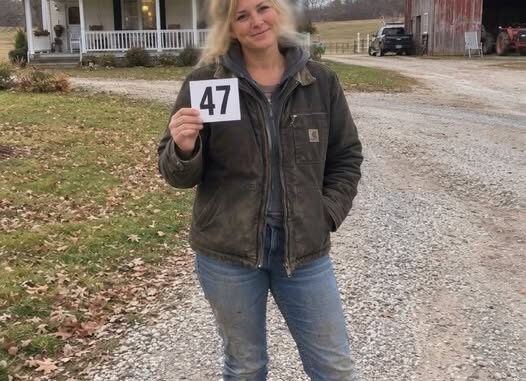
Four years later, I stood at an auction holding bidder card number 47, hoping to bring the property back into our family.
It was a moment we’d spent years preparing for.
The Farm That Meant Everything
My name is Amy, and I grew up in Kearney, Nebraska.
My husband, Luke, was raised on a farm eleven miles outside town.
The property included a white farmhouse, a red barn, and eighty acres of grazing land.
His mother, June, had lovingly cared for the home and its garden.
When she passed away in January, the entire family struggled with the loss.
The following month, Luke’s father, Walt, announced that he wanted to sell the farm.
Luke and I asked whether he’d consider selling it to us through an installment agreement.
We offered to make regular payments, similar to the arrangement Walt had once made with his own father.
He promised to consider it.
But in April, he sold the property for $286,000 to a man from Denver who planned to use it for seasonal hunting.
Luke learned about the sale during a brief phone call at work.
He was disappointed, but he didn’t want to argue with his father.
A Difficult Family Conversation
Not long afterward, a patient at the dental office where I worked told me that Walt had been discussing the sale around town.
Apparently, he believed I wouldn’t appreciate farm life because I’d grown up in town.
He worried that Luke and I might eventually divide the land into residential lots.
The comments hurt.
I had always respected the farm and understood how much it meant to my husband.
But Luke asked me not to confront his father.
Walt was still grieving June, and Luke didn’t want to make their relationship more difficult.
I respected his wishes.
At Easter dinner, I thanked Walt for giving Luke such a meaningful childhood on the farm.
I told him that regardless of who owned the property, the memories would always belong to our family.
Walt quietly nodded.
On our drive home, Luke asked why I’d said it.
I explained that I hoped we might have another opportunity to buy the farm someday.
I wanted us to be ready if that happened.
Four Years of Saving
The following Monday, I contacted a dental practice in Hastings about a Saturday position.
I already worked as a dental hygienist, but I was willing to take on additional hours.
For the next four years, I left home early every Saturday morning.
The income from that second job went into a separate savings account.
Luke and I also reduced our household expenses.
We postponed vacations, continued driving our older minivan, and bought many of our children’s clothes secondhand.
It wasn’t always easy.
But we had a shared goal.
Every month, we drove past the farm.
We sometimes maintained the grass near the mailbox and checked on the lilac bushes June had planted.
I even contacted the new owner to ask whether I could water them.
He kindly agreed, explaining that he rarely visited outside hunting season.
Meanwhile, Walt continued attending our son’s baseball games.
We never discussed the farm.
I didn’t want our plans to become another source of tension.
An Unexpected Opportunity
Four years later, I noticed a property auction announcement in the local newspaper.
The farm was going back on the market.
I immediately contacted the owner.
He confirmed that the auction arrangements had already been finalized and that anyone interested could participate.
I checked our savings account.
We had accumulated $71,400.
It represented years of additional work and careful spending.
Luke and I met with our banker to discuss financing.
After reviewing our income, savings, and financial obligations, we agreed on a maximum purchase price.
$305,000.
That was the highest amount we believed we could responsibly afford.
We promised each other that we wouldn’t exceed it.
Auction Day
The final Saturday of March was cold and windy.
More than sixty people gathered outside the farmhouse.
The auctioneer, Denny Kruse, stood on a hay wagon and welcomed the bidders.
At registration, I received a white card.
Number 47.
Luke had originally planned to handle the bidding.
But as we stood in the yard, I noticed him looking toward the farmhouse porch.
It was where his mother used to sit.
I could tell the day was emotional for him.
When the bidding began, he hesitated.
So I raised my card.
The auction moved quickly.
Several interested buyers participated, including a representative from a land company.
The price climbed toward $280,000, then $290,000.
I continued bidding.
At $295,000, Luke gently placed his hand on my back.
Neither of us said anything.
We both knew how much this meant.
Then I noticed Walt standing near the back of the crowd.
He was watching quietly.
The Final Bids
The auctioneer called for $300,000.
The land company representative remained interested.
I raised bidder card 47 again.
As the offers approached our financial limit, I remembered the early Saturday mornings, the vacations we’d postponed, and the years we’d spent saving.
I also remembered our promise not to put our family’s financial stability at risk.
Luke and I exchanged a glance.
We knew exactly how much we could afford.
I made another bid within our approved limit.
The competing bidder considered his next move.
Then he stepped back.
The auctioneer called for any further offers.
Nobody responded.
A moment later, the bidding closed.
We had won.
The farm was going back into our family.
Returning to the Farmhouse
After the auction, Luke and I stood quietly in the yard.
It was difficult to believe that four years of planning had brought us back to the place where he’d grown up.
Walt approached us.
He had watched the entire auction from the back of the crowd.
For a moment, none of us knew what to say.
Then Luke told him how much it meant to have the opportunity to preserve the property.
Walt listened.
There was no argument about the earlier sale.
The moment wasn’t about proving anyone wrong.
It was about beginning a new chapter.
Later, Luke and I walked through the farmhouse.
The rooms were familiar, even though some things had changed.
We visited the red barn and looked across the grazing land.
Outside, June’s lilac bushes were still growing.
I thought about all the Saturdays I’d spent working toward this day.
Every sacrifice suddenly felt worthwhile.
More Than a Property Purchase
Buying the farm didn’t erase the disappointment Luke had felt when it was first sold.
And it didn’t mean every family disagreement had disappeared.
But it gave us an opportunity to preserve a place that held generations of memories.
We had approached the purchase carefully, saved consistently, and worked together toward something important.
The property was no longer simply part of Luke’s childhood.
It could now become part of our children’s future.
I imagined them exploring the yard, helping in the garden, and hearing stories about their grandparents.
Perhaps one day, they’d understand why their parents had worked so hard to bring the farm back.
Final Thoughts
When Walt first sold the property, I could have focused on resentment.
Instead, Luke and I chose to prepare for an opportunity we weren’t even sure would come.
For four years, we worked, saved, and made financial decisions with that goal in mind.
When the opportunity finally arrived, we were ready.
The farm mattered because of the memories it held, but bringing it back taught us something equally valuable: patience, teamwork, and careful planning can help turn a meaningful dream into reality.
And when I looked at that white farmhouse again, I knew we’d given our family something that couldn’t be measured by its purchase price alone.
A place to make new memories, while honoring the old ones.
Leave a Reply