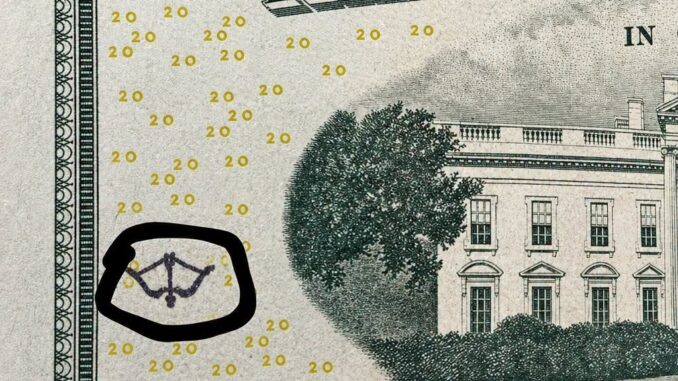
Have you ever looked closely at a U.S. dollar bill and noticed a tiny symbol that doesn’t seem to belong there?
Perhaps it’s a small arrow, a star, a pair of initials, or even a miniature bow and arrow stamped somewhere on the paper.
At first, you might assume it’s a printing mistake, a secret government marking, or something added by a previous owner.
But there’s another fascinating possibility.
Some unusual stamps found on U.S. currency are known as chop marks, markings historically associated with money changers and merchants who handle cash in international markets.
These little symbols can reveal an interesting side of the global currency trade.
While most people think of American dollars as money used within the United States, physical U.S. banknotes circulate far beyond the country’s borders.
They pass through banks, exchange offices, businesses, and marketplaces around the world.
Along the way, some bills acquire stamps that may indicate they were previously examined or handled by a currency dealer.
And although these marks are small, the history behind them is surprisingly interesting.
What Are Chop Marks on U.S. Currency?
Chop marks are small symbols or stamps applied to money by private individuals or businesses.
The term is most closely associated with historical marks placed on coins, particularly silver coins that circulated through international trade.
However, similar markings can also appear on modern paper currency.
On U.S. dollar bills, these marks may take the form of initials, geometric designs, numbers, or recognizable symbols.
Some are stamped in colored ink.
Others appear as small, discreet impressions.
In certain currency-exchange markets, such marks have been used by money handlers to identify banknotes they have examined or processed.
A stamp may indicate that a particular dealer previously accepted the bill as genuine.
However, not every unusual mark on a dollar bill is necessarily a chop mark.
Some markings may have been added for accounting, identification, personal, or entirely unrelated reasons.
Without knowing the origin of a specific symbol, its exact meaning cannot always be established.
Why Would Someone Stamp a Dollar Bill?
At first, marking money might seem unnecessary.
After all, U.S. banknotes already contain security features designed to help people identify genuine currency.
But international cash transactions can involve circumstances very different from those encountered in an ordinary American store.
In some regions, U.S. dollars are widely exchanged through independent money changers and local businesses.
These dealers may handle large quantities of foreign currency.
They need to examine banknotes carefully because accepting counterfeit money can lead to financial losses.
Some currency handlers have used private stamps as part of their business practices.
The mark can indicate that a bill passed through their hands or was accepted after examination.
This does not make the bill officially authenticated.
Instead, it reflects a private practice associated with particular traders or exchange networks.
The Historical Origins of Chop Marks
The tradition of marking money has a long history.
One of its best-known forms developed through the circulation of silver coins in China and other parts of Asia.
During periods when foreign silver coins were widely used in trade, merchants and money handlers needed ways to evaluate the coins they received.
They were concerned about factors such as authenticity, silver content, and weight.
Some merchants stamped coins with distinctive marks after examining them.
These impressions became known as chop marks.
Over time, a single coin might accumulate several different stamps as it passed through multiple hands.
Today, heavily chop-marked historical silver coins are familiar to many numismatists, or collectors and researchers who study currency.
The marks offer evidence of the coins’ circulation and commercial use.
The modern practice of placing small stamps on banknotes has similarities to this older tradition, although the exact customs and purposes can vary.
How Chop Marks Became Associated With Paper Money
As global trade expanded, paper currency became increasingly important in international transactions.
The U.S. dollar developed a particularly prominent role.
American banknotes circulated outside the United States through tourism, trade, savings, remittances, and currency exchange.
In some markets, private money changers handled substantial amounts of U.S. cash.
Because counterfeit banknotes could create serious financial risks, verifying authenticity became an important part of their work.
Some dealers adopted practices that included marking notes they had examined.
These stamps could help identify currency that had previously passed through a particular business.
However, such marks were never part of the official U.S. currency authentication system.
They were private markings rather than government-issued security features.
Why the U.S. Dollar Travels Around the World
The U.S. dollar is one of the most widely used currencies in international finance.
It plays a major role in global trade, financial markets, and central bank reserves.
Physical dollar bills also circulate internationally.
In some countries, people use U.S. currency for savings or transactions.
In others, dollars are commonly exchanged by travelers, merchants, and businesses.
This international circulation means that a banknote printed in the United States may eventually pass through several countries.
It might be exchanged at an airport, accepted by a merchant, deposited at a bank, or traded through a currency-exchange business.
Some notes return to the United States after spending time abroad.
Others continue circulating internationally.
A private stamp on a bill may be one clue that it has passed through a particular cash-handling environment.
The Mystery of the Bow and Arrow Symbol
Among the unusual markings that people sometimes notice on U.S. currency is a small design resembling a bow and arrow.
The symbol may appear on a $20 bill or another denomination.
Its unusual shape can attract attention because it doesn’t resemble the official designs printed by the U.S. Bureau of Engraving and Printing.
Some observers interpret such markings as private currency stamps.
However, a bow and arrow symbol does not have one universally established meaning on U.S. banknotes.
Without documentation linking a particular stamp to a specific money changer or organization, it is difficult to determine exactly who applied it.
The symbol could be a private identification mark, a currency-handler stamp, or another type of marking.
Its presence alone does not prove that the bill traveled to a particular country.
Still, it can make an otherwise ordinary banknote an interesting object to examine.
What Do Chop Marks Usually Look Like?
Private stamps on banknotes can appear in many different forms.
Some consist of simple letters or initials.
Others feature small geometric patterns, arrows, stars, or stylized symbols.
The ink may be black, blue, red, or another color.
The size and placement can also vary.
Some markings are small enough to go unnoticed during everyday transactions.
Others are more prominent.
Unlike official currency features, these stamps are not standardized by the U.S. government.
Their designs depend on the people or businesses that apply them.
This variety makes them interesting to collectors, but it also makes identification challenging.
Two similar-looking symbols may have entirely different origins.
How Money Changers Check Whether a Bill Is Genuine
Currency dealers use several methods to evaluate banknotes.
Modern U.S. currency includes security features intended to make counterfeiting more difficult.
Depending on the denomination and series, these features can include watermarks, security threads, color-shifting ink, microprinting, and other specialized elements.
Money handlers may examine these details when accepting cash.
Some businesses also use currency-authentication equipment.
The purpose is to reduce the risk of accepting counterfeit notes.
A private chop mark, when used, may indicate that a dealer has already examined a particular bill.
However, the stamp itself is not proof that the banknote is genuine.
A counterfeit bill could theoretically carry a similar marking.
For that reason, authentication should rely on the banknote’s actual security features rather than an unofficial stamp.
Can a Chop Mark Help Identify Where a Bill Has Been?
One of the most intriguing ideas associated with chop marks is that they may offer clues about a banknote’s travels.
A bill bearing a recognizable dealer’s stamp could potentially be linked to a particular exchange business or market.
If the mark has been documented, researchers or collectors may be able to learn more about its origin.
However, most private markings do not provide a complete travel history.
A stamp generally cannot reveal every transaction a bill has passed through.
It also cannot establish exactly when the marking was applied unless additional evidence exists.
A bill may have traveled through several countries without receiving any stamps.
Another may have been marked without ever leaving its original country.
Therefore, chop marks are best understood as possible clues rather than reliable tracking systems.
Why Trust Matters in International Currency Exchange
Trust is essential whenever money changes hands.
A merchant needs confidence that the payment received has value.
A currency dealer needs assurance that the banknotes being exchanged are authentic.
A customer wants to know that the money received can be used in future transactions.
These concerns become particularly important when cash moves between different financial systems.
In markets where independent currency exchange is common, relationships and business reputations can influence transactions.
A private stamp may sometimes function as a sign that a particular dealer handled or accepted a note.
However, the reliability of that mark depends entirely on the person or business behind it.
It does not replace official currency verification.
The broader lesson is that international cash circulation depends on both formal financial systems and everyday trust between individuals and businesses.
Are Chop Marks Official U.S. Government Symbols?
No.
Chop marks are not official elements of American currency design.
The U.S. government does not use private bow-and-arrow stamps, merchant initials, or similar markings to authenticate banknotes.
Official banknotes contain specific printed designs and security features.
These features are produced as part of the currency manufacturing process.
A small symbol added later by a private individual or business is separate from those official elements.
This distinction is important because unusual markings can sometimes be mistaken for hidden government codes.
Although U.S. bills do contain official identifiers, such as serial numbers and Federal Reserve indicators, privately applied stamps are not part of that system.
Are U.S. Bills With Chop Marks Still Legal Tender?
Finding an unofficial stamp on a dollar bill does not automatically make it worthless.
Many marked banknotes remain usable.
However, the legal treatment of currency markings is more complicated than simply saying all small stamps are permitted.
Under U.S. law, certain forms of currency defacement are prohibited, particularly when performed with the intent to make the money unfit for reissue.
The relevant circumstances and intent matter.
A small mark does not necessarily mean a banknote has lost its monetary value.
Nevertheless, businesses, banks, or automated cash-processing machines may reject notes that are excessively damaged or altered.
Acceptance can also depend on local policies and the condition of the bill.
If a banknote is heavily marked, damaged, or difficult to authenticate, exchanging it through an appropriate financial institution may be necessary.
Can a Store Refuse a Dollar Bill With a Stamp?
Yes, a business may decline to accept a particular banknote.
In the United States, legal-tender status does not generally require every private business to accept every form of cash in every transaction, subject to applicable state and local laws.
A merchant might be concerned about a heavily marked bill.
The marking could obscure security features or make the note difficult to examine.
Automated machines may also have trouble processing certain damaged or altered notes.
However, a small stamp does not automatically make a bill unusable.
Many lightly marked notes continue circulating without difficulty.
The practical result depends on the bill’s condition and the policies of the institution or business handling it.
Does a Bow and Arrow Mark Make a $20 Bill Valuable?
An unusual stamp can make a banknote interesting, but it does not automatically increase its value.
Collectors evaluate currency based on several factors.
These may include rarity, condition, historical significance, and documented provenance.
Most ordinary circulated bills with unidentified private stamps are not necessarily worth more than their face value.
In some cases, added markings can reduce a banknote’s appeal to collectors who prefer unaltered examples.
However, a historically documented or unusual marking may attract specialized interest.
The key is establishing what the symbol represents.
A mysterious bow and arrow stamp is not, by itself, evidence that a $20 bill is rare or valuable.
Anyone curious about a particular note can consult a reputable currency dealer or numismatic specialist for an assessment.
Why Collectors Find Marked Currency Interesting
Currency collecting is about more than finding rare dates or unusual serial numbers.
Some collectors are fascinated by the history of money in circulation.
They study how coins and banknotes moved through different economies.
They also examine markings, alterations, and other evidence of use.
Historical chop-marked coins are particularly interesting because they can reflect trade networks and merchant practices.
Modern marked banknotes may appeal to collectors interested in international currency exchange.
Even when a stamp cannot be identified, it can raise questions about the note’s history.
Who marked it?
Where was it circulating?
Was the symbol connected to a particular business?
These questions make ordinary currency an interesting subject for historical investigation.
The Difference Between Chop Marks and Official Currency Features
It’s easy to confuse unusual private markings with legitimate features of U.S. banknotes.
But they serve very different purposes.
Official security features are incorporated during production.
They help people identify genuine currency and make counterfeiting more difficult.
Private chop marks are added after a banknote enters circulation.
They may reflect the practices of a currency dealer, merchant, or other individual.
They are not standardized across denominations.
Nor do they provide an official guarantee of authenticity.
Recognizing this difference helps prevent misunderstandings about mysterious symbols on money.
A stamp may be interesting, but the banknote’s security features remain the appropriate basis for checking whether it is genuine.
Could a Dollar Bill Travel Through Several Countries?
Absolutely.
Physical currency can circulate through numerous hands and locations during its lifetime.
Imagine a traveler exchanging dollars before leaving the United States.
Those notes might be spent in a foreign market.
A merchant could exchange them through a local currency dealer.
The dealer might later sell them to another customer.
Eventually, the same notes could be deposited into a bank or carried to another country.
This is only an illustrative example, but it shows how physical currency can move through international networks.
A single banknote may participate in many transactions before being removed from circulation.
Private stamps can sometimes offer hints about this activity.
However, most of a bill’s journey remains invisible.
Why U.S. Currency Is Widely Used Outside America
The international role of the U.S. dollar developed through economic and financial history.
Today, it remains a major currency for international transactions and reserves.
Its widespread use is supported by factors including the scale of U.S. financial markets and the dollar’s established position in global commerce.
Physical banknotes are also held and exchanged outside the United States.
Some individuals use dollars as a store of value.
Others receive or exchange them through travel, business, or remittances.
This international demand helps explain why American currency can appear in unexpected locations.
It also provides context for the private marking practices associated with certain foreign-exchange markets.
A dollar bill may be American in origin, but its circulation can be international.
Why Some Bills Have Several Different Stamps
Occasionally, a banknote may carry more than one private marking.
This can happen for several reasons.
Different businesses may have handled the note.
Separate stamps may have been applied for accounting or identification.
Some marks may have been added by individuals for unrelated purposes.
Without documentation, it is difficult to know exactly why multiple symbols appear.
Historically, silver coins could accumulate numerous chop marks as they passed through different merchants’ hands.
That practice is well documented in numismatic history.
With modern paper currency, however, multiple stamps should not automatically be interpreted as a complete record of international transactions.
Each mark needs to be considered individually.
How to Examine a Bill With an Unusual Symbol
If you discover a strange marking on a U.S. bill, start by examining it carefully.
Look at the shape, size, and color of the symbol.
Notice whether it appears to have been stamped with ink or applied using another method.
Check whether the design resembles initials, a logo, or a recognizable image.
You can also compare the banknote with official examples of the same denomination and series.
This helps distinguish standard printed features from markings added later.
If you’re interested in researching the stamp, clear photographs can be useful.
Currency collectors and specialized numismatic communities may recognize certain documented markings.
However, be cautious about accepting unsupported claims.
An unusual symbol does not necessarily have a secret meaning or indicate a rare collectible.
The Fascinating History Hidden in Everyday Money
Most people rarely stop to consider where their cash has been.
A banknote passes from one person to another.
It moves through stores, banks, restaurants, and countless other transactions.
Eventually, it may become worn enough to be removed from circulation.
But during its lifetime, that piece of paper can travel considerable distances.
It may cross international borders.
It may be exchanged in unfamiliar markets.
It may pass through the hands of people who speak different languages and live in entirely different economic circumstances.
A small private stamp can make that otherwise invisible journey feel more tangible.
Even when the exact origin of the mark is unknown, it encourages curiosity about the global movement of money.
What Chop Marks Reveal About the History of Trade
The tradition of marking currency illustrates a longstanding concern in commerce: determining whether money can be trusted.
Historically, merchants needed to evaluate the coins they received.
Silver content, weight, and authenticity could affect a coin’s value.
Chop marks developed within that environment.
As forms of money changed, traders continued developing methods to identify and evaluate currency.
Modern banknotes rely on sophisticated security features and financial institutions.
But private markings still offer an interesting glimpse into informal commercial practices.
They demonstrate that the history of money is also a history of verification, reputation, and exchange.
Why a Small Symbol Can Spark So Much Curiosity
A tiny bow and arrow stamp may occupy only a small portion of a dollar bill.
Yet it can raise surprisingly big questions.
Who put it there?
Was it used by a money changer?
Did the bill circulate overseas?
Does the symbol represent a business or individual?
Could it have historical significance?
These questions are fascinating because the answers are not always obvious.
A banknote is both a financial instrument and a physical object.
It can carry evidence of the people who handled it.
While most marks are not especially valuable or mysterious, they can still inspire curiosity about the world beyond everyday transactions.
Final Thoughts: The Hidden Story Behind Marked Dollar Bills
The next time you receive a U.S. banknote with an unusual stamp, take a closer look.
A small arrow, pair of initials, geometric design, or bow and arrow symbol may be an example of a private currency marking.
Some of these marks are associated with money changers and merchants who handle U.S. dollars in international markets.
Their history connects to older traditions of marking currency, particularly the chop marks found on silver coins used in Asian trade.
However, it’s important to remember that not every unusual symbol has a confirmed meaning.
A private stamp is not an official authentication feature, and it does not automatically prove where a bill has traveled or increase its value.
Still, these markings offer a fascinating reminder that money moves through a much larger world than the transactions we see every day.
A dollar bill may begin its life in the United States, but it can pass through numerous countries, businesses, and individuals before returning home.
Sometimes, that journey leaves a visible trace.
And sometimes, all it takes is a tiny symbol stamped on a piece of paper to remind us how connected the global economy really is.
Leave a Reply