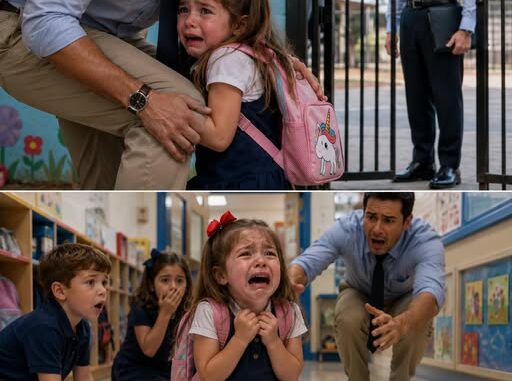
The final bell at kindergarten had just rung, signaling the end of another routine day of ABCs and finger painting. For Ruben, a veteran teacher who had seen thousands of children pass through his classroom, the afternoon pickup was usually a chaotic but predictable affair. Parents lined up at the door, children were reunited with their guardians, and the school day concluded with the usual hum of chatter. But on this particular day, the atmosphere in the classroom felt heavy. When the man arriving to collect six-year-old Valentina walked through the door, the classroom dynamic shifted in a way that Ruben could feel in his bones. The man was smiling, projecting the image of a doting family member, but the reaction of the little girl standing next to Ruben’s desk was visceral.
Valentina, usually a bubbly and expressive child, suddenly froze. Her face went pale, and she retreated until she was pressed firmly against Ruben’s leg. As the man approached, smiling and beckoning for her to come, Valentina reached out with a trembling hand and grabbed a tight fistful of Ruben’s pant leg. She didn’t look at the man; she looked only at Ruben, her eyes wide with a terror that was impossible to mistake for a tantrum or simple shyness. She leaned in, so close that Ruben had to bend down to hear her, and whispered three words that would alter the course of their lives forever: Please don’t let me go with him.
Those words hit Ruben with the force of a physical blow. In that moment, the entire logic of the school’s protocol—the idea that any adult on the authorized pickup list was automatically a safe guardian—collapsed. Ruben had spent years learning how to read the subtle cues of children, and he knew when a child was playing and when they were fighting for their life. He looked down at Valentina, who was physically shaking against his leg, and he saw the absolute, unvarnished truth of her fear. He knew he could not simply hand her over, even if the paperwork said it was permitted. He knew that if he walked her to that man’s car, he would be betraying the most sacred trust he held as an educator.
Ruben stood tall, placing a protective hand on Valentina’s shoulder. He felt her small body relax almost imperceptibly as he made his choice. He addressed the man with a calm, professional veneer, informing him that there was a minor administrative issue with the release forms that required him to step into the office for a moment. The man’s smile faltered, replaced by a flicker of irritation, but he followed Ruben toward the administration wing. As soon as they were away from the classroom, Ruben gestured toward the principal’s office, but he didn’t stop there. He had already signaled to the school’s security team. He knew that the danger was not an administrative error; it was a crisis of safety.
The aftermath was not a victory lap. It was a long, harrowing, and slow process of peeling back the layers of a nightmare. The man was not who he claimed to be, and Valentina’s instincts had been screaming for help that she hadn’t known how to ask for until she reached the point of total desperation. The investigation that followed revealed a reality far darker than any of the school staff could have imagined. Valentina, once paralyzed by the fear of being heard, was finally given the space to speak. She learned, through endless hours of therapy and the support of people who finally prioritized her voice over the comfort of the adults in her life, that her safety was not a suggestion. It was a non-negotiable right.
The school, shaken to its core by how close they had come to a tragedy, overhauled their entire system. They implemented new, rigorous protocols that required immediate verification and an absolute zero-tolerance policy for any sign of hesitation from a child. They decided that the convenience of the adults would never again outweigh the silent, trembling signals of a student. The adults had failed to notice the signs, but Valentina had been screaming for help in her own quiet way for months. The lesson taken from that day was that children are not just passive participants in their own lives; they are observers who often see the gray, looming shadows that adults are too blinded by social norms to notice.
Valentina eventually gave Ruben a drawing as a thank-you gift. It was a simple, stark image executed in crayon: a teacher standing like a giant between a small, terrified child and a dark, indistinct gray shadow that looked almost like a monster. Ruben framed the drawing and placed it in a prominent position on the wall of his office. It stayed there as a permanent fixture, a silent, haunting reminder of the day he chose to listen to the only authority that mattered: the absolute truth of a child’s fear. It served as a testament to the fact that sometimes, the most important work an educator does has nothing to do with the curriculum. It has everything to do with being the person who is brave enough to act when a child whispers the truth in a room full of people who are not listening.
Looking back, the incident serves as a harrowing lesson for the world. We live in a society that often prioritizes bureaucracy, credentials, and the comfort of social order over the lived reality of those who are most vulnerable. We assume that because a person is on a list, they are safe. We assume that because a person looks the part of a guardian, they are benevolent. But the instincts of a child, when uncorrupted by the pressure to be polite or obedient, are a compass that points toward the truth with terrifying accuracy. Valentina didn’t need a background check to know she was in danger; she felt it in her marrow.
The process of healing for Valentina was long, and it was marked by the painful realization that the world can be a very dangerous place, even for the smallest among us. Yet, her journey was also one of profound reclamation. She reclaimed her voice, her autonomy, and her right to be heard. She showed that even when you are six years old, you have the power to define the terms of your own safety. And for Ruben, the drawing remains the most valuable thing he owns. It is a reminder that the duty of an adult is not just to teach, but to protect, to observe, and to have the courage to stand between a child and the shadow, even when the rest of the world insists that the coast is clear. It was the day a teacher became a guardian, and a little girl became the hero of her own story.
Leave a Reply