Riddles are an entertaining way to challenge your thinking, explore the creative side of language, and enjoy a little friendly competition with family and friends.
Some puzzles require mathematical skills or logical reasoning, while others depend on recognizing unusual expressions and clever combinations of words.
The London Bridge riddle is an excellent example of how an ordinary sentence can contain an unexpected answer.
At first, it appears to describe a simple encounter with a gentleman. However, the secret to solving the puzzle lies in how certain words sound when spoken together.
Before discovering the solution, take a moment to see whether you can solve it independently.
Can You Solve the London Bridge Riddle?
Here is the original puzzle:
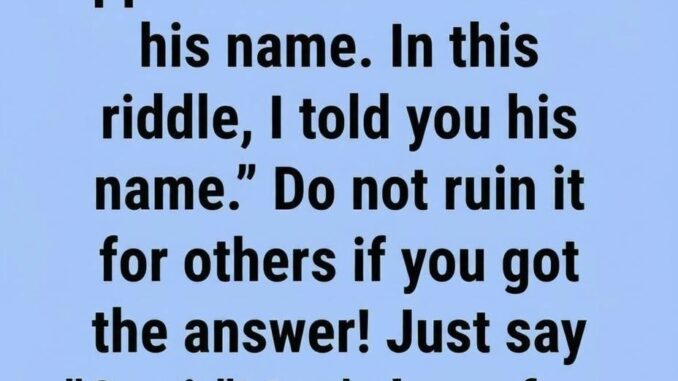
“I met a man on the London Bridge. He tipped his hat and drew his name. In this riddle, I told you his name. What is it?”
Read the sentence carefully and consider the information it provides.
You might imagine a gentleman walking across London Bridge, politely greeting someone by tipping his hat.
However, the next part of the sentence seems slightly unusual.
What does it mean that he drew his name?
Perhaps he wrote something on paper or made a gesture that revealed his identity.
While these interpretations might seem reasonable, the actual solution is much simpler.
The man’s name is already included in the wording of the puzzle.
What Is the Correct Answer?
The man’s name is Andrew.
The solution comes from the following two words:
“And drew.”
When spoken together, these words sound remarkably similar to the name Andrew.
The puzzle cleverly places the answer within an ordinary sentence, encouraging readers to focus on the story rather than the sounds of individual words.
Once you recognize the connection, the entire riddle becomes much easier to understand.
There is no need to research London Bridge, identify a historical figure, or search for additional information.
Everything required to solve the puzzle is contained within the original question.
Why Is the London Bridge Riddle So Clever?
The effectiveness of this puzzle comes from its ability to direct attention toward an imaginary scene.
Mentioning London Bridge encourages readers to picture a familiar landmark.
Adding a gentleman who tips his hat creates an image of a polite encounter.
These details make the sentence sound like a short story rather than a language puzzle.
The expression “drew his name” also encourages people to think about writing, drawing, or handwriting.
However, the solution has nothing to do with the man’s artistic abilities.
Instead, the answer becomes apparent when readers listen carefully to the pronunciation of the words.
This unexpected change in perspective is what makes the riddle entertaining and memorable.
Understanding the Solution Step by Step
If you are interested in how the puzzle works, the following explanation breaks it down into several simple stages.
Step 1: Read the Complete Riddle
Begin by reading the entire sentence without immediately attempting to identify the man.
Pay attention to the different details and how they are presented.
Step 2: Identify the Unusual Expression
The phrase “drew his name” stands out because it is not a particularly common expression in everyday conversation.
Unusual wording can sometimes indicate that a puzzle contains hidden wordplay.
Step 3: Say the Words Aloud
Focus on the words “and drew.”
Pronounce them together naturally rather than treating them as completely separate words.
Step 4: Recognize the Familiar Name
The combined pronunciation resembles Andrew, a familiar first name.
This provides the answer to the original question.
Step 5: Review the Original Sentence
Return to the riddle and notice how the name was included within the description of the man’s actions.
The answer was available from the beginning, but recognizing it required a different approach to reading the sentence.
How Wordplay Makes Riddles Interesting
Wordplay involves using language in creative and sometimes unexpected ways.
Many riddles depend on words with multiple meanings, similar pronunciations, or combinations that create entirely different expressions.
Some puzzles use homophones, which are words that share the same pronunciation but have different meanings or spellings.
Others contain hidden words or expressions that become apparent only when the sentence is examined more closely.
The London Bridge riddle uses phonetic wordplay.
Its solution depends on recognizing how two neighboring words sound when pronounced together.
In ordinary conversations, people generally concentrate on understanding the meaning of a sentence.
Riddles encourage readers to explore other possibilities, including pronunciation, spelling, and alternative interpretations.
This makes even a short sentence an opportunity for creative thinking.
Why Brain Teasers Are an Enjoyable Activity
Simple puzzles have remained popular because they provide accessible entertainment for people with different interests and backgrounds.
They require little preparation and can be enjoyed almost anywhere.
Encouraging Creative Thinking
Riddles invite people to consider possibilities beyond their initial interpretation.
A question that seems complicated at first may have a surprisingly straightforward explanation.
Exploring different meanings can make the process of solving a puzzle particularly enjoyable.
Creating Interesting Conversations
Sharing a riddle can introduce a fun topic during a family gathering, lunch break, or conversation with friends.
Different people may approach the same question in completely different ways.
Listening to their suggestions can be just as entertaining as discovering the correct answer.
Providing a Sense of Accomplishment
Solving a puzzle independently can be a satisfying experience.
Even when the answer is relatively simple, recognizing a hidden clue can create an enjoyable moment of discovery.
Offering Accessible Entertainment
Unlike many games that require equipment, preparation, or detailed instructions, riddles can be shared through a simple conversation.
This makes them convenient for road trips, social gatherings, and quiet moments at home.
Adding Variety to Everyday Breaks
A short brain teaser can provide an entertaining change from ordinary daily activities.
Whether enjoyed alone or with others, puzzles offer a simple opportunity to explore language and creative reasoning.
Three More Riddles to Test Your Thinking
If you enjoyed discovering the answer to the London Bridge puzzle, consider trying these additional riddles.
Each one uses an unexpected interpretation of familiar words or objects.
Riddle 1: What Has Many Keys but Cannot Open a Door?
Think of an object that contains numerous keys, although none of them are designed to operate a lock.
Answer: A piano.
A piano features keys that produce musical notes rather than opening doors.
The puzzle works because the word “key” has different meanings depending on the context.
Riddle 2: What Becomes Wetter as It Dries?
At first, this question appears contradictory.
How can something become increasingly wet while helping something else become dry?
Answer: A towel.
A towel absorbs moisture when it is used to dry hands, dishes, or other objects.
As it removes water from a surface, the towel itself becomes wetter.
Riddle 3: What Has a Neck but No Head?
Consider an ordinary household item rather than a person or animal.
Answer: A bottle.
The narrow upper section of a bottle is commonly called its neck.
However, unlike a living creature, a bottle does not have a head.
These examples demonstrate how familiar words can create entertaining puzzles when used in unexpected contexts.
Simple Ways to Enjoy Riddles With Family and Friends
Riddles can easily become part of everyday conversations and recreational activities.
Families might enjoy sharing a puzzle during dinner, while friends could exchange brain teasers during a coffee break.
They can also be incorporated into gatherings through simple guessing games.
For example, participants could write their favorite riddles on small pieces of paper and place them inside a bowl.
Each person could select a question and attempt to solve it before hearing the answer.
Another option is to organize a friendly quiz featuring different categories, including wordplay, everyday objects, and logical reasoning.
The London Bridge riddle is particularly suitable for these activities because it is short, easy to remember, and requires no specialized knowledge.
Why Simple Riddles Are Often the Most Memorable
An entertaining puzzle does not necessarily require complicated calculations or lengthy explanations.
Sometimes, the most memorable riddles are those that use ordinary language in an unexpected way.
The London Bridge puzzle demonstrates how a familiar name can be hidden within two common words.
Its simplicity makes it easy to share, while its clever wording provides an enjoyable challenge for first-time listeners.
Once someone understands the answer, they can easily remember the puzzle and share it with others.
Final Thoughts: A Name Hidden in Plain Sight
The London Bridge riddle is a delightful example of creative language and phonetic wordplay.
Although the question initially appears to describe a brief encounter with a gentleman, the answer is hidden within the phrase “and drew.”
When spoken together, those words reveal the name Andrew.
The puzzle reminds us that approaching familiar language from a different perspective can lead to unexpected discoveries.
The next time you encounter a riddle, consider reading it aloud, examining unusual expressions, and exploring alternative meanings before deciding on an answer.
Sometimes, the cleverest answers are hidden within the simplest words.
Leave a Reply