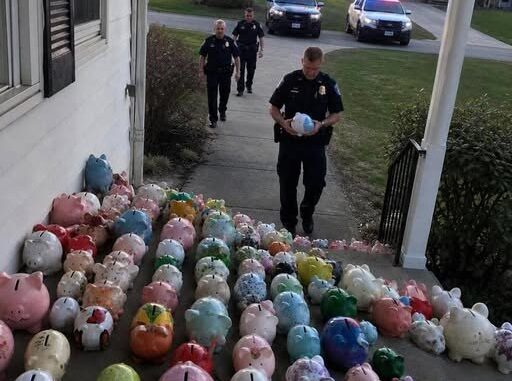
My six-year-old son, Oliver, gave away every dollar in his piggy bank to help our elderly neighbor after her house went dark. I thought his kindness ended there—until the next morning, when our yard was covered in piggy banks, patrol cars blocked the street, and a secret the whole town had forgotten came spilling out.
At first, I thought Mrs. Adele had finally come over from across the street. Maybe the power company had called. Maybe her nephew, Elias, had sent help. But when I opened the door, a police officer stood there, holding a red piggy bank.
Behind him, pink and blue ceramic and plastic pigs lined the walkway, spilled across the grass, and crowded the porch steps. Two patrol cars sat at the end of the driveway, angled to keep traffic back.
“Mom,” Oliver whispered, clutching my robe in his race car pajamas. “Did I do something bad?”
I pulled him closer. “No, baby.”
The officer crouched slightly. “You’re Oliver?”
He nodded, tight-lipped.
“Did I do something bad?”
“No,” the officer said gently. “Nobody’s in trouble. You just noticed something a lot of grown-ups missed.”
He held the piggy bank toward me. “Ma’am, I need you to break this open.”
Inside, there were no coins—only keys, business cards, gift cards, and folded notes.
Oliver crouched beside it. “Mom, what’s all this?”
I read the first note aloud: “Mrs. Adele paid for my lunch every Friday in third grade. I own a grocery store now. Her groceries are covered for the next year. Yours too, Celia.”
Celia, standing nearby, wiped tears from her eyes. “That’s me.”
Another note: “She told me I was too smart to learn on an empty stomach. Any repairs she needs are on me, Ray.” Ray stepped forward, tears glistening. “I’m Ray. She gave me reading time every Tuesday.”
The notes kept coming—teachers, former students, neighbors—each telling a story of Mrs. Adele’s quiet generosity. She had worked in the school cafeteria for decades, helping children in ways no one else noticed.
Oliver pointed to a small, chipped blue piggy bank. “That one looks old.”
Officer Hayes held it up. “You gave me this when I was seven. You said to bring it back any time I needed lunch and didn’t have the words to ask.”
Mrs. Adele stared. “Hayes?”
“Yes, ma’am. You let me keep my pride, and it made me the officer I am today.”
It was then I realized why the patrol cars were there: traffic control, yes, but also to manage the growing crowd of neighbors, reporters, and former students drawn by Oliver’s simple act of kindness.
Earlier that week, Oliver had noticed Mrs. Adele’s porch light remained dark for three nights. He insisted on giving her his piggy bank, coins, birthday money, and tooth fairy quarters. “You need it more than me,” he said.
Mrs. Adele resisted at first. “I can’t take your savings.”
“You told me good people don’t count what they give,” Oliver replied.
It was that small, pure-hearted gesture that reminded our town what she had always done quietly: care for children, neighbors, and strangers alike.
By morning, with help from senior services and neighbors who had been touched by her decades of generosity, Mrs. Adele’s bills, utilities, and daily needs were addressed. Her nephew Elias finally stepped in, surprised at how long she had been in the dark—literally and figuratively.
That evening, her porch light glowed through Oliver’s window.
“What did she whisper to you that night?” I asked as I tucked him in.
He smiled sleepily. “She said I had your heart and not to let the world talk me out of being good.”
Across the street, Mrs. Adele’s light stayed on. And from that night on, whenever Oliver’s room went dark, it reminded us all that kindness doesn’t disappear. Sometimes, it just waits for one small hand to turn it back on.
“She said I had your heart,” Oliver murmured, drifting to sleep.
Leave a Reply