When my sister Nora arrived at my house holding a worn envelope, I knew something was wrong.
Her eyes were red, and she looked as though she’d barely slept.
“Claire, can we sit down?” she asked. “There’s something important I need to tell you.”
I immediately thought of Ellie, the five-year-old girl Nora and her husband had adopted just two weeks earlier.
“Is Ellie okay?”
Nora nodded quickly.
“She’s fine. She’s at home with Tom.”
She sat at my kitchen table and placed the envelope between us.
“But I’ve discovered something about her past. Something we weren’t told before the adoption.”
I looked at the papers.
I had no idea that the information inside would make us question everything our family believed about the previous five years.
The Child My Sister Had Waited Years to Welcome
Nora had always wanted to become a mother.
For eight years, she and her husband, Tom, had hoped to grow their family.
Eventually, after many conversations and careful consideration, they decided to pursue adoption.
The process required patience.
There were interviews, assessments, paperwork, and home visits.
They understood that adoption wasn’t simply about fulfilling their wish to become parents. It was about providing a stable and loving home for a child who needed one.
When they learned that five-year-old Ellie might be a suitable match, they approached the opportunity thoughtfully.
They spent time getting to know her through the appropriate arrangements.
They learned about her routines, interests, and needs.
And gradually, a relationship began to form.
When the adoption was finalized, Nora called me in tears.
“Claire, she’s coming home.”
I was overjoyed for her.
My sister had spent years preparing to become a parent.
Now she and Tom were beginning a new chapter with a little girl they already loved deeply.
But there was another reason Ellie’s arrival meant so much to me.
Five years earlier, I’d experienced a loss that had changed my own life.
A Memory I Had Carried for Five Years
I had given birth to a baby girl.
I remembered holding her tiny hand and studying her face for a few precious moments.
Soon afterward, the medical team explained that she needed specialized care.
She was transferred for further treatment.
The following morning, I was told that my daughter hadn’t survived.
I remember the hospital room.
The quiet voices.
The way everything around me seemed to slow down.
I also remember the funeral arrangements and the difficult months that followed.
Losing my daughter affected every part of my life.
For a long time, I struggled to imagine a future that felt different from the one I’d expected.
My family supported me as best they could.
Nora was especially patient.
She never pressured me to move on or told me how I should feel.
She simply stayed close.
As the years passed, I gradually found ways to continue living while carrying the memory of my daughter.
I didn’t try to have another child.
That was a personal decision, and Nora respected it.
When she told me about Ellie, I was genuinely happy.
I wanted to be the kind of aunt who made her niece feel welcome and loved.
I never expected Ellie to remind me so strongly of my own child.
Meeting Ellie for the First Time
The first time I met Ellie, she was sitting on Nora’s living room rug with a coloring book.
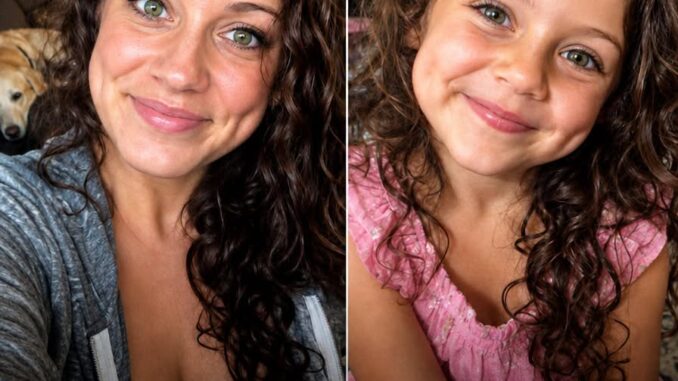
She had curly hair, expressive eyes, and a small dimple in her left cheek.
Nora introduced us.
“Ellie, this is your Auntie Claire.”
Ellie looked up.
“Hi.”
I smiled.
“Hello, Ellie. It’s lovely to meet you.”
She returned to her coloring.
A few minutes later, she showed me a picture she’d made.
It was a house with a purple roof, a yellow door, and flowers along the walkway.
I told her I liked the colors.
She smiled.
Something about her expression felt familiar.
I couldn’t explain why.
Later, Nora mentioned that Ellie seemed to share several features with our family.
I agreed, although I assumed it was a coincidence.
Over the next two weeks, Ellie became more comfortable around me.
She asked me to help braid her hair.
She showed me her favorite toys.
And she loved telling stories about imaginary adventures.
I began looking forward to our visits.
Being around her brought me joy.
Sometimes, it also stirred memories I hadn’t thought about in a long time.
I believed those feelings came from my own experience of motherhood and loss.
Then Nora arrived at my kitchen table with the envelope.
The First Inconsistency
Nora opened the envelope and removed several documents.
She explained that while reviewing Ellie’s medical information, she’d noticed an inconsistency.
Some dates and details didn’t match the background information the family had received during the adoption process.
At first, Nora assumed it was an administrative error.
She contacted the appropriate professionals and requested clarification.
As the questions continued, additional historical records were reviewed.
A possible biological connection to our family emerged.
With the necessary consent and legal authorization, a DNA comparison was arranged.
Nora looked down at the report.
“Claire, I need you to understand that I didn’t go looking for this. I was trying to make sure Ellie’s medical history was accurate.”
I nodded.
“Just tell me what you found.”
She turned the document toward me.
“The results indicate that Ellie is very closely related to us.”
I stared at her.
“How closely?”
Nora took a breath.
“The report identifies you as her biological mother.”
For several seconds, I couldn’t speak.
I looked at the page again.
Then I looked at my sister.
“That can’t be right.”
“I know how impossible it sounds,” she said.
“My daughter passed away five years ago.”
Nora reached for my hand.
“I know what you were told. That’s why we need to have everything independently verified.”
Questions Neither of Us Could Answer
I sat silently, trying to understand what Nora was telling me.
The girl I’d met two weeks earlier.
The child who liked having her hair braided.
The little girl who smiled when I visited.
Could she really be my daughter?
I remembered the hospital.
I remembered the medical staff explaining that my baby needed further treatment.
And I remembered receiving the news that she hadn’t survived.
There had been a funeral.
There were documents.
For five years, I’d accepted that my daughter was gone.
Now Nora was telling me that the records might contain a serious error.
“How could something like this happen?” I asked.
“I don’t know,” she replied.
She showed me another document.
It was an old hospital transfer record.
The date matched the day my daughter was born.
My name appeared on the page.
So did the name recorded for my newborn.
At the bottom was a handwritten note referencing a transfer to another medical facility.
The record included an authorization signature and a case number.
But the information Nora had received didn’t clearly explain what happened afterward.
I read it several times.
“Why wasn’t I told about this transfer?”
Nora shook her head.
“That’s one of the questions I’ve been trying to answer.”
I looked toward the window.
Outside, the neighborhood was going about its ordinary afternoon.
People walked past.
Cars drove along the street.
Everything looked normal.
But my entire understanding of the past had changed.
What Would Happen to Ellie?
After the initial shock, another concern entered my mind.
Nora and Tom had just adopted Ellie.
They loved her.
She was beginning to feel comfortable in their home.
And now we had discovered information that could affect her understanding of her identity.
I looked at my sister.
“Nora, what does this mean for your family?”
She knew what I was asking.
“Ellie is my daughter,” she said gently. “Tom and I love her. That hasn’t changed.”
I nodded.
“But if she’s biologically mine—”
“Then you deserve to know the truth,” Nora replied. “And Ellie deserves accurate information about her history, shared in a way that’s appropriate for her age.”
She paused.
“We’re not going to make sudden decisions. We’ll work with the right professionals and make sure her well-being comes first.”
I felt relieved.
I didn’t want Ellie to become the center of a conflict.
She was five.
She needed stability, reassurance, and people who cared about her.
I also didn’t want Nora to feel that the family she’d waited so long to build was being threatened.
My sister reached across the table.
“Claire, I brought this to you because I love you. I couldn’t keep it from you.”
I began to cry.
For the first time in five years, I allowed myself to consider the possibility that my daughter might still be alive.
But we needed more answers.
And before we could decide what to do, Nora’s phone rang.
A Call From the Adoption Agency
Nora looked at the screen.
“It’s the agency representative. I’ve been waiting for her to call.”
She answered.
I watched her expression change as she listened.
At first, she looked confused.
Then concerned.
“Are you saying this information was already in the original file?”
She listened again.
“Was it reviewed during the adoption process?”
There was a pause.
Then she asked another question.
“Someone requested that a placement with biological relatives be considered?”
I sat forward.
Nora glanced at me.
She continued listening before thanking the representative and ending the call.
“What did she say?” I asked.
Nora placed her phone on the table.
“There’s a sealed note in Ellie’s historical case file. Apparently, some information about her biological background was restricted while an earlier investigation was underway.”
“An investigation into what?”
“She couldn’t give me all the details over the phone.”
Nora explained that the agency representative had referred the matter for further review.
There was also information suggesting that someone had asked the authorities to consider whether Ellie could be placed with suitable biological relatives.
That didn’t mean Nora and Tom had been selected automatically.
Their application had still been assessed through the usual procedures.
But the possible family connection had been part of the historical records.
I was stunned.
“Who made that request?”
Nora looked down at the envelope.
“That’s what we’re trying to find out.”
Then she removed a photograph.
The Woman in the Photograph
The picture showed a woman standing outside a hospital.
I recognized the building immediately.
It was the hospital where I’d given birth.
The woman looked familiar too.
Her name was Margaret.
She had been one of the nurses who cared for me during my hospital stay.
I remembered her gentle manner.
She’d spoken kindly to me during an incredibly difficult time.
“That’s Margaret,” I said.
Nora nodded.
“Do you remember her?”
“Of course.”
Nora turned the photograph over.
There was a short handwritten message.
It said that if I ever learned about the inconsistencies in my daughter’s records, Margaret was willing to explain what she knew.
I stared at the handwriting.
For years, I’d believed there was nothing more to learn about what happened at the hospital.
Now there was someone who might have answers.
“We need to speak with her,” I said.
Nora agreed.
She explained that Margaret had retired but that she’d managed to obtain contact information through an appropriate referral.
We arranged to meet her the following morning.
I barely slept that night.
Visiting Margaret
Margaret lived in a quiet residential neighborhood on the other side of town.
Her small house had a white fence and a garden filled with flowers.
Nora and I arrived shortly after ten.
As we walked toward the front door, I felt nervous.
I had so many questions.
What if the records were wrong?
What if the DNA results had been misinterpreted?
What if the truth was more complicated than either of us expected?
Before I could decide what to say, the door opened.
Margaret stood in front of us.
She looked older than I remembered.
Her hair was silver, and she wore a light-blue cardigan.
She looked at Nora first.
Then she saw me.
“Claire?”
I nodded.
Margaret’s expression softened.
“Please come inside.”
We sat in her living room.
There were family photographs on the mantel and a vase of fresh flowers on the coffee table.
Margaret offered us tea.
Neither of us wanted anything.
She sat across from us and folded her hands.
“I’ve been hoping there would be an opportunity to explain what I know,” she began.
The Missing Information
Margaret told us that five years earlier, she’d been working at the hospital when my daughter was born.
She remembered the medical transfer.
According to her recollection, my baby had needed additional treatment at another facility.
Margaret explained that the paperwork surrounding the transfer had contained serious inconsistencies.
Some records had been incomplete.
Others had been filed under different reference numbers.
The information I’d received about my daughter’s outcome did not appear to match the transfer documentation.
I listened carefully.
“Are you saying my baby survived?”
Margaret nodded.
“According to the records later reviewed, she survived the initial medical emergency and continued receiving care.”
I covered my mouth.
Nora reached for my hand.
“Then why was Claire told otherwise?” she asked.
Margaret looked troubled.
“I can’t fully explain every decision that was made. There were failures in how information was recorded and communicated.”
She said concerns had eventually been raised, but the records had already passed between several departments.
By the time the discrepancies were examined, the case had become complicated.
“I should have followed up more persistently,” Margaret said.
I looked at her.
“Did you know my daughter was alive?”
“Not at the time you received that information,” she answered. “I learned more much later.”
Her explanation didn’t resolve everything.
But it gave us a starting point.
How Ellie Entered the Adoption System
Nora asked what had happened after the transfer.
Margaret explained that the child had continued receiving care and later spent time in temporary care arrangements.
Over the following years, incomplete records and unresolved questions about family identity had affected the case.
Eventually, Ellie entered the adoption system.
Margaret said she’d recognized details connected to the original hospital case during a later review.
She’d tried to ensure that the appropriate professionals examined the information.
I listened with a mixture of relief and sadness.
The possibility that Ellie was my daughter was becoming more substantial.
But I still couldn’t understand how so many years had passed without someone contacting me.
“Why didn’t anyone tell me?” I asked.
Margaret looked down.
“I don’t have an answer that will make this easier.”
She explained that confidential records and ongoing investigations had complicated the process.
But she also acknowledged that the lack of clear communication had caused serious harm.
I knew we would need to examine the original records and seek independent professional guidance.
Margaret’s recollections alone couldn’t answer every question.
Still, I was grateful she’d agreed to speak with us.
Why Nora and Tom Were Considered
Before leaving, Nora asked about the request to keep Ellie connected to her biological family.
Margaret explained that someone involved in reviewing the historical case had recommended exploring suitable placements with relatives.
The recommendation had been included in the file for the relevant authorities to consider.
Nora and Tom had independently completed the required adoption assessments.
Their home had been approved.
But the historical recommendation may have contributed to the decision to consider their application.
I looked at Nora.
She looked equally surprised.
For weeks, we’d thought Ellie’s resemblance to our family was an ordinary coincidence.
Now there was a possible explanation.
But I reminded myself that resemblance wasn’t proof.
The medical records, adoption documents, and DNA findings still needed a thorough independent review.
I wanted the truth.
And I wanted it established carefully.
Most importantly, I didn’t want Ellie to feel uncertain about whether she belonged in the home she’d just joined.
Returning to Ellie
When Nora and I returned home, Tom was waiting with Ellie.
She was sitting at the kitchen table with crayons spread across a sheet of paper.
The moment she saw us, she smiled.
“Auntie Claire!”
She jumped down from her chair and ran toward me.
I knelt to greet her.
“Hello, sweetheart.”
She held up her drawing.
“Look what I made!”
The picture showed a colorful house beneath a bright yellow sun.
Three people stood in front of it.
Ellie pointed to each one.
“That’s Mommy Nora. That’s Daddy Tom. And that’s you!”
I looked at the drawing.
The figures were holding hands.
It was a simple picture.
But it meant more to me than I could explain.
“That’s beautiful, Ellie.”
She touched my cheek.
“Why are you crying?”
I smiled through my tears.
“Sometimes people cry when they’re feeling lots of things at once.”
She seemed satisfied with that answer.
Then she hugged me.
I held her gently.
Across the room, Nora watched us.
Our eyes met.
Neither of us spoke.
We both knew that the next steps would require patience and care.
Putting Ellie’s Needs First
That evening, after Ellie went to bed, Nora, Tom, and I sat together.
We discussed everything we’d learned.
We agreed that we needed independent confirmation of the biological relationship and a complete review of the relevant records.
We also planned to seek legal advice and guidance from professionals experienced in adoption and childhood family transitions.
There were questions about the hospital records.
Questions about the adoption process.
And questions about how and when to explain Ellie’s history to her.
We didn’t want to make assumptions.
We also didn’t want to overwhelm her with information she wasn’t ready to understand.
Tom spoke first.
“Whatever we discover, Ellie needs to know she’s loved.”
Nora nodded.
“She’s only just beginning to feel settled here.”
I looked at both of them.
“I don’t want to take that away from her.”
Nora reached for my hand.
“And I don’t want you to lose the opportunity to know your daughter.”
We sat quietly.
Then we agreed on something that would guide every decision we made.
Ellie’s well-being would come first.
We would tell the truth in an age-appropriate way.
We would respect her existing relationships.
And we would seek professional support whenever we needed it.
A New Understanding of Family
Over the following days, I spent time reflecting on everything that had happened.
For five years, I’d believed my daughter was gone.
I’d carried that grief through birthdays, holidays, and ordinary afternoons when I wondered what life might have been like.
Now there was credible information suggesting that Ellie was the child I’d lost.
I felt grateful.
Confused.
Sad about the time we’d missed.
And worried about what the truth might mean for her.
But I also felt something I hadn’t expected.
Deep appreciation for Nora and Tom.
They had welcomed Ellie into their lives with patience and love.
They knew her favorite foods.
They understood her bedtime routines.
They comforted her when she was upset.
They had become her parents.
That mattered.
I didn’t want my biological connection to erase the bond they’d built.
And Nora didn’t want her role as Ellie’s adoptive mother to prevent Ellie from learning about her origins.
We began to understand that our family might need to make room for a more complicated history than we’d imagined.
It wouldn’t be simple.
But we were willing to work through it together.
The Conversation With My Sister
One evening, Nora came to my house after Ellie had gone to sleep.
We sat at the same kitchen table where she’d first shown me the envelope.
For a while, we talked about ordinary things.
Work.
Family plans.
A recipe Nora wanted to try.
Then she grew quiet.
“Claire, can I tell you something?”
“Of course.”
She looked at me.
“When Tom and I adopted Ellie, I thought our family was finally complete.”
I nodded.
“I know.”
“I still feel that way,” she continued. “But now I understand that Ellie’s story began long before she came home with us.”
I listened.
“I don’t want her to grow up thinking we kept important information from her,” Nora said.
“Neither do I.”
She reached across the table.
“I hope you know that I’ll support you in building a relationship with her, whatever the legal review establishes.”
I squeezed her hand.
“And I’ll respect the home and family you’ve given her.”
Nora smiled through her tears.
It wasn’t a perfect solution.
There were still difficult questions ahead.
But for the first time since she’d arrived with that envelope, I felt we were moving forward together.
The Photograph on the Refrigerator
A few days later, Ellie came over for a visit with Nora and Tom.
She brought another drawing.
This one showed a garden.
There were flowers, butterflies, and a little bench beneath a tree.
In the center stood four people.
Ellie explained that the picture included Nora, Tom, herself, and me.
I smiled.
“Where should we put it?”
She looked around the kitchen.
“On the refrigerator!”
I found a magnet and placed it where she could see it.
Ellie stepped back.
“Perfect.”
Then she went into the living room to play with Daniel, who had stopped by to visit.
I remained in the kitchen for a moment, looking at the picture.
I didn’t know exactly what our family would look like in a year.
There were still records to review.
Questions to answer.
And decisions that would need careful consideration.
But I knew one thing.
Ellie was surrounded by people who loved her.
And we were determined to keep it that way.
One More Discovery
Several weeks after our conversation with Margaret, Nora received another update from the professionals reviewing Ellie’s historical records.
They had located an additional document.
It had been stored separately from the main adoption file.
The document was a sealed letter written before Ellie’s adoption.
The letter had been preserved with instructions for its release through the appropriate review process.
At first, Nora assumed it contained routine background information.
But the accompanying note suggested that it might explain why someone had requested that Ellie remain connected to her biological relatives.
Nora called me.
“Claire, there’s something else.”
I closed my eyes for a moment.
After everything we’d already learned, I wasn’t sure I was ready for another surprise.
“What is it?”
“A letter,” she said. “It was written before Ellie came to live with us.”
“Who wrote it?”
“We don’t know yet.”
I looked toward the refrigerator.
Ellie’s drawing was still there.
Four people beneath a bright yellow sun.
Whatever the letter contained, I knew we needed to approach it carefully.
The truth mattered.
But so did the little girl whose life had been shaped by decisions she was too young to understand.
I took a breath.
“Then we’ll read it when we’re allowed to,” I told Nora. “And we’ll figure out the next steps together.”
She agreed.
As I ended the call, I looked once more at Ellie’s drawing.
Five years earlier, I believed my daughter’s story had ended.
Now, I was beginning to understand that it might have continued in ways I never could have imagined.
And somewhere in those records was a letter that could explain how our family had found its way back together.
The End
Leave a Reply