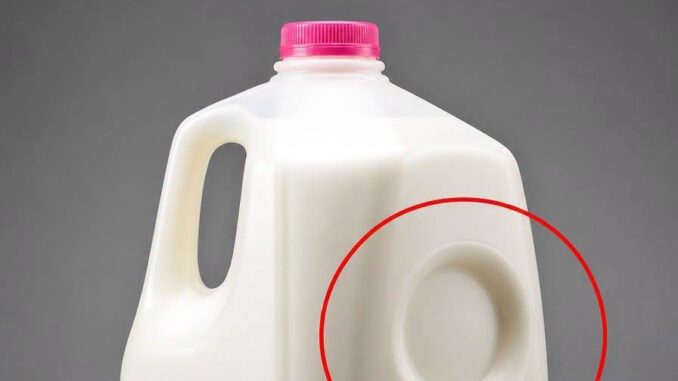
Everyday household products often contain small design features that serve practical purposes. One interesting example is the circular indentation found on the side of many plastic milk jugs.
Although this recessed area may appear to be decorative or simply part of the manufacturing process, it can contribute to the container’s flexibility, durability, and overall structural design.
Understanding how milk jugs are manufactured reveals how thoughtful packaging decisions can improve the functionality of ordinary household items.
The Purpose of the Circular Indentation
Plastic milk jugs are designed to hold liquids while remaining lightweight, convenient to carry, and suitable for transportation and storage.
The circular indentation is one of several molded features that may help manufacturers achieve these goals.
Its specific purpose can vary depending on the container’s design, but recessed panels can contribute to flexibility and help manage changes in pressure.
1. Allowing Flexibility During Temperature Changes
Milk and its packaging can experience temperature variations during transportation, refrigeration, and household storage.
These changes may affect the pressure inside the container and cause the plastic to expand or contract slightly.
The circular indentation provides an area where the container may flex in response to these changes.
This flexibility can help reduce stress on certain sections of the plastic.
However, the indentation does not guarantee protection against leaks or damage, particularly if the milk freezes and expands significantly.
Anyone planning to freeze milk should follow appropriate storage recommendations and use a suitable container with sufficient room for expansion.
2. Helping Manage Everyday Impacts
Milk jugs experience various forms of handling as they travel from production facilities to grocery stores and eventually into household refrigerators.
During this process, containers may encounter minor bumps, movement, and changes in external pressure.
Molded indentations and other structural features can help distribute forces across the container.
Depending on the packaging design, these features may improve its ability to withstand ordinary handling without requiring excessively thick plastic walls.
Nevertheless, plastic milk jugs can still crack or leak when dropped or subjected to significant force.
3. Supporting Lightweight Packaging Design
Manufacturers aim to create containers that balance strength, convenience, material efficiency, and production costs.
Rather than relying exclusively on thicker plastic, packaging engineers can incorporate curves, recessed panels, and reinforced sections into the container’s shape.
These features can help improve structural performance while maintaining a lightweight design.
The circular indentation is one example of how the shape of a container may influence its flexibility and strength.
Can a Bulging Milk Jug Indicate Spoilage?
Some people believe that the circular indentation can act as an indicator of milk freshness.
Although certain types of microbial activity can produce gases and cause packaging to swell, changes in the shape of a milk jug can also result from temperature fluctuations, transportation, freezing, or physical handling.
For this reason, the appearance of the circular indentation should not be considered a reliable method of determining whether milk is safe to consume.
Consumers should pay attention to several factors when storing milk:
-
Follow the storage instructions printed on the packaging.
-
Keep milk refrigerated at 40°F (4°C) or below.
-
Check the container for unusual swelling, damage, or leakage.
-
Pay attention to unexpected changes in smell, appearance, or texture.
-
Avoid consuming milk when its storage history or safety is uncertain.
A normal-looking container does not necessarily guarantee that its contents are safe. If spoilage is suspected, discarding the milk is the safer option.
Why Is the Indentation Usually Circular?
Rounded shapes are commonly used in packaging because they provide smooth transitions between different sections of a container.
Unlike sharp corners, curved surfaces can help reduce localized concentrations of stress.
Circular indentations are also compatible with common plastic molding techniques, allowing manufacturers to reproduce consistent container shapes during large-scale production.
However, not every milk jug includes a circular indentation.
Some manufacturers use rectangular recessed panels, curved grooves, or other structural designs to achieve similar packaging objectives.
How Milk Jug Design Relates to Sustainability
Packaging manufacturers continually explore ways to reduce material consumption while maintaining product quality and functionality.
Thoughtful container design can contribute to these efforts in several ways.
Reducing Plastic Consumption
Efficient structural designs may allow manufacturers to produce lightweight containers without unnecessarily increasing the thickness of their walls.
When properly engineered, these designs can reduce the amount of raw material required for each container.
Across large production volumes, even relatively small material reductions can contribute to resource conservation.
Supporting Recycling
Many plastic milk jugs are manufactured from high-density polyethylene, commonly known as HDPE.
This material is widely used for household containers because of its durability, relatively low weight, and compatibility with many recycling programs.
Although the circular indentation itself does not make the plastic more recyclable, efficient packaging design can support broader efforts to reduce material consumption.
Consumers should follow their local recycling guidelines when disposing of empty milk containers.
Improving Transportation Efficiency
Lightweight packaging can contribute to reducing the overall weight of transported goods.
While the milk itself accounts for most of the weight of a filled container, reducing unnecessary packaging material may offer modest transportation and manufacturing efficiencies when applied across large quantities.
The actual environmental benefits depend on the complete packaging design, manufacturing process, and distribution system.
Other Practical Features Found on Milk Jugs
The circular indentation is not the only functional detail incorporated into milk containers.
Several other familiar features contribute to their everyday convenience.
Integrated handle: The molded handle makes it easier to lift, carry, and pour milk while maintaining a comfortable grip.
Shaped base: Molded contours around the bottom of the jug can help support its structure and provide stability on flat surfaces.
Color-coded caps: Some dairy producers use different cap colors to help customers distinguish between milk varieties and fat percentages. However, these colors are not universally standardized, so checking the product label remains the most reliable approach.
Secure cap and seal: Properly designed closures help protect the contents during transportation and storage while allowing consumers to open and reseal the container conveniently.
Together, these features demonstrate how packaging design combines practical engineering with everyday usability.
Final Thoughts
The circular indentation on a plastic milk jug is an interesting example of the engineering considerations behind familiar household products.
Depending on the container’s design, recessed panels may contribute to flexibility, stress management, and efficient material use.
Although the indentation should not be treated as a reliable freshness indicator or a guarantee against damage, it illustrates how small packaging details can serve useful practical purposes.
The next time you pour a glass of milk, consider the various design choices that make its container lightweight, convenient, and suitable for everyday use.
Even the simplest household products can contain thoughtful engineering features that often go unnoticed.
Leave a Reply