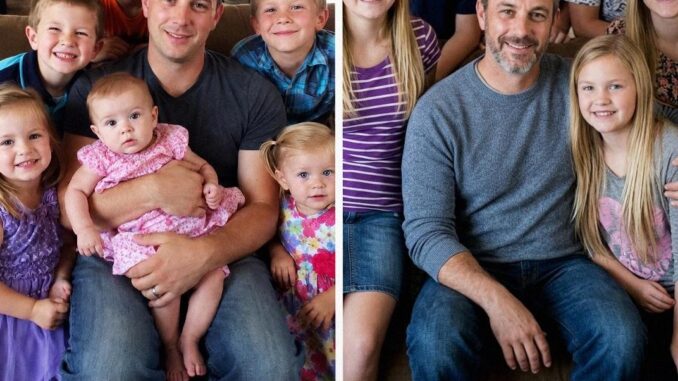
That evening, after the guests left and the last of the balloons sagged toward the grass, the house felt unusually quiet. Not the heavy kind of silence we used to have in the early years after she left—when every creak of the floor sounded like a memory—but a softer silence, the kind that comes after something finally closes instead of endlessly hurting.
Caleb sat on the back steps, turning the empty cake plate in slow circles like he was trying to understand how something so sweet could sit in the middle of something so bitter. I joined him, handing him a soda, and for a while neither of us spoke. We didn’t need to. Twelve years of shared survival has a way of replacing conversation.
Inside the house, Sophie had already fallen asleep on the couch with frosting still on her cheek. The twins were arguing quietly about whether the Mustang was “cool or cursed,” and the oldest two were cleaning up in a way that felt more like grounding themselves than tidying a party.
None of us mentioned Melissa at first.
But silence has its limits.
“I didn’t feel anything when she gave me the car,” Caleb finally said. “Is that bad?”
I shook my head. “It means you’ve learned the difference between a gift and an apology shaped like one.”
He let out a short breath that almost sounded like a laugh, but it broke halfway. “She kept looking at me like I was supposed to forgive her just because she showed up.”
“That’s the part people don’t understand,” I said. “Showing up once doesn’t erase not showing up for years.”
We sat there until the sky shifted from deep blue to something softer, like the world was trying to forgive the day even if we weren’t ready to.
A week later, life settled into its familiar rhythm again—school runs, work shifts, burnt toast mornings. The Mustang stayed parked in front of her old house down the street for three days before disappearing without explanation. No one asked where it went. No one needed to.
What mattered more was what stayed.
Caleb kept the shoebox in his room, now placed on his desk instead of hidden under his bed. Sometimes I’d see him open it quietly, not out of sadness anymore, but understanding—like reading a history book about a country he used to live in but no longer belonged to.
And me? I didn’t become a hero that day. I was still just a tired father who forgot where he left his keys most mornings. But something inside the house shifted, something steady and final.
We weren’t waiting anymore.
We were living.
And for the first time in a long time, that was enough.
The months after that birthday didn’t bring any dramatic changes, but they did bring clarity—the kind that doesn’t arrive loudly. It just quietly replaces confusion, like a fog lifting without anyone noticing the moment it started.
At first, we thought Melissa might try again. A phone call. A letter. Something to soften what had happened. But nothing came. Not even anger. It was as if the night of the Mustang had drained the last excuse she had been carrying around for twelve years.
Caleb went back to school with a different kind of focus. He wasn’t lighter exactly, but he was steadier. Teachers noticed it too—the way he stopped reacting to small things, the way he seemed less interested in proving anything to anyone. It wasn’t closure in the way people like to describe it online. It was acceptance without permission.
One evening, I found him in the garage fixing his old bike, the same one he had refused to replace even when friends offered him newer ones. He wiped grease off his hands and said, almost casually, “I think I understand why you never talked badly about her.”
I leaned against the doorframe. “Yeah?”
“If you had,” he said, tightening a bolt, “we would’ve grown up angry at something we didn’t fully understand. And I think that would’ve hurt more than the truth.”
I didn’t answer right away. There are moments in parenting where silence is the only honest response.
The twins started asking different questions too. Not “Why did she leave?” anymore, but “Why did she think she could come back like that?” Even Sophie, who was too young to remember anything clearly, began drawing pictures of families with missing outlines—figures sketched in faint pencil where someone used to stand.
Life has a way of revealing what children feel long before they can explain it.
One night, I found the shoebox on the kitchen table instead of Caleb’s room. He was sitting across from it, not opening it, just looking at it like it had changed weight.
“I think I’m done keeping it,” he said.
I asked him why.
“Because I don’t want my past to feel like something I have to carry forever,” he replied. “I just want it to be something I remember.”
We went through it together one last time. The crumpled drawings. The faded birthday cards. The small, uneven handwriting that marked every stage of waiting. Nothing about it had changed—but we had.
When we finished, Caleb stood up and gently closed the box. Not slammed. Not thrown away. Just closed.
“I’m going to keep one thing,” he said, pulling out a single card. It was the earliest one Sophie had drawn before she could even write her name properly.
“Everything else,” he added, “belongs to who we were. Not who we are.”
Later that night, I sat alone on the porch after the kids went to bed. The air was cool, carrying the faint sound of distant traffic and a neighborhood that had long since moved on from our story. I thought about Melissa—not in anger anymore, and not in longing either. Just as a person who had stepped out of a life and never learned how to step back into it.
Some people imagine that forgiveness is the final step. But I’ve learned it isn’t. Sometimes the final step is simply no longer needing an answer.
Inside the house, I could hear my children laughing at something small and ordinary—something that didn’t matter in any meaningful way, and that’s exactly what made it beautiful.
Because in the end, that’s what we had built without her.
Not a story about who left.
But a life that continued anyway.
Leave a Reply