The freezing wind slicing through downtown Chicago that January evening felt sharp enough to cut straight through bone. Streetlights flickered weakly against dirty snowbanks while exhausted commuters hurried past one another without making eye contact, everyone too cold or too overwhelmed to notice anything outside their own struggle to get home. At thirty-eight years old, I felt like I had been carrying the weight of the entire world on my shoulders for months. My shift at the sporting goods store had dragged endlessly through malfunctioning registers, impatient customers, and post-holiday return chaos, and all I could think about was how my daughter’s math grades kept slipping despite every late-night homework session we attempted together. Life had become an exhausting cycle of barely staying ahead of bills, responsibilities, and quiet fears I rarely admitted out loud.
The digital thermometer outside the mall flashed a brutal 26.6°F as I pulled my coat tighter around myself and headed toward the bus stop. My feet ached. My head pounded. I remember thinking that all I wanted in the entire world was a hot bath, silence, and one evening where nobody needed anything from me.
That was when the smell reached me.
Warm grilled meat, garlic sauce, and fresh bread drifted through the icy air from the small shawarma cart parked beside a darkened flower shop. The stand had become something of a local landmark over the years, though not exactly a friendly one. The owner cooked incredible food, but his personality was infamous around the neighborhood. He carried himself with permanent irritation etched into his face, speaking to customers with the emotional warmth of frozen concrete.
Normally I would have kept walking.
But then I saw them.
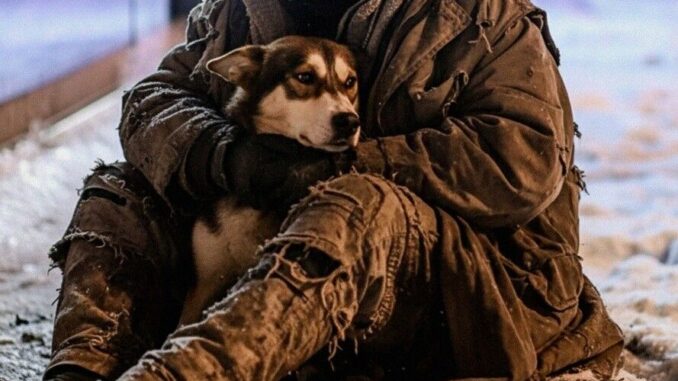
A man somewhere in his fifties stood near the edge of the cart’s weak yellow light wearing a coat so thin it looked almost useless against the cold. Huddled tightly against his legs was a scruffy brown-and-white dog shaking violently from the freezing wind. Even from several feet away, I could see the animal’s ribs beneath its fur. The man himself looked exhausted in a way that went far beyond physical fatigue — the kind of exhaustion that settles into someone after years of disappointment and rejection.
He stepped carefully toward the vendor, shoulders hunched low.
“Sir, please,” he asked quietly, his voice trembling almost as much as the dog beside him. “Could I just get some hot water? Anything warm for the dog?”
The vendor barely looked up from the grill.
“GET OUT!” he snapped instantly. “This isn’t a shelter. Move along!”
The words hit harder than they should have.
Maybe it was the cold.
Maybe it was the dog trembling against the man’s boots.
Or maybe it was the sudden memory of my grandmother rising painfully inside me. She had survived years of poverty during her childhood and often told me stories about strangers whose smallest gestures kept her alive emotionally during the hardest moments of her life. She used to say something over and over whenever I complained about people:
“Kindness costs nothing, but it can change everything.”
Watching the man lower his eyes and begin turning away from the cart, I realized I would think about this moment for the rest of the night if I walked away too.
So before I could second-guess myself, I stepped forward.
“Two coffees,” I said. “And two shawarmas.”
The vendor grunted without expression and began preparing the food with fast, practiced movements. Eighteen dollars disappeared from my wallet — money I realistically should have saved for tutoring sessions or groceries — but by then I already knew I wouldn’t regret it.
I caught up with the man halfway down the block before he disappeared into the shadows near an alley entrance. When I handed him the warm food and coffee, his expression changed completely. It wasn’t simple gratitude. It looked more like shock, as though kindness itself had become something so unfamiliar that he no longer expected it to exist.
“God bless you,” he whispered hoarsely, clutching the coffee with shaking hands while the dog immediately pressed closer toward the warmth.
I smiled awkwardly, eager to escape the intensity of the moment before I started crying from sheer emotional exhaustion myself. But just as I turned to leave, he called after me.
“Wait.”
He dug frantically through his coat pocket, pulled out a wrinkled scrap of paper and a pen, then scribbled something quickly before pressing it into my hand.
“Read this when you get home,” he said softly. “Please.”
I shoved the note into my pocket and ran for the arriving bus, already mentally shifting back toward laundry, homework, and tomorrow’s responsibilities.
By the following evening, I had completely forgotten the note existed.
I was sorting laundry when the crumpled paper fell from my coat pocket onto the floor. Expecting maybe a thank-you message or request for help, I unfolded it casually.
Then my entire body went cold.
“Thank you for saving my life,” the note read. “You already saved it once before.”
Beneath the message was a date from three years earlier.
And one location:
Lucy’s Café.
The memory hit me instantly.
Three years earlier, during a violent thunderstorm, I had stopped at Lucy’s Café after work. The place was packed with soaked commuters seeking shelter from the rain. Near the back sat a man alone, drenched completely, staring blankly at the floor with an expression I couldn’t forget even now. Staff members hovered nearby clearly preparing to throw him out because he hadn’t ordered anything.
Without thinking much about it, I had bought him a coffee and croissant, smiled, and told him to hang in there.
That was it.
Five dollars.
Two minutes of kindness.
Then I went home and forgot about it entirely.
But he hadn’t forgotten.
To him, that tiny moment became something enormous.
I barely slept that night. The realization that such a small gesture had stayed alive inside another human being for three years while he struggled through homelessness and despair felt overwhelming. More disturbingly, I realized how close he had apparently been to ending his life the day we met at the café.
The next evening, I went back to the shawarma stand deliberately searching for him.
I found him sitting in the same corner beneath the weak streetlight, the little dog wagging its tail wildly the second it recognized me. That was when I learned the dog’s name was Lucky.
The man introduced himself as Victor.
When I told him I had read the note, tears filled his eyes immediately.
“That day at Lucy’s,” he admitted quietly, “I planned to kill myself afterward. I truly believed nobody would notice if I disappeared.”
Then he explained what happened.
Victor had once been a truck driver with a wife, daughter, and stable middle-class life. Years earlier, a terrible highway accident shattered his leg and destroyed his ability to work consistently. Medical debt piled up while insurance companies delayed and denied support repeatedly. Depression consumed his marriage. Eventually everything collapsed — his job, his home, his family. By the time we met him outside the shawarma stand, all he had left was Lucky, a stray dog he rescued from an alley because, as he put it, “nobody else wanted either of us.”
That conversation changed something permanently inside me.
Buying someone dinner suddenly didn’t feel like enough anymore.
So this time, I asked for help.
I told my husband Tom everything. I told my children too, expecting maybe polite sympathy before life moved on. Instead, my teenagers became completely invested in helping Victor rebuild his life. My daughter designed social media posts. My son helped launch a fundraising campaign. Tom, who worked as a lawyer, contacted a colleague specializing in disability litigation.
What began as one winter meal slowly transformed into something extraordinary.
The fundraiser spread across local community groups. Donations poured in from strangers moved by Victor and Lucky’s story. Tom’s colleague eventually proved the insurance company wrong and secured a settlement Victor should have received years earlier. Together, we helped him obtain identification documents, stable housing, and eventually a warehouse job whose manager adored Lucky enough to let the dog nap in the office during shifts.
The most beautiful transformation wasn’t financial.
It was emotional.
Little by little, Victor stopped carrying himself like a man waiting to disappear. His posture changed. His voice strengthened. Hope returned visibly to his face.
A year later, on my birthday, the doorbell rang unexpectedly.
When I opened the door, I almost didn’t recognize him.
Victor stood there clean-shaven in a crisp button-down shirt and thick winter coat while Lucky proudly wore a bright red collar beside him. In his hands rested a chocolate cake from the best bakery in town.
“You’ve saved my life three times now,” he said softly. “At the café. At the shawarma stand. And every day afterward.”
That evening, my family gathered around the kitchen table sharing cake and listening to Victor tell stories about his new apartment, his job, and Lucky charming everyone at work. Watching my children laugh with him, I suddenly understood something my grandmother had tried teaching me my entire life.
Kindness is never just about charity.
It is about recognition.
About reminding another human being they still matter even when the world has convinced them otherwise.
And sometimes, the smallest act — a cup of coffee, a warm meal, a moment of compassion on a freezing January night — can become the exact thing standing between despair and survival.
Leave a Reply