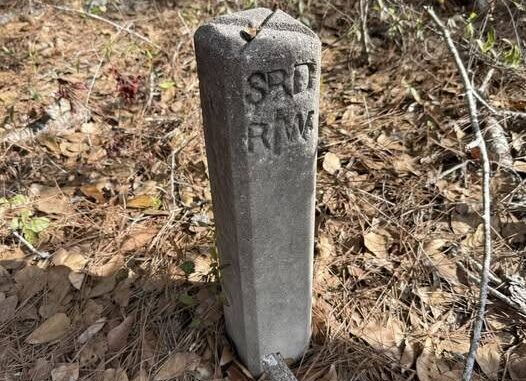
Sometimes, the most meaningful discoveries are not grand monuments, restored landmarks, or famous historical sites. Instead, they are small, easily overlooked objects resting quietly in places where most people would never think to look.
Imagine walking along a forest trail or an old rural path. The ground beneath you is uneven but calm, shaped by years of weather and time. Trees stretch overhead, their branches filtering soft light onto the ground. Leaves gather in natural patterns along the edges of the trail, and the sound of birds and wind replaces the noise of everyday life.
At first, everything feels ordinary—just another peaceful walk through nature.
Then something interrupts that sense of simplicity.
Off to the side, partially hidden by grass or brush, stands a small concrete post. It is not tall or impressive. It may only reach knee height. Its surface is worn, faded by decades of sun, rain, and seasonal changes. If there are markings on it, they may be barely visible now—softened by time, dirt, or erosion.
Most people would pass it without a second thought.
But that unassuming block of concrete might represent something far more significant than it appears.
It could be a surviving State Road Department right-of-way marker, a quiet remnant of infrastructure that once played an important role in shaping movement, travel, and connection in the region.
And while it may look simple, it often carries an entire forgotten story.
The Experience of Discovering Something Overlooked
For hikers, explorers, or anyone who enjoys wandering old paths, stumbling upon objects like this creates a sudden shift in perception.
What began as a routine walk becomes something more intriguing. The environment stops feeling random and starts feeling intentional. The forest is no longer just nature—it becomes a layered space where human history and natural growth overlap.
That small concrete marker turns into a clue.
It suggests that this quiet trail was not always quiet. That beneath the overgrowth and soil, something once existed here with purpose and structure.
These moments often spark curiosity. People begin to look closer at their surroundings. A slightly raised strip of land may suddenly resemble an old roadbed. A straight line cutting through trees might hint at a former transportation route. Small changes in elevation or scattered gravel might no longer feel accidental.
Instead, they begin to form a pattern.
The land starts telling a story that was never fully erased.
What a Right-of-Way Marker Really Means
Concrete posts like the one found along forgotten paths are often associated with State Road Department surveys. The letters “R/W,” commonly seen on these markers, stand for “right of way.”
A right-of-way is a legally defined strip of land reserved for transportation routes such as roads, highways, or utility corridors. Before any road is constructed, surveyors and engineers determine exact boundaries for where the infrastructure will sit.
These boundaries are not just conceptual—they must be physically marked on the land so they can be identified and maintained over time.
To accomplish this, durable markers were installed along the edges of roadways. Concrete became a preferred material because it was inexpensive, strong, and resistant to weather damage. Unlike wooden stakes or temporary signs, concrete could remain in place for decades without maintenance.
Even after the road itself disappeared, the marker often remained exactly where it was originally placed.
This is why people still find them today in forests, fields, and along abandoned corridors.
They are remnants of planning, engineering, and development from a time when that space had a very different purpose.
Why These Small Markers Matter
At first glance, a weathered concrete post might not seem important. It is easy to assume it is just leftover construction debris or something meaningless left behind.
But in reality, it can reveal a surprising amount about the history of the land.
Its presence confirms that the area was once officially surveyed and designated for transportation use. That means the nearby terrain was not always wilderness or an informal trail—it was once part of a structured road system.
At some point, engineers designed a route through the landscape. Survey teams measured distances and angles with precision. Construction crews then cleared land, graded soil, and built a road meant to support travel, trade, or daily transportation.
That small marker is evidence of all that activity.
It is a physical reminder that the space once played a role in connecting communities, even if that role has long since faded.
How Roads Slowly Disappear Over Time
One of the most fascinating aspects of these markers is that they often survive long after the roads they once bordered have vanished.
Roads are not permanent. While they may seem fixed and unchanging, they can disappear gradually when they are no longer maintained or used.
Once traffic shifts to newer routes or highways are built elsewhere, older roads may be abandoned. Without maintenance, nature begins to reclaim them.
Cracks appear in pavement. Weeds grow through the surface. Leaves and soil collect in low areas. Over time, shrubs and trees begin to take root where vehicles once traveled.
Decades later, what was once a functional road can become nearly invisible—blending into the surrounding forest or field.
Yet the concrete markers remain behind, standing quietly in place.
Because they were designed for durability, they resist weathering far better than the roads they once defined. Rain, heat, frost, and erosion may wear them down slightly, but they often remain structurally intact for generations.
In many cases, they become the last physical evidence that a road ever existed there.
Learning to Read the Landscape
Once you become aware of right-of-way markers, the surrounding environment begins to look different.
What once seemed like random terrain starts to reveal structure.
A narrow ridge running through the woods may actually be the raised foundation of an old road. A shallow ditch nearby could have once been used for drainage. A line of unusually straight vegetation might trace the path of long-forgotten pavement.
Even subtle changes in soil or stone distribution can provide clues.
Gravel that appears out of place may indicate a former road surface. Slight curves in the land might reflect the engineered path of a roadway designed to follow natural contours.
Each detail becomes part of a larger puzzle.
Slowly, the landscape transforms from natural scenery into a historical map written in physical form.
Where These Markers Are Often Found
Right-of-way markers were typically placed along official road systems at regular intervals. However, they are more commonly noticed in areas where roads have been abandoned or rerouted.
They are often discovered near:
- Old rural highways
- Decommissioned state roads
- Forest service roads
- Former bridge crossings
- Junctions or intersections that no longer exist
Surveyors placed them strategically so that road boundaries would remain clear over time. Even if surrounding features changed, the markers would continue to define where the legal edge of the roadway once stood.
Small Objects That Preserve Big History
Large historical landmarks often receive the most attention. People visit preserved bridges, restored buildings, and famous monuments because they are visually impressive and widely recognized.
But small objects like right-of-way markers preserve a different kind of history—one that is quieter, but just as meaningful.
They represent everyday infrastructure. The kind that people once relied on without thinking about it.
Roads that carried workers to jobs. Routes that connected small towns. Paths that families used for travel, trade, and daily life.
These were not extraordinary places at the time. They were simply part of normal existence.
Yet over time, as transportation systems evolved, many of these roads were forgotten.
The markers remain as silent witnesses to that earlier era.
Imagining the Past Through the Present
For many people who come across these markers, there is a natural sense of curiosity.
Standing beside a small concrete post in the middle of a forest, it is easy to imagine what once existed there.
Perhaps cars once passed by regularly, their tires crunching over gravel. Maybe pedestrians walked along the shoulder, or bicycles moved between nearby towns. There may have been road signs, mile markers, or bridges that have long since disappeared.
Now, only the marker remains.
It stands in place, surrounded by trees that may not have existed when the road was active.
This contrast between past function and present silence is part of what makes these discoveries so compelling.
Why Concrete Markers Last So Long
The survival of these markers is not accidental. Concrete was chosen specifically for its long-term durability.
Unlike wood, it does not rot easily. Unlike metal, it does not rust quickly when exposed to soil and moisture. Once set into the ground, it can withstand decades of environmental stress.
Even when vegetation grows around it or soil shifts slightly, the marker often remains stable.
In some cases, it outlasts not only the roads it marked, but also bridges, signs, and other infrastructure that once stood nearby.
A Connection Between Then and Now
Discovering one of these markers creates a direct connection between the present landscape and its past use.
It shows how transportation systems evolve over time. It reveals how human activity shapes the land—and how nature eventually reclaims it.
What looks like untouched wilderness today may have once been a busy travel corridor.
Understanding this adds depth to the way we see the environment. It reminds us that landscapes are constantly changing, even when those changes are not immediately visible.
Why These Discoveries Feel So Meaningful
There is something deeply satisfying about finding an object like this.
It is not valuable in a traditional sense. It is not rare in a collectible way. Yet it carries meaning because of what it represents.
It is a fragment of history left behind in plain sight.
It encourages curiosity, imagination, and exploration. It turns an ordinary walk into a moment of discovery.
And it reminds us that history is not always preserved in museums or books. Sometimes it is embedded quietly in the ground beneath our feet.
Still Standing Through Time
That small concrete marker beside a forgotten path is more than just leftover construction material.
It is a boundary marker from a time when the land served a very different purpose.
Even after the road has disappeared and nature has reclaimed the space, the marker remains.
Quiet. Weathered. Unnoticed by many.
But still holding its place in history.
Final Reflection
Sometimes history does not vanish.
It simply becomes hidden.
A forgotten road may no longer appear on maps. A once-important route may no longer be traveled. But small traces remain, waiting to be rediscovered by those who take the time to look closer.
A simple concrete post in the woods is one of those traces.
It marks not just the edge of a road—but the edge between past and present.
And for those who notice it, it becomes a reminder that even the smallest objects can hold entire stories within them.
Leave a Reply